

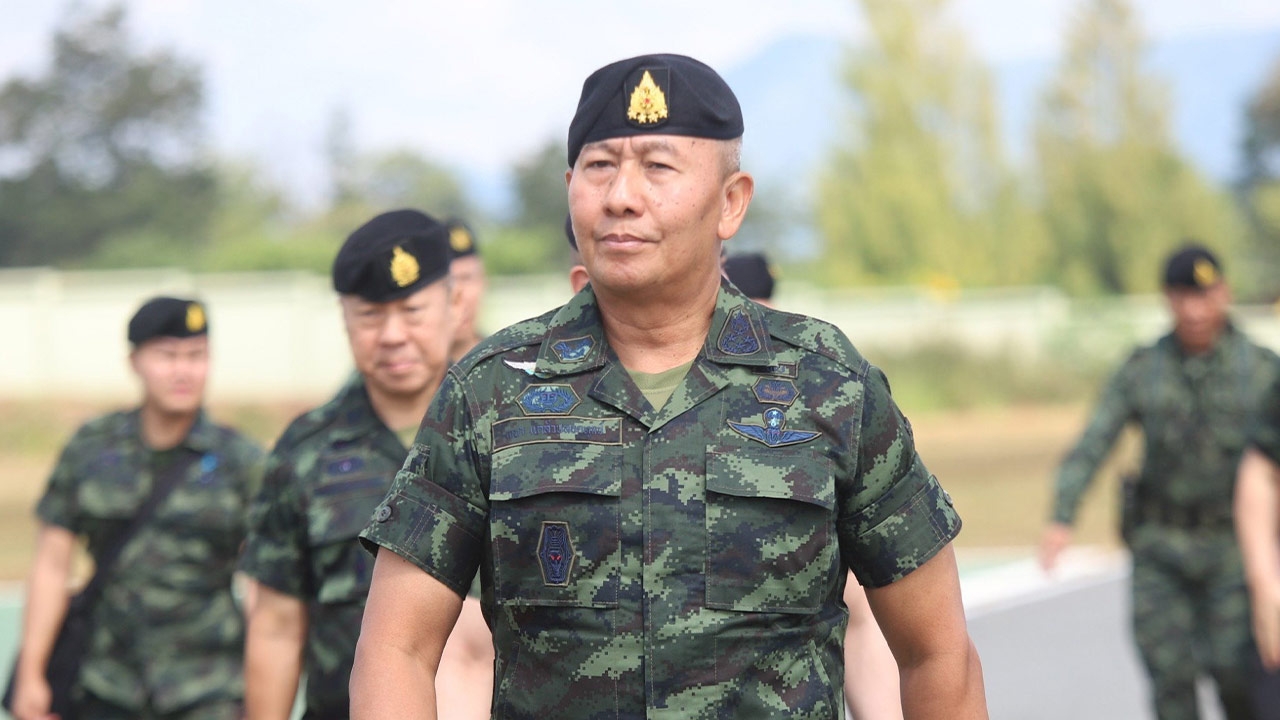
The Commander-in-Chief of the Army has arranged a major deployment of 228 colonel-level positions, placing commanders to control the country's borders in response to escalating tensions.
On 28 April 2026, General Pana Klaewplodtuk, Commander-in-Chief of the Army, signed Army Order 121/2569 concerning the assignment and salary adjustment of officers. This order appoints and transfers 228 officers at the rank of colonel and lieutenant colonel, including deputy regiment commanders and battalion commanders, across the country.

This deployment is a strategic placement of new combat commanders in key units such as infantry, cavalry, artillery, special forces, and rangers to prepare for tense border situations in multiple areas.

In the central region, important position changes occurred within the 'Queen's Tiger' unit, the 902nd Infantry Regiment, Royal Guard (formerly the 21st Royal Guard), and units under the 9th Infantry Division. These include Colonel Thana Surachoti (Class 41) as Deputy Commander of the 2nd Infantry Regiment, Royal Guard; Lieutenant Colonel Olan Korom (Class 45) as Commander of the 902nd Infantry Regiment, 2nd Battalion; Lieutenant Colonel Nittipet Baramee (Class 46) as Commander of the 12th Infantry Regiment, 2nd Battalion; Lieutenant Colonel Thanachon Phraepleai (Class 47) as Commander of the 12th Infantry Regiment, 3rd Battalion; and Lieutenant Colonel Natthaporn Menakhongka (Class 46), transferred from the 5th Battalion, 23rd Regiment, Royal Guard, to command the 1st Cavalry Regiment, 1st Battalion, Royal Guards Cavalry.
In the 2nd Army Area, battalion and regiment commanders of the Ranger Forces under the Suranaree Task Force (6th Infantry Division) and the 3rd Infantry Division were appointed to manage the lower northeastern border situation. These include Colonel Setsit Puangbanyen (Class 40) as Commander of the 22nd Ranger Regiment, Colonel Nitikon Sirikam (Class 41) as Commander of the 26th Ranger Regiment, Colonel Thalad Poolsawat (Class 42) as Commander of the 23rd Ranger Regiment, and Lieutenant Colonel Jiranawat Srihom (Class 46) as Commander of the 16th Infantry Regiment, 1st Battalion.
Meanwhile, the 3rd Army Area reinforced the Thai-Myanmar border situation by assigning commanders in the northern region to safeguard sovereignty along the contested border areas with neighboring countries. These include Lieutenant Colonel Pichit Rerkviree (Class 44) as Commander of the 14th Infantry Regiment, 1st Battalion; Colonel Khwanek Ratchadathanawat (Class 40) as Commander of the 33rd Military Circle Battalion; and Colonel Sahachai Promtrut (Class 41) as Commander of the 12th Cavalry Regiment, 1st Battalion.
In the 4th Army Area, key commanders were rotated to address the southern insurgency, with important position changes in the 5th and 15th Infantry Divisions, including the transfer of battalion commanders among ranger units to rotate forces. These include Colonel Chanrit Hansarach (Class 41), moving from Commander of the 43rd Ranger Regiment to Commander of the 49th Ranger Regiment; Colonel Natthaphon Sunthornnon, swapping from Commander of the 49th Ranger Regiment to Commander of the 43rd Ranger Regiment; Lieutenant Colonel Natthawut Makhasen (Class 42) as Commander of the 15th Infantry Regiment, 1st Battalion; and Colonel Witya Sariya (Class 41) as Commander of the 45th Ranger Regiment.
For special operations and artillery units, skilled officers were transferred to lead technical units. Colonel Sompop Nilnaepkaew (Class 40) was promoted to Deputy Commander of the 2nd Special Operations Regiment, and Lieutenant Colonel Phanuwat Sanga-ngam (Class 47) was appointed Commander of the 5th Special Operations Regiment, 2nd Battalion.
In the air defense artillery units, Lieutenant Colonel Panyasit Paenkaew (Class 47) was appointed Commander of the 1st Air Defense Artillery Regiment, 6th Battalion, and Lieutenant Colonel Natthapat Srichiangsa (Class 46) as Commander of the 2nd Air Defense Artillery Regiment, 2nd Battalion.
Overall, this transfer is viewed as a fine-tuning of battalion-level combat mechanisms, refreshing leadership to align with various threats the Army is expected to face in 2026.