

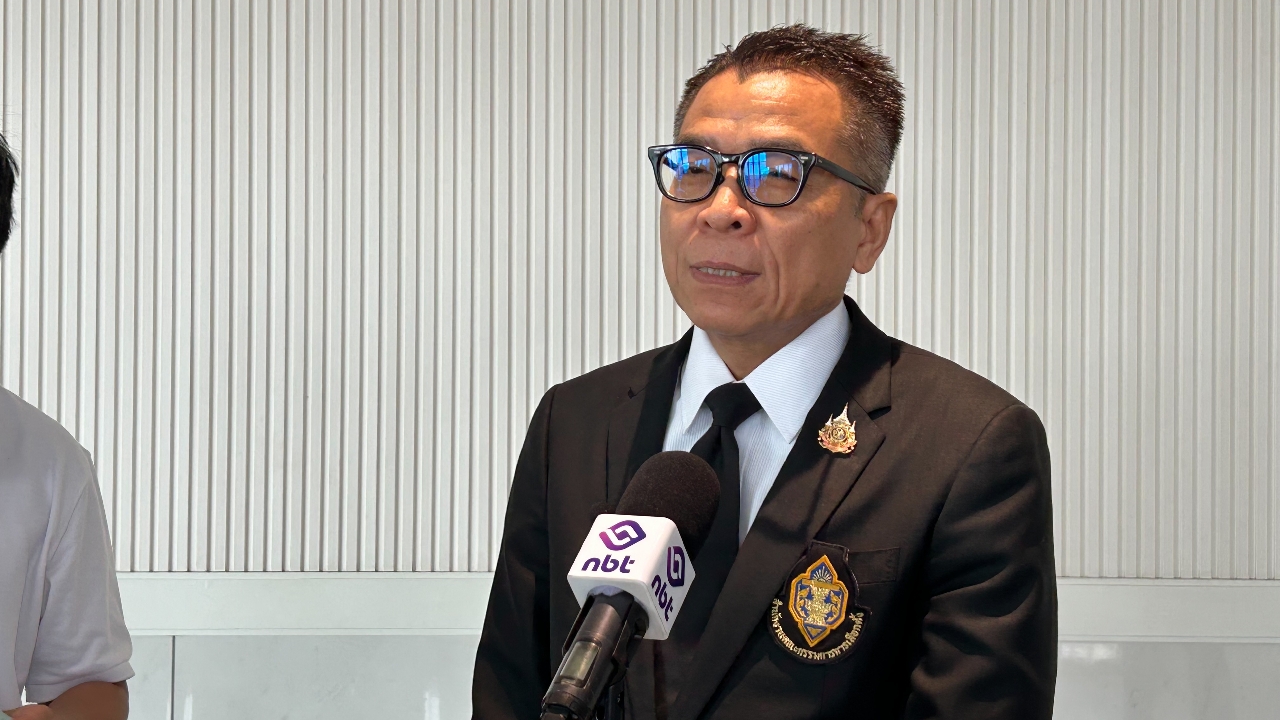
The Election Commission Secretary-General criticized political parties for blaming the EC, pointing out unfair rules yet failing to fix the flaws. He affirmed the EC's role is to report election results and act according to the law, while promoting the trial use of the "i-Vote" system in local elections.
On 29 Apr at 09:00 at TK Palace Hotel, Mr. Sa-wang Boonmee, Secretary-General of the Election Commission (EC), said during his opening speech for the 2026 Quality Political Party Trainer Refresher Course, Batch 2 for Central and Southern regions, that as Thailand approaches 100 years since the 1932 political change, expectations for better politics remain unmet. He acknowledged ongoing problems in Thai politics affecting daily life, as politics dominates all issues and winners monopolize power. From now on, the EC Office, trainers, and political parties will work together beyond current efforts to successfully instill and educate about democracy under the constitutional monarchy, aiming to help people with differing views live together peacefully.
Laws have changed, but people have not.
The EC Secretary-General added that Thailand has three main laws regarded as good: the Constitution of the Kingdom of Thailand, which some call democratic or anti-corruption, has been used since 1997—nearly 30 years and three constitutions in total. People expect laws to change behavior, but they have not. Changing laws won’t transform politics because the players and voters remain the same groups. Parties are dissolved, new constitutions introduced, but the same people form parties again. The 52 million voters remain unchanged in knowledge and mindset, voting as before, so the country won’t change. What can change is the knowledge that we will spread—not to preach, but to exchange ideas with citizens so society can improve by itself. Democracy thrives not because of bureaucracy or anyone else, but because of the people.
Vote buying and selling is done internally.
“Our election system is designed very strongly; no one can interfere—not the seven EC commissioners, nor the Secretary-General, nor any influential families. But vote buying and selling is an external issue between voters and citizens. If we highlight that citizens themselves can change the country together during elections, it’s not about the EC. The EC’s role is to report results and take legal action if violations occur. The EC only knows as much as the public on election day; it sees no more,” said Mr. Sa-wang. . . .
Advised that if loopholes are seen, laws should be amended.
Mr. Sa-wang said that Thai political parties have historically focused more on security than freedom, leading to frequent party dissolutions. Over almost 100 years, political parties existed less than half the time; the rest was under coups. Coups make it difficult for parties to operate or form. As party registrar, he knows parties face many regulations—one side is constrained, the other struggles to develop. Though sympathetic, these are legal issues. Those who can amend laws are the parties themselves; if something is wrong, parties should improve it.
Criticized political parties for not caring about the law.
“From working with political parties, I see that they do not care much about party laws. If they did, parties would be better because the party law is their own home. Amending party laws is the parliament’s and MPs’ responsibility, but when in power, they don’t focus on improving laws to enable better operations or fair competition rules. Sometimes parties suffer consequences from their own actions and sometimes from competition laws. But when they lose, they always blame the commission, even though the commission must follow the law. If the law is not amended, we must rule as is every time. Decisions and discretion, even if criticized by society, would be the same if we could go back, because we apply the law and facts to resolve issues. I entrust the nation to all of you, political parties, and trainers to disseminate knowledge and develop Thai politics towards greater prosperity and stability.”
Urged MPs to amend laws.
Later, Mr. Sa-wang added in an interview about improving laws so political parties can operate effectively and compete fairly in elections, that two main laws govern parties: the Political Parties Act and the Election Act. The EC Office has tried proposing law amendments to ensure fair competition among parties, as the public watches for unfair rule control and scrutinizes the EC. Therefore, rules must be fair. If unfairness is seen, he urges MPs to amend laws to ensure fairness. However, previous proposals were not approved by parliament. Thus, he hopes MPs and parties, as law users aware of flaws, will amend laws to suit party operations and elections, instead of blaming the EC for alleged partiality during each election.
“I speak only regarding elections, which the public participates in. The 52 million eligible voters, 1.6 million local administrators, and others including media and observers all perform mutual oversight. The EC merely reports election results to the public,” Mr. Sa-wang emphasized.
However, Mr. Sa-wang declined to comment on MPs focusing more on constitutional amendments than on improving party and election laws.
Preparing to pilot i-Vote.
Regarding calls to introduce i-Vote, the electronic voting system, the EC Secretary-General said it is a concept the EC has tried to propose for nationwide elections but has yet to get parliamentary approval, especially for the MP election law. However, the EC may pilot the i-Vote system in local elections first, as this can be done without legal amendments.