

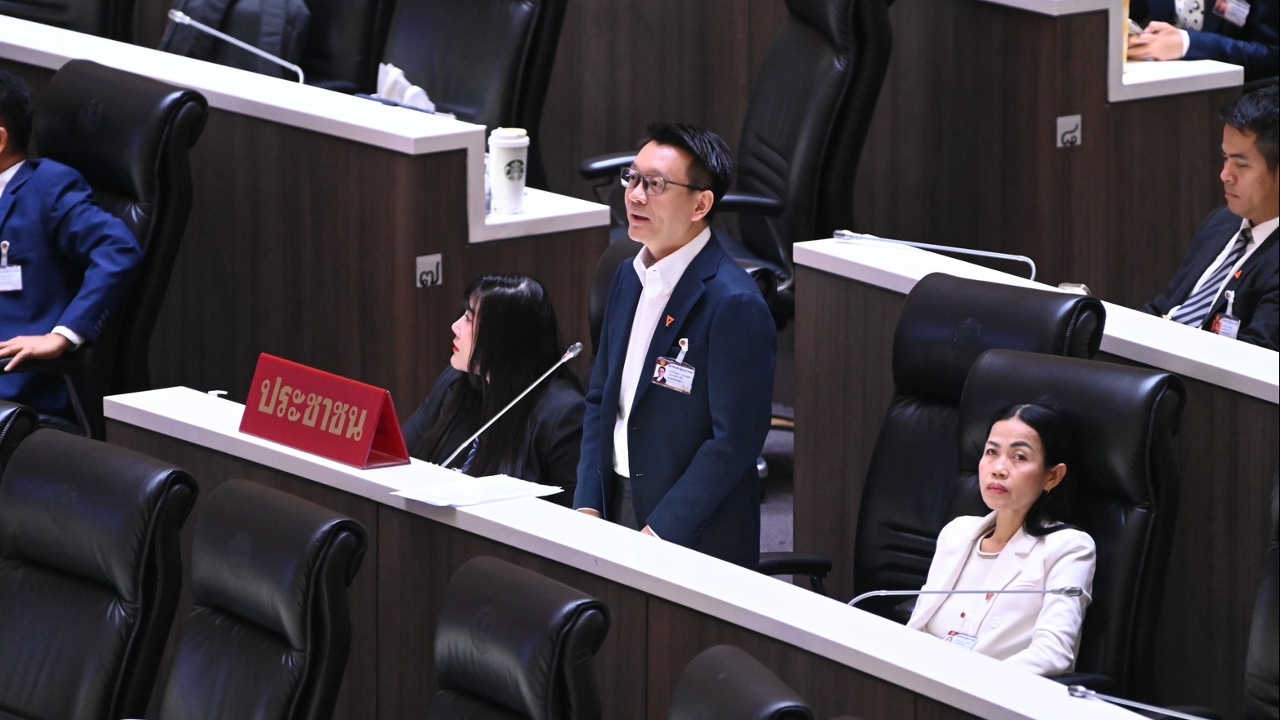
Veerayut highlights the "Confront, Invite, Taste" strategy to solve the problem of falling agricultural product prices. He advises beginning with the courage to confront fertilizer producers and foreign trading houses, and encouraging farmers to adapt.
On 29 Apr 2026 GMT+7, during a House of Representatives session, a motion on "Solving the Problem of Falling Agricultural Product Prices" proposed by the People's Party was reviewed, continuing from the previous week. Veerayut Kanchuchat, Deputy Leader of the People's Party and the party's closing speaker, stated that currently, Thai agricultural product prices are integrally falling across the board—whether field crops like unhusked rice, fruits such as coconuts, mangoes, and longan, land animals like dairy cows, or aquatic animals such as Nile tilapia, all face problems. He acknowledged that agricultural product management is complex and challenging, with rising costs, fertilizer scarcity, intense export market competition, price volatility—some controllable, many not—and also the impact of imports, especially vegetables from China, which increasingly undercut the market yearly. To truly solve the problem, it must start by finding the missing link through close coordination between the Ministry of Agriculture and the Ministry of Commerce, both led by the "Two Big Sus": Suriya Jungrungreangkit, Minister of Agriculture, and Supachai Sutthumpun, Minister of Commerce.
Proposal of "Confront, Invite, Taste"
Veerayut said that, for him, he proposes a strategic framework "Confront, Invite, Taste" for the government to use in addressing the problem of falling agricultural product prices.
1. "Confront" The starting point to solve the problem of falling agricultural prices is that the government, particularly the two ministers, must bravely confront fertilizer producers, who are few in number in Thailand. Although the Ministry of Commerce allows the public to report via Line when fertilizer prices are high, no public announcement clarifies what the controlled fertilizer prices actually are. Another issue to confront is the "foreign trading houses" that dominate, suppress prices, and undermine product standards. Clarity is needed on whether the government will create central or community trading houses, or use another approach to solve this. In any case, it must confront the root causes directly.
2. "Invite" Previous governments, including the Bhumjaithai government, mainly used "coercion" with farmers—for example, enforcing bans on burning with penalties. However, this approach often fails to catch violators or only targets small offenders. Veerayut proposes using "incentives" to encourage farmers to adapt, such as coupons supporting development toward GAP-standard farming, controlling inputs, harvesting, and transportation, since GAP is a gateway to export markets.
Veerayut further stated that although the government claims to offer low-interest loans, farmers and fishers are already deeply indebted and reluctant to borrow more. In this situation, persuasion is essential—for instance, upgrading old agricultural machinery to new ones, especially harvesters and tractors that consume large amounts of fuel. Measures like "trade-in old machinery for new" must extend to agriculture, not just be limited to urban EV users. If the goal is to encourage crop rotation, soil resting, or planting perennial trees, most farmers nationwide are indebted to the Bank for Agriculture and Agricultural Cooperatives (BAAC). To incentivize, debt reduction, interest suspension, or debt moratoriums should be offered, provided farmers engage in crop changes, soil resting, or perennial planting.
3. "Taste" To successfully open new markets, those markets must have the opportunity to taste Thai fruits, which are distinguished by flavor and diversity. Maintaining this diversity ensures sustainability for Thai agricultural markets and avoids dependence on a single export market, preventing China from becoming the "sole buyer" that dictates prices and fruit types. Ultimately, Thai farmers lose bargaining power and genetic diversity.
Veerayut added that market expansion requires consumers to first become familiar with the products' flavors. For example, Western countries hardly know Thai pomelo, especially the very delicious Honey Pomelo, because they have never had the chance to taste it. Simultaneously, value-added processing is important for niche markets—for instance, dairy cows currently facing problems could have their products promoted into yogurt and ice cream, creating new markets. Similar to how Thai coffee is gaining global popularity, craft and homemade qualities are key to capturing high-value markets. The strategy to fix falling agricultural product prices begins with bravely confronting fertilizer producers and foreign trading houses, then encouraging farmers to adapt, along with creating opportunities for foreign markets to taste Thai fruits, rather than limiting sales to the usual products.