

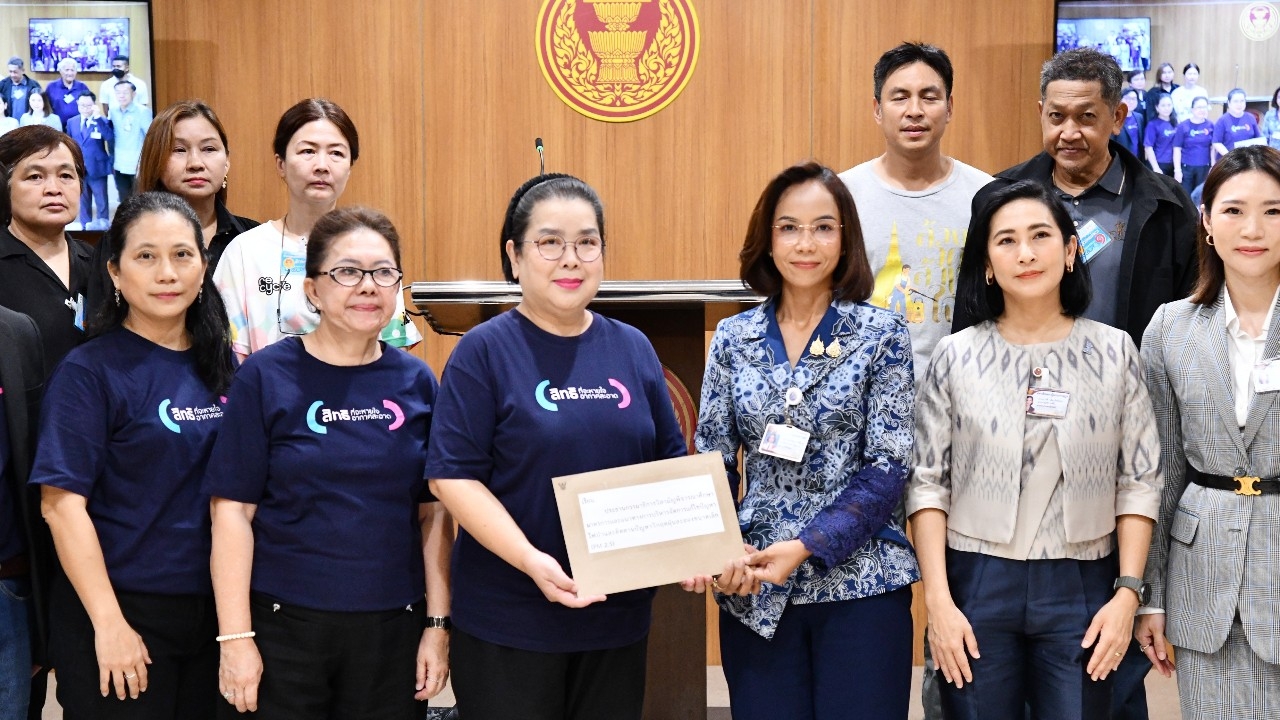
Civil society groups entered Parliament to submit a petition to the Forest Fire Commission to promote a practical Clean Air Act. “Pimpatra” accepted the petition, confirming that the government under “Anutin” is moving forward with it as an urgent priority.
At 09:00 on 30 April 2026 at the Parliament, Ms. Pimpatra Wichaikul, Chair of the Special Parliamentary Commission studying measures to solve forest fire and PM2.5 problems, along with commission members, received a petition from a coalition of over 100 civil society organizations advocating for clean air. Hundreds of thousands of supporters signed, reflecting concerns over worsening air pollution, which has become a structural national issue.

A coalition representative stated that the clean air crisis is not only an environmental issue but affects people of all ages, especially vulnerable groups. They raised concerns about the draft Clean Air Act under parliamentary consideration, noting that some provisions may allow delays in enforcement and undermine public confidence.

The coalition representative emphasized their ongoing efforts to promote clean air issues but remained worried about the law's direction. They called on Parliament to consider a draft law with provisions that can effectively solve the problem, not just repeatedly address symptoms or serve as a “greenwashing” version. They urged the commission to represent the public in pushing for an effective Clean Air Act.

Ms. Pimpatra Wichaikul said on behalf of the commission and MPs that Prime Minister Anutin Charnvirakul has clearly stated that “clean air is a fundamental right” and is pushing for this law to become a government urgent agenda. The main approach is to confirm the draft law, with the Prime Minister insisting that the government supports the pending Clean Air Act to maintain continuity and avoid starting over, which will benefit tackling this year’s severe PM2.5 problem.
The integrated management will focus on empowering the “Clean Air Policy Committee,” chaired by the Prime Minister, to effectively coordinate across ministries, especially in addressing open burning and industrial pollution. Economic measures will support incentives for farmers to reduce burning, such as providing agricultural machinery and promoting “green agriculture” to lower production costs simultaneously.

Ms. Pimpatra stated that the coalition government parties have agreed on pushing the law forward, though details vary according to each ministry’s responsibilities. Regarding transboundary pollution, the government prioritizes regional (ASEAN) negotiations, especially with neighboring countries that cause haze from forest and agricultural burning, using “sustainable trade” as a condition. The government also emphasizes transitioning to clean energy, increasing renewable energy shares like solar power in agriculture and transport to reduce long-term emissions.
“The government under Anutin aims to balance ‘strict law enforcement’ with ‘assistance and relief for affected people,’ viewing the Clean Air Act as a crucial legal tool to manage the dust crisis more effectively than previous administrative orders,” said Ms. Pimpatra.
Ms. Pimpatra added that on 29 April, Mr. Suchat Chomklin, Minister of Natural Resources and Environment, led a delegation to meet with Mr. Sonsai Siphandone, Prime Minister of Laos, to elevate cooperation on transboundary haze and PM2.5 issues with concrete actions. The focus is on using modern technology and traceability systems, preparing a new memorandum of understanding (MOU) aligned with current agency structures. The Thai side confirmed readiness to support knowledge and funding through the “Green Bank” to create clean air and better quality of life in line with the government’s proactive policy.