

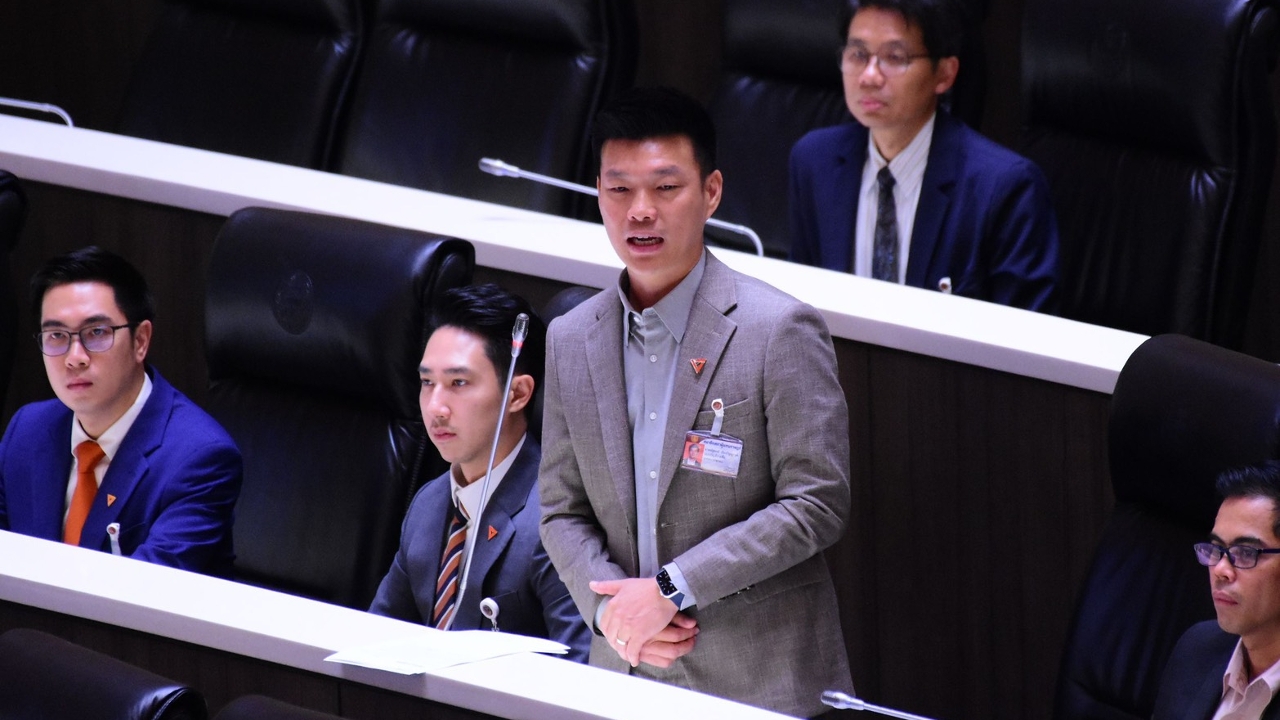
Nattapong pressed the Prime Minister on his standards for removing Phiphat from the cabinet, warning against double standards. Meanwhile, Abhisit countered Sophon’s remarks, criticizing the allowance for the Prime Minister and ministers to avoid answering live parliamentary questions without written notice of necessity.
At 09:00 on 30 Apr 2026 GMT+7 at the parliament, the House of Representatives convened with Sophon Sarum, Speaker of the House, presiding. The session considered a live question from Nattapong Rueangpanyawut, party-list MP and leader of the Prachachon Party, who asked the Prime Minister about oil hoarding linked to shadowy capital groups, scammer gangs, or high-level government figures. The Prime Minister assigned Phiphat Ratchakitprakarn, Minister of Transport, to respond, but as Phiphat was occupied, Siriphong Angkasakulkiat, Deputy Minister of Transport, answered instead.
Nattapong asked why only two people—the Prime Minister and Phiphat—could clearly answer the live question, since it stemmed from investigations into oil hoarding by "Sia Tue" in Ang Thong province. This is a major issue the government has yet to clarify for society. Neither has provided a clear response. This raises coincidental doubts about whether this oil hoarding case involves shadowy capital networks, scammers, and high-level government figures.
Five reasons for suspicion
The five main coincidences involve individuals surrounding the Prime Minister and Deputy Prime Minister currently, as follows:
1) “Sia Tue” coincidentally owns an oil depot in Phetchaburi province, sold to BCPG, a subsidiary of Bangchak, in 2023 for an inflated price of 9 billion baht versus an appraised value of only 5 billion baht, raising questions about the purpose of this overpayment.
2) “Sia Tue” also owns several casinos, especially in Cambodia, which might be linked to shadowy capital networks and scammers aiming to take over Bangchak through share purchases.
3) “Sia Tue” is the father of a son who was once wanted on money laundering and online gambling charges. Chaiyachon Chidchob, secretary-general of the Bhumjaithai Party, confirmed to the media that this son attempted to bribe 40 million baht to stop prosecution of shadowy capital and gambling networks.
4) “Sia Tue” is also the father of a daughter who holds shares in an oil company in Ang Thong province. Last week, the Energy Minister responded to a question from Rangsiman that the DSI is currently investigating illegal oil hoarding in Ang Thong.
5) “Sia Tue” is friends with Deputy Prime Minister Phiphat, who admitted to the media two days ago that although asked about a loan contract of over 100 million baht he gave to Sia Tue’s network company, he avoided discussing the loan details and instead said, “Do I really have a friend who is that troubled?”
Not just coincidence
Nattapong continued that these five points are not mere coincidences but “coincidences plus” within this government. There are many other coincidences his team has investigated, indicating that the oil hoarding is connected to the "Ai Mong" network, potentially linked to shadowy capital, transnational criminals, and high-ranking government officials. These are not new facts but questions Thai society has yet to receive answers from the Prime Minister and Deputy Prime Minister Phiphat.
Calling out double standards
Nattapong added that since Phiphat did not come to answer directly, he posed another question to the Prime Minister: When the PM previously called Woraphak Thanyawong, former Deputy Finance Minister, to resign amid reports linking him to shadowy capital and scammers, how will the PM treat Phiphat, who has admitted friendship with Sia Tue, whose network might be involved with shadowy capital and transnational criminals? Will the PM apply the same standard or a double standard because Phiphat is a key financier for the Bhumjaithai Party?
Deputy Transport Minister Siriphong Angkasakulkiat explained in place of Phiphat that the question relates not to the Ministry of Transport but involves matters under the Department of Special Investigation (DSI), so it should be addressed to the Minister of Justice.
Abhisit criticizes the Speaker
Then Abhisit Vejjajiva, party-list MP and leader of the Democrat Party, protested that live questions require the Prime Minister and ministers to answer personally unless there is a necessary reason to avoid it, which must be notified in writing to the Speaker along with a schedule for answering. Going forward, if the PM cannot answer, the Speaker should inform the House of the unavoidable reason and the nature of the duty, so the parliament’s authority is upheld and society is informed. Sophon clarified that postponements of live questions follow established practice, and if Abhisit refers to a "dry question" case, postponement is allowed. To enforce strict rules would require amending the regulations. Abhisit replied that these rules are already in the House rules under Article 151 on general questions, but without verification, the rules are ineffective. He called for transparency about the necessity and evidence of unavoidable duties to prevent enabling the PM and ministers to evade parliament repeatedly.
Sophon added that he has coordinated with the Secretary-General of the House and political parties to amend obstructive rules. The written rules exist, but members often do not comply, causing difficulties in the Speaker’s rulings. Meanwhile, Karavee Prisanantakul, Ang Thong MP from Bhumjaithai and chairman of the government coalition coordination committee, requested opposition cooperation to notify in advance on Monday or Tuesday who will ask live questions so ministers can be arranged to answer. However, Parit Watcharasin, party-list MP from Prachachon, countered that the rules clearly state that if the PM or ministers delegate answering, a necessary unavoidable reason must be notified in writing to the Speaker before or on the parliamentary meeting day. Such written notification must be in the Speaker’s hands to ensure integrity, and the Speaker should disclose this document to members openly, not accept retrospective papers, to avoid suspicion.