

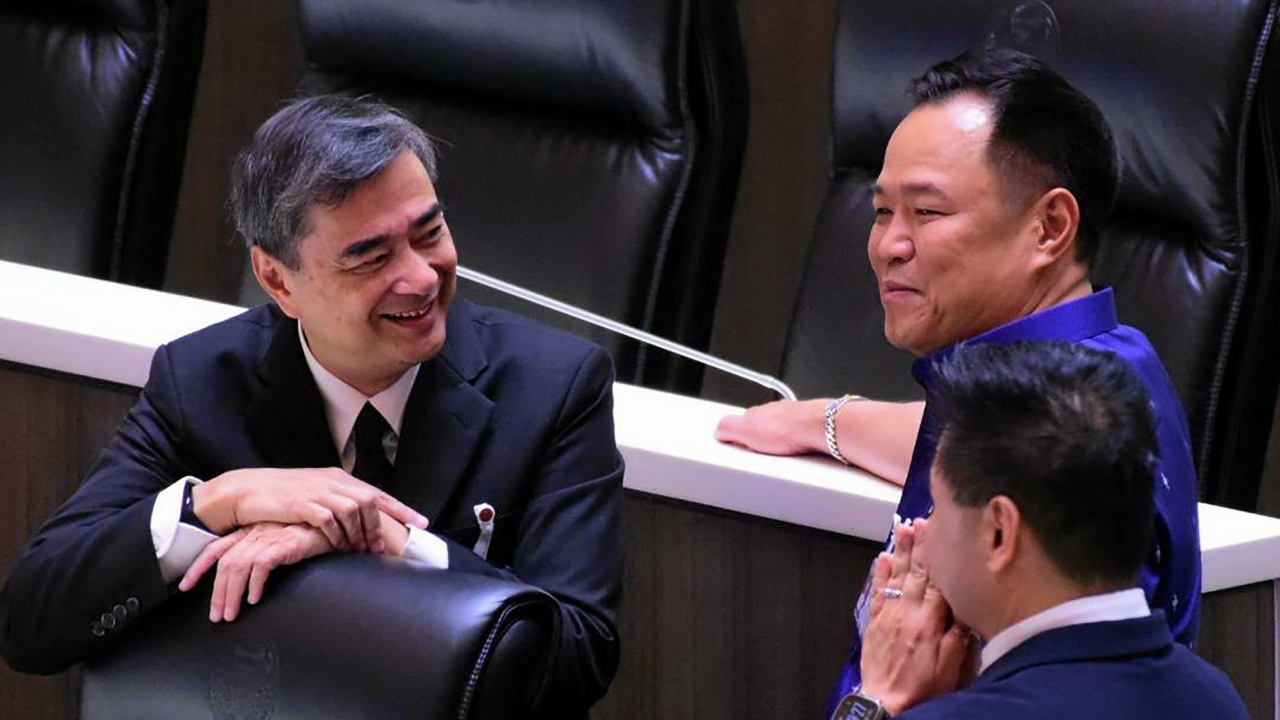
Suan Dusit Poll revealed that the political index in April 2026 decreased across all indicators, viewing Anutin as the most prominent figure in the government camp, while in the opposition, Abhisit ranked first. The public wants the government to address livelihood issues and reduce living costs.
On 3 May 2026, Suan Dusit Poll of Suan Dusit University surveyed public opinion nationwide on the subject of the Thai political index for April 2026. The sample comprised 2,214 people (surveyed online and in person) from 27–30 April 2026. There were 25 indicators reflecting confidence in Thai politics across various aspects. Each indicator was scored out of 10 points. The results ranked from highest to lowest scores were as follows.
1. The overall Thai political index for April 2026 scored 3.79 out of 10 points (down from 3.89 in March 2026).
2. The public rated 25 indicators of the Thai political index, each out of 10 points, ranked from highest to lowest. The political index in April 2026 declined from March across all indicators.
1. Opposition performance 4.31 points
2. Citizens' rights and freedoms 4.24 points
3. Public participation 4.22 points
4. Development of education for the public 4.18 points
5. National security 4.13 points
6. Overall social conditions 4.06 points
7. Political stability 4.03 points
8. Overall performance of political parties 3.99 points
9. Safety of life and property 3.95 points
10. Behavior and conduct of politicians 3.91 points
11. Government performance 3.85 points
12. Transparency of government information disclosure 3.83 points
12. Overall problem-solving 3.83 points
14. National development progress 3.78 points
15. Prime Minister's performance 3.76 points
16. Governance according to announced policies 3.71 points
17. Laws and justice system 3.69 points
18. People's living conditions 3.55 points
19. Unemployment problem-solving 3.54 points
20. Cost of living, salaries, wages, and welfare 3.49 points
21. Overall economic condition 3.46 points
22. Anti-corruption and transparency efforts 3.35 points
23. Poverty alleviation efforts 3.34 points
24. Prices of goods 3.23 points
25. Drug and influential figure problem-solving 3.22 points
3. Government politicians with the most prominent roles
Rank 1: Mr. Anutin Charnvirakul 39.07%
Rank 2: Mr. Yotchanan Wongsawat 28.22%
Rank 3: Ms. Supachai Sutthammanoon 17.01%
Rank 4: Mr. Eknat Prompan 9.78%
Rank 5: Mr. Sihasak Puangkaetkaew 5.92%
4. Opposition politicians with the most prominent roles
Rank 1: Mr. Abhisit Vejjajiva 27.82%
Rank 2: Ms. Rakchanok Srinok 23.25%
Rank 3: Mr. Natthapong Ruangpanyawut 17.24%
Rank 4: Mr. Rangsiman Rome 16.07%
Rank 5: Mr. Thammanat Prompao 15.62%
5. Messages the public wants to convey to the government
Rank 1: Solve livelihood problems and reduce living costs for the people 49.82%
Rank 2: Reduce electricity and fuel prices 31.03%
Rank 3: Work diligently and develop the country according to campaign promises 19.15%
6. Messages the public wants to convey to the opposition
Rank 1: Monitor government corruption and budget use 44.37%
Rank 2: Perform duties earnestly and adhere to principles 34.57%
Rank 3: Be the voice of the people 21.06%

Dr. Pornpan Buathong, Chairperson of Suan Dusit Poll, stated that the decline in the Thai political index across all indicators shows the public is not concerned about a single issue but views the overall picture of politics, governance, economy, and quality of life in the same direction: they have yet to see clear results. Especially, scores related to the economy and livelihoods remain low. The public's feedback urges the government to urgently solve livelihood and living cost problems, as the government's major challenge is not just policy announcements but making people genuinely feel that their lives have improved.
Meanwhile, Assistant Professor Kanyakarn Sathiensukon, Assistant Dean for International Relations at the School of Law and Politics, Suan Dusit University, noted that over the past two months, public confidence in the government's work has continuously declined. Analyzing the situation shows external factors, such as the Middle East conflict, significantly influence public perception, especially regarding energy prices impacting electricity, fuel, and goods prices. Meanwhile, incomes and wages have not increased correspondingly. Public dissatisfaction is thus not directed at external factors but rather at the government's effectiveness in mitigating these impacts.
This external crisis is a test of the government's ability, whether in controlling prices, implementing announced policies, or taking proactive measures. If the government responds slowly, unclearly, or lacks transparency, it exacerbates existing problems such as economic issues, governance concerns, and corruption allegations. The Middle East crisis thus becomes another factor widening the gap between government expectations and public sentiment, lowering confidence indices in several dimensions. These reflect that current political confidence in Thailand depends on the government's capacity to transform external crises into opportunities for efficient and accountable internal management to restore public trust.