

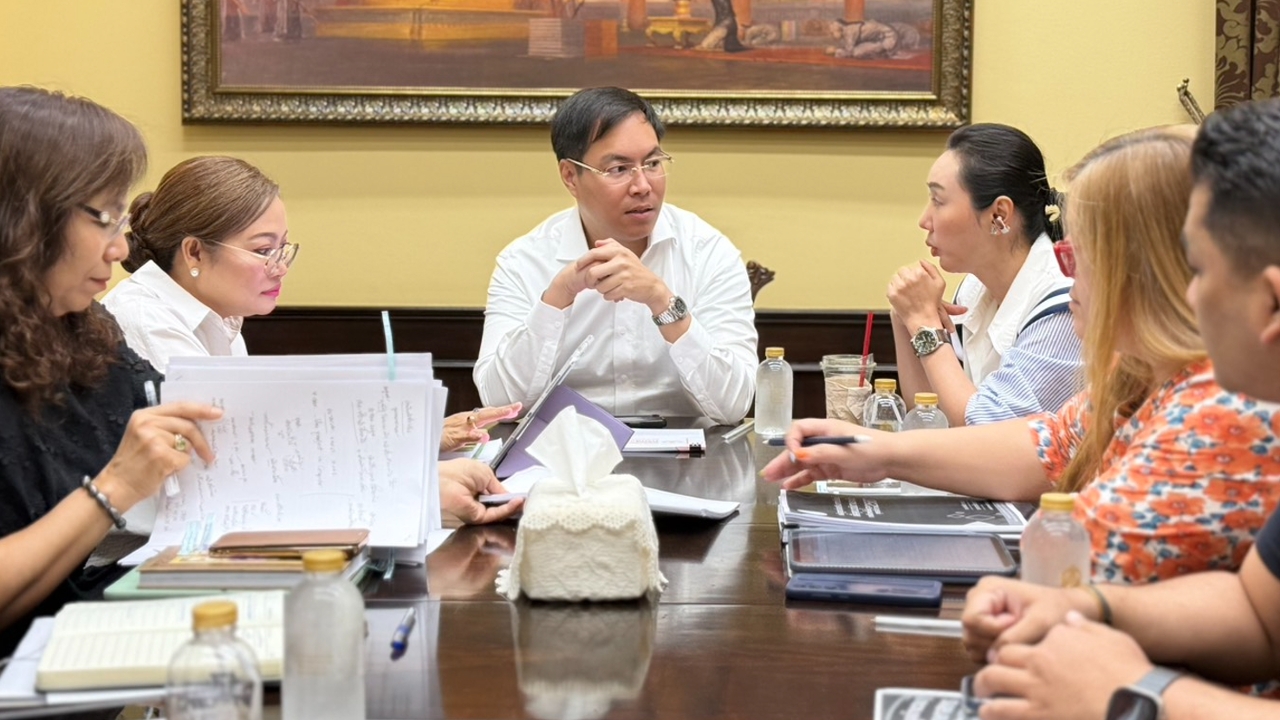
The Director-General of the Department of Learning Promotion led a delegation to report to the Deputy Minister of Education, affirming that the old curriculum cannot be immediately canceled due to limitations in transfer regulations and the removal of student records.
On 4 May 2026 GMT+7, a reporter reported that Dr. Ketsadip Supawanich, Director-General of the Department of Learning Promotion (DLP), met with Mr. Akaranat Kankittinan, Deputy Minister of Education, ahead of a scheduled appointment to clarify key facts. The focus was on three important issues to ensure accurate understanding and drive improvements in the learning system's effectiveness.
Regarding the curriculum issue, DLP explained that the 2008 curriculum cannot be immediately canceled due to restrictions in transfer procedures and the removal of student records. Furthermore, since learning is lifelong, over 60% of learners are still studying under the 2008 curriculum and have not yet graduated. Students may return at any time to complete their studies. Currently, lists are being compiled nationwide for transfer and removal to prepare for the transition to the latest 2024 curriculum. This pilot has been implemented in 10 provinces and expanded to 12 more, totaling 22 provinces to prepare for nationwide implementation. From semester 1 of the 2027 academic year onward, no new students will be admitted under the 2008 curriculum; instead, the 2024 curriculum will be fully adopted.
On the issue of textbook quality, DLP explained that previously there was no committee overseeing textbook quality similar to that of the Office of the Basic Education Commission (OBEC). Therefore, the oversight system has been revised to appoint two committees: one to inspect textbook quality related to paper, cover, design, and price, and an existing committee to review content quality. Additionally, following policy from the Deputy Minister of Education, a third committee will be established to set quality and price standards, providing uniform guidelines for textbook producers.
Regarding learning spaces and equipment, DLP stated that due to budget constraints and its established practice of integrating collaboration with local partners, some areas still lack dedicated buildings and must use facilities from external agencies such as provincial administrative organizations, municipalities, temples, closed or consolidated OBEC schools, or rented spaces. In Bangkok, 45 of 50 districts rent spaces, while others rely on partner cooperation. To resolve this, a nationwide survey will be conducted to coordinate the use of space from the Treasury Department or unused government facilities. A letter has also been sent to OBEC to request use of 153 small schools that have been closed or merged. Expansion will depend on approval for using closed or merged OBEC schools and future budgets.
The Department of Learning Promotion will continue to advance all three issues and report progress to the Deputy Minister of Education to ensure the country's learning management is of quality, accessible, and truly supports lifelong learning.