

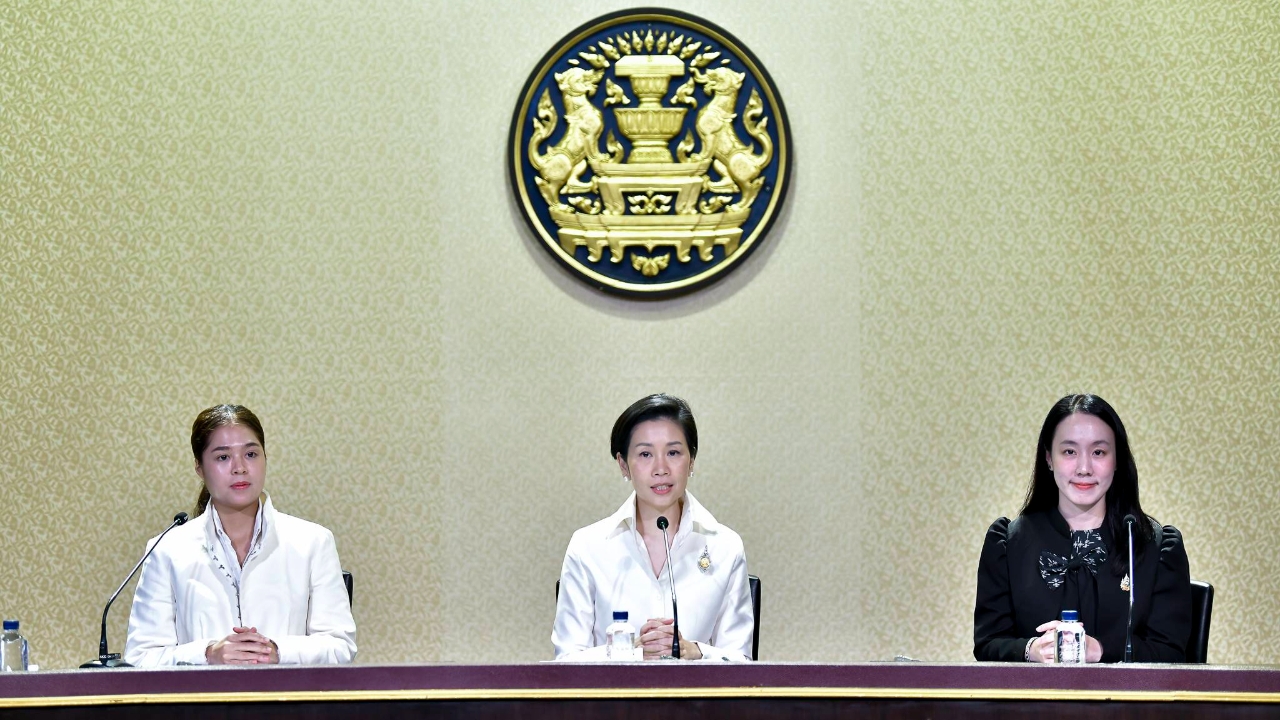
Ratchada revealed ongoing legal reforms aimed at reducing redundant steps, cutting excessive budgets, and adopting an agile approach in line with government policy.
On 5 May 2026, Ms. Ratchada Thanadirek, spokesperson for the Prime Minister's Office, announced the Cabinet's approval of a draft regulation to repeal eight outdated Prime Minister's Office regulations. This move aims to eliminate redundancies and reform the civil service system to align with current circumstances, as outlined in the government's policy announced earlier this year.
Ms. Ratchada described this repeal as a "legal guillotine" to remove unnecessary procedures. Most of the eight regulations are already supported by main agencies or laws at the Act level, making the additional Prime Minister's Office regulations an obstacle and an unnecessary financial burden.
The repealed regulations include: Accelerating Administrative Procedures (1978), canceled because the Administrative Procedure Act already protects public service standards; Government Complex Organization (1996), whose mission has been fulfilled and transferred to the Ministry of Interior as a ministerial announcement; Strengthening National Identity (2006), merged into the Ministry of Culture to reduce overlap in national master planning; Community Land Title Deeds (2010), transferred to the National Land Policy Committee (NLP), which has clearer and fairer specialized laws; National Intellectual Property Policy (2012), authority returned to the Department of Intellectual Property under the Ministry of Commerce to manage copyrights and patents directly.
Tracking Missing Persons and Identifying Unnamed Bodies (2021), delegated to the Institute of Forensic Science, Ministry of Justice, to carry out existing duties; Administration of Special Ratchadamnoen Road Area (2004), canceled as the mission is complete and no longer fits current conditions; Enhancing Competitiveness (2002), canceled to allow the Board of Investment and the Targeted Industry Policy Committee to operate under the 2017 Act.
The government spokesperson emphasized that this repeal aligns with the intent of Section 77 of the Constitution of the Kingdom of Thailand, which requires the state to have only necessary laws. The government aims to reduce complexity, enabling agencies to work more efficiently and importantly, to cut budget burdens caused by duplicative committees or offices, thus redirecting funds to genuinely beneficial public services.