

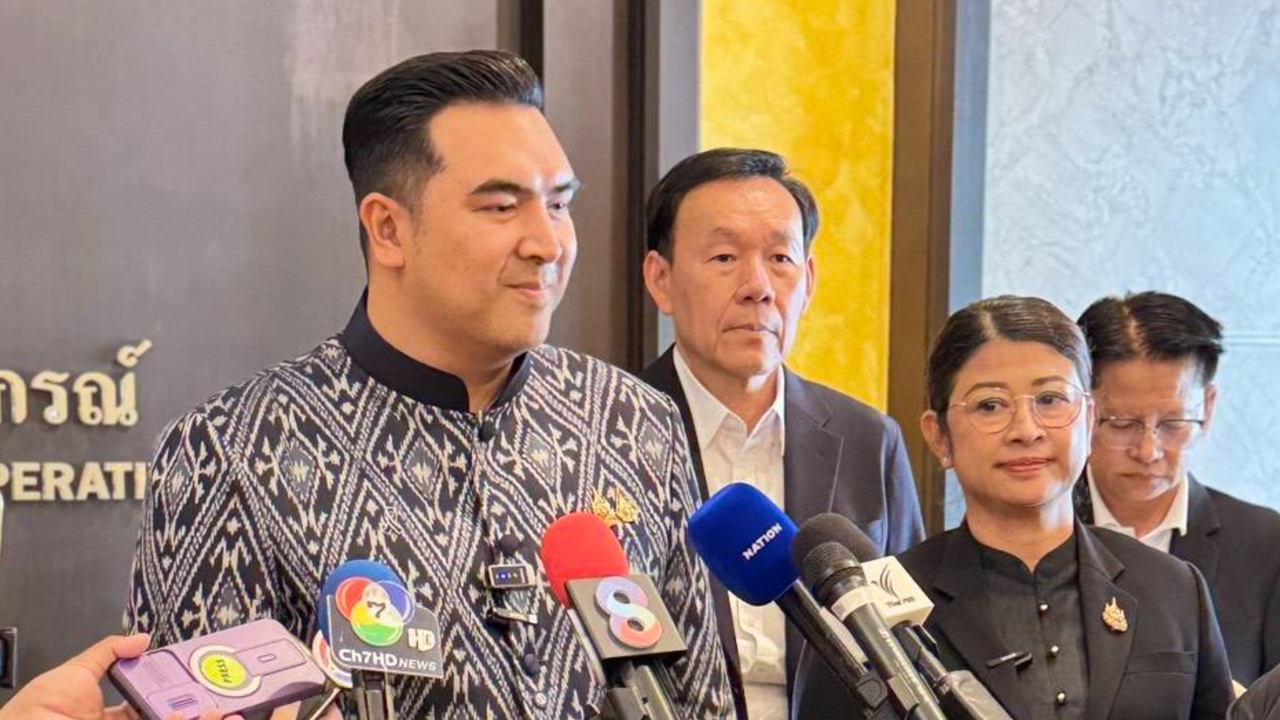
The Deputy Minister of Agriculture and Cooperatives revealed no irregularities in the procurement of the 'Thailand FishAI' app, stating it followed proper procedures. He admitted the app's performance does not yet justify the investment. He denied that the project was used to cover up the transfer of the Royal Rainmaking Director and confirmed all projects are being reviewed. The Department of Fisheries explained the budget came from the Digital Economy and Society Development Fund instead of its own funds.
5 May 2026 GMT+7 Mr. Watcharapol Khawkhum, Deputy Minister of Agriculture and Cooperatives, said after discussions with Mrs. Thitiporn Laoprasert, Director-General of the Department of Fisheries, and related agencies regarding the briefing on the 'Thailand FishAI' application project by the Department of Fisheries. The briefing focused on the project's cost-effectiveness and transparency. He explained that the Director-General was called in to provide details since she had been in office less than 30 days.
: The Director-General of the Department of Fisheries explained that the project did not use the department's budget but was funded by the Digital Economy and Society Development Fund starting in 2025. This was coordinated through Mr. Ponpisil Suwanchai, an expert in fisheries management at the Department of Fisheries, who secured a budget of 9.1 million baht, divided as follows: 5 million baht for AI development; 1 million baht for app development; 1 million baht for website development; 1 million baht for cloud system development; as well as procurement of computers, tablets, and backend systems.
The Deputy Minister of Agriculture confirmed that after the discussion, no abnormalities were found in the project, but he acknowledged that the current investment amount does not correspond to the app’s operational effectiveness. He instructed the Department of Fisheries, contractors, and related agencies to improve the app’s efficiency, especially in fish species identification where limitations remain, striving to maximize value. Any problems must be addressed promptly to ensure smooth operation.
Regarding questions about Blue System Technology Co., Ltd., the contractor for this and several other Department of Fisheries projects and whether it received preferential treatment, legal and Ministry of Finance officials stated that the company is specialized in this field. Preliminary checks have found no irregularities or lack of transparency, and all procurement complied with regulations. At present, there is no need to form an investigative committee. However, going forward, the app’s performance will be monitored weekly to accelerate improvements and maximize effectiveness.
In response to demands from a People's Party MP to disclose project details, especially the Terms of Reference for procurement, authorities are prepared to provide transparency to the public. He affirmed that the department’s actions are not intended to overshadow rumors about the transfer of the Royal Rainmaking Department’s director. He emphasized his direct supervisory role over the Department of Fisheries and readiness to investigate any irregularities in all projects.
: Mr. Ponpisil Suwanchai, fisheries management expert at the Department of Fisheries and head of the Thailand FishAI project, said that the project aims to develop a 'mobile aquatic species library' that compiles digital data on aquatic animals and plants, allowing public access to information easily. It integrates artificial intelligence to classify fish species and supports national aquatic resource surveys. The app also serves as a communication channel for the public to contact fisheries officials, reducing travel time and costs, while encouraging public participation in submitting data to expand the country's biodiversity database. For initial misclassifications of fish species,
the research team has accelerated system improvements by adding filters: if an image is not of a fish, the system will not classify it and will prompt users to submit clearer images. Currently, the system can classify about 50-52 fish species from the database with high accuracy, using models selected for over 70% accuracy before deployment. Developing AI requires large datasets.
The project has collected more than 50,000 real fish images from Department of Fisheries breeding sites to ensure quality data for training and to avoid copyright issues. The Department chose to develop AI domestically to maintain data sovereignty and reduce long-term costs, as using foreign services would incur processing fees per use, which would accumulate as user numbers grow.