

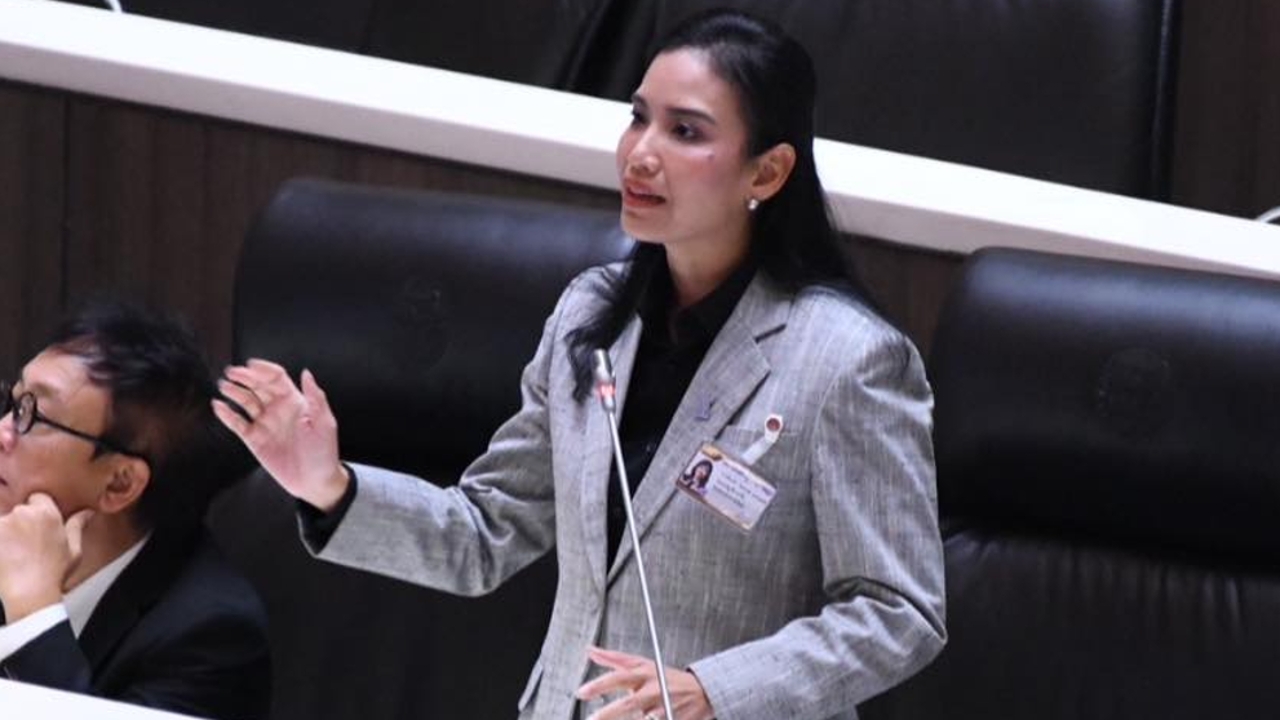
Radklao reveals the justice system's structure, urging the parliament to form a committee to overhaul Thai prisons. She exposes the overcrowding crisis where inmates sleep in spaces no bigger than yoga mats, criticizes the "no-choice system" that causes the poor to overcrowd prisons, and promotes five dimensions: "dismantle-separate-build-adjust-cleanse" to return good citizens to society.
On 6 May 2026, at the Parliament during the House of Representatives meeting, Radklao Intawong Suwankiri, a party-list MP from the Democrat Party, proposed a motion requesting the House to establish a special committee to study justice and the quality of life of prisoners, as well as their reintegration into society after mistakes, aiming to fundamentally reform the correctional system facing a crisis. She emphasized that a good justice system must "be the smartest at protecting society" not merely skilled at imprisoning.
She presented prisoner statistics.
Radklao revealed alarming 2026 statistics showing that Thailand ranks seventh globally in prisoner population, with over 330,000 inmates, despite actual capacity being only 240,000, reflecting extreme overcrowding.
"Let me illustrate: the sleeping space per prisoner is only the size of a 'yoga mat.' They lie shoulder to shoulder all night, leading to crises including tuberculosis, skin diseases, and mental health problems—like a hospital cramming all patients with various illnesses together in an ICU until chaos ensues," Radklao said. Radklao said,
"Prisons are meant to hold the poor" is no exaggeration.
She further stated that the phrase "Prisons are meant to hold the poor" is accurate, as 70% of inmates are small-scale drug offenders who cannot afford bail, while major perpetrators often evade capture. Furthermore, nearly 100,000 detainees awaiting trial remain unconvicted but imprisoned due to poverty. The Democrat MP also criticized budget allocation distortions, noting only 1% is spent on rehabilitation. "How then can we return good citizens to society?" she asked, citing correctional officers' remarks that "Thai law punishes the poor or drug dealers alike, and it all ends up in prison," highlighting Thailand’s lack of sentencing alternatives.
Proposes five-dimensional structural reform
Radklao continued that for sustainable change, she proposes the 27th special committee take over from the previous one to reform the structure in five main dimensions.
1. Legislative dimension: overhaul criminal policies, increase sentencing alternatives such as community service for minor offenses, and use electronic monitoring bracelets instead of bail money per the UN Tokyo rules to reduce inequality.
2. Separate prisoner categories: strictly separate "those awaiting trial" from "convicted prisoners" to prevent criminal grooming within prisons.
3. SDU (Service Delivery Unit) innovation: involve private and public sectors to upskill prison labor through independent agencies, citing the U.S. UNICOR example where inmates produce goods (tables, chairs, military uniforms) sold to the government, generating revenue without taxpayer burden.
4. Reallocate budget: shift mindset from "imprisonment" to "investment in human capital" to return working-age individuals to the economy.
5. Remove stigma and create incentives: study drafting a Rehabilitation Act for non-recidivist individuals who perform community service and report continuously for three years, reducing stigma to help them reintegrate socially.
"Most inmates eventually return to Thai society. If prejudice and outdated systems persist, these individuals will have no choice but to reoffend. I urge the formation of this committee to transform the justice system from imprisonment to providing opportunities alongside sustainable social protection," she appealed. Radklao concluded her remarks.