

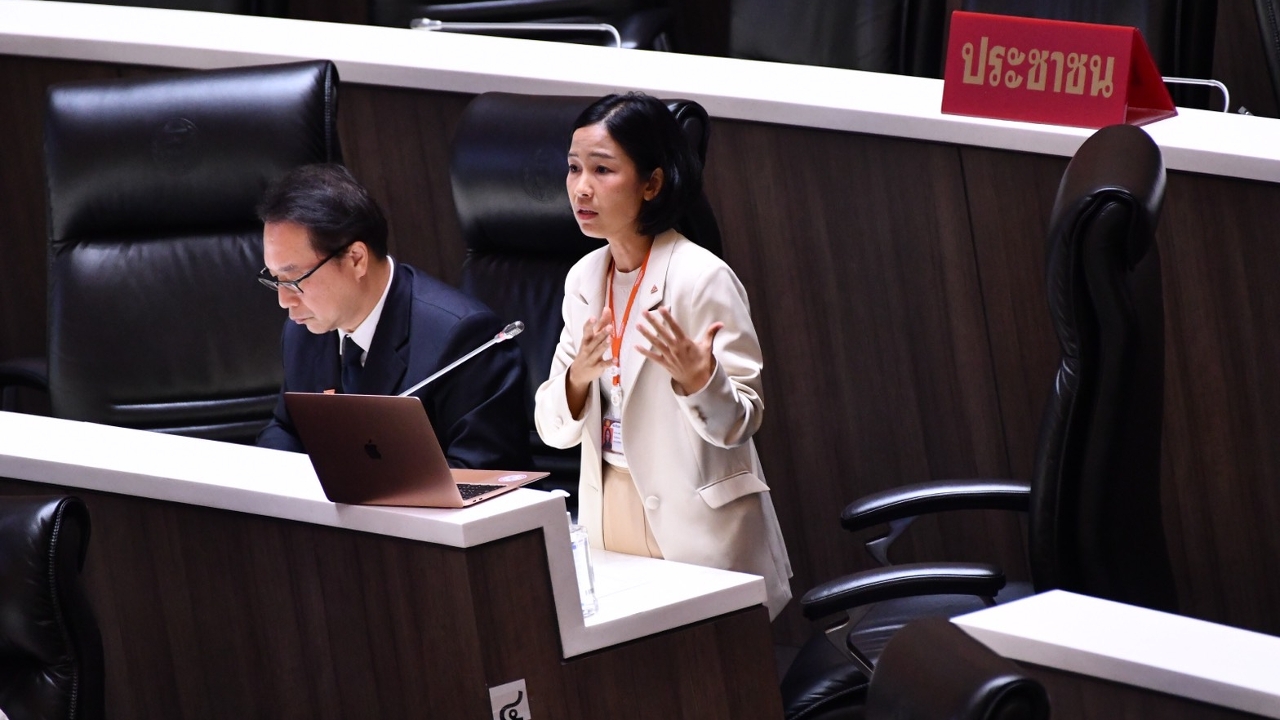
Sasinan cited the cases of Bung Netiporn and Ekachai to highlight bottlenecks in the prison healthcare system. She proposed expanding health rights, vocational training, and education to help restore inmates as capable members of society.
On 6 May 2026, during a session of the House of Representatives, a motion was considered to establish a special committee to study justice and the quality of life of prisoners, as well as their reintegration into society after past mistakes. Ms. Sasinan Thammanithinan, a Bangkok MP from the Prachachon Party and the motion's proposer, spoke on the key principles and reasons for advancing this issue to raise Thailand's prison human rights standards.
Ms. Sasinan stated that from her experience working with the Committee on Law, Justice, and Human Rights, despite studies over many terms, prison overcrowding remains critical. Currently, there are over 300,000 inmates while capacity is only 200,000. Many prisons are over 100 years old and lack renovation, resulting in living standards below international levels. Her proposal is not to repeat past studies but to focus on the “quality” dimension of both healthcare systems and reintegration processes.
She pointed out that health rights are fundamental, yet in practice, the patient referral system in prisons is a bottleneck leading to losses, such as the case of Bung Netiporn, a political activist who died. Investigations found no night-shift doctors in the prison and problems managing cell keys during emergencies. Also, Ekachai Hongkangwan, seriously ill, was treated differently from other political prisoners allowed outside care. These issues require urgent resolution by the committee.
Additionally, Ms. Sasinan emphasized the high recidivism rate of 33.87% over the past three years. She argued that prisons’ goals must shift from “incarceration” to “rehabilitation.” Currently, the Department of Corrections focuses mainly on discipline training or disconnected projects like community service that lack real-world links, such as farming programs without land for inmates or meditation and Pali language classes. In contrast, other countries sign MOUs with industry councils to provide vocational training aligned with actual labor market needs.
Ms. Sasinan continued that amid declining birth rates and a shrinking workforce, the state should shift from punitive approaches or stripping civil rights to minimizing state burdens through non-custodial detention, bail rights, and community understanding to reintegrate former inmates into the economy. This requires changing the view that "prison cells are opportunities." This can be achieved through prison internships, online learning, or MOUs with universities to allow inmates access to education and examinations according to their rights.
Ms. Sasinan concluded that this issue involves not only the Ministry of Justice but also the Ministries of Public Health, Education, and Higher Education. With systematic collaboration, establishing a special parliamentary committee can help solve these problems by designing a system focused not just on confinement but on human development. We can restore “normal people,” not just “good people,” back into Thai society with dignity and safety for all.