

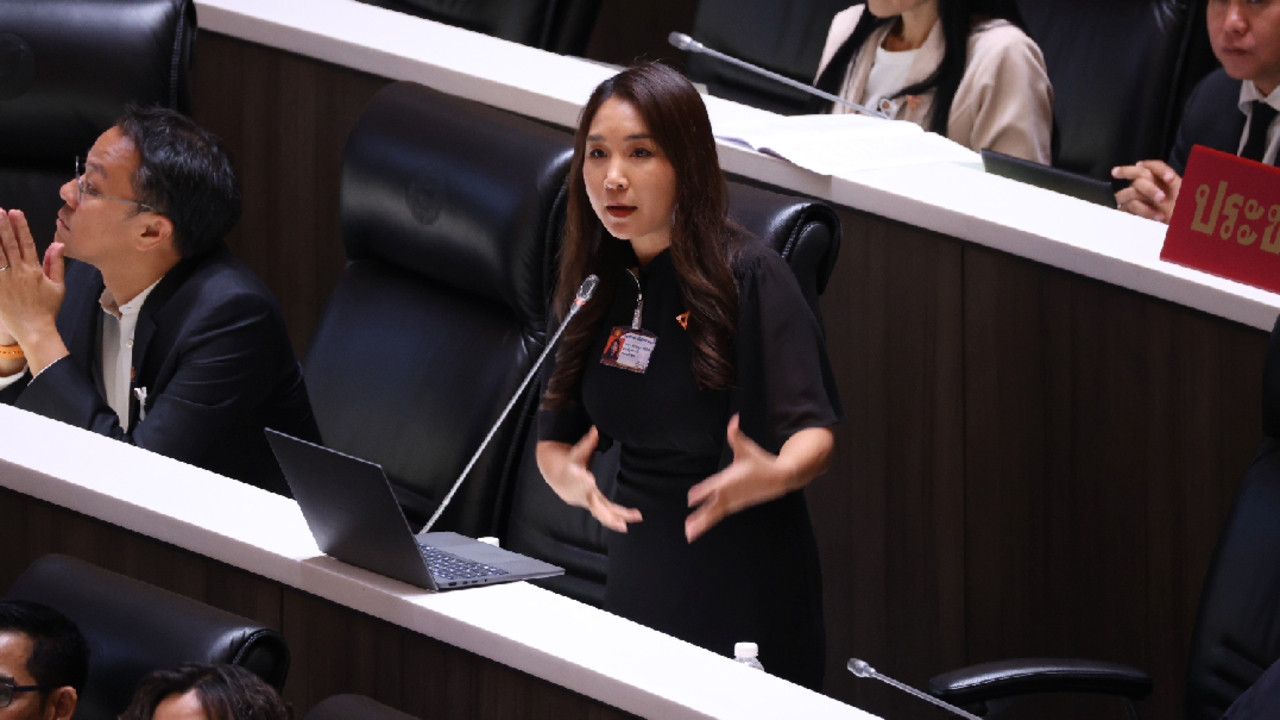
Sirikanya criticized the government for issuing a 400 billion baht loan decree that embeds an energy transition plan aimed at avoiding scrutiny. Meanwhile, Pradorn explained that urgent action cannot wait amid soaring living costs.
On 7 May 2026, during a House of Representatives session chaired by Sopon Sarum, Sirikanya Tansakul, a party-list MP from the Prachachon Party, questioned the Prime Minister about the necessity of issuing a 400 billion baht loan decree. The loan plan is divided into two parts: 200 billion baht for relief and 200 billion baht for energy restructuring. She pointed out that the government is using citizen relief as a hostage to include non-urgent projects, risking violation of Section 172 of the constitution.
"The government is borrowing at full force, stuffing non-urgent projects into the decree that should be in the 2027 budget for parliamentary scrutiny. This approach is like issuing a blank check, forcing citizens to bear the debt, and distributing funds randomly without verifying who is truly affected. If the Constitutional Court finds problems, the government must be responsible. Don't hide behind the people's hardships," said Sirikanya.
Meanwhile, Pradorn Prisananantakul, Minister attached to the Prime Minister's Office, delegated by the Prime Minister to respond, stated that the war crisis has severely impacted product costs and electricity prices. However, the mid-year 2026 central budget has only 20 billion baht left, and total transferred budgets amount to less than 40 billion baht, insufficient to provide relief to 30 million people.
The Minister further explained that if action is delayed, there will be a severe cost-of-living crisis. With the war likely to continue beyond six months, the government must promptly inject funds to support the public. Accusations of issuing a blank check are too harsh. The government has a careful plan to borrow domestically at a low interest rate of only 1.3%, with a clear repayment plan allocating 4% of the budget to debt service the following year.
Whether the decree is urgent depends on the leadership's vision. People are suffering from high electricity costs due to reliance on fossil fuels. Therefore, this opportunity must be used to transition to clean energy. The government is confident every baht will reach the people, and this decree fully complies with Section 172 of the constitution, as it is an emergency measure urgently required to maintain the country's economic security.