

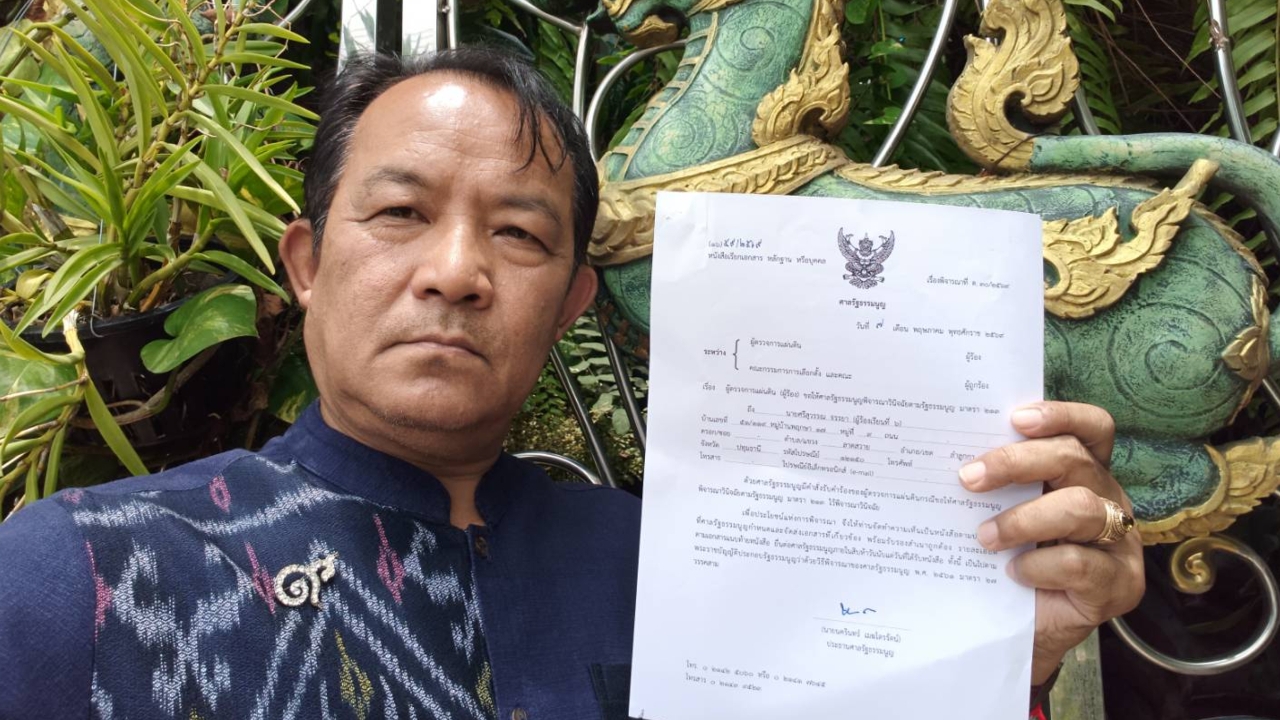
The Constitutional Court has ordered Srisuwan to submit a written opinion to the court on whether election ballots containing QR codes comply with the Constitution and relevant laws.
10 May 2026 GMT+7 Mr. Srisuwan Janya, leader of the Rak Chart Rak Phandin organization, revealed that the organization received a letter from the Constitutional Court requesting a written opinion on issues defined by the court, along with all related documents, concerning a complaint filed through the Ombudsman under Section 213 of the 2017 Constitution. The issue is to determine whether the Election Commission's arrangement to produce election ballots with QR codes and barcodes is consistent with the Constitution and laws.
This follows a complaint submitted on 13 February 2026 by the Rak Chart Rak Phandin organization to the Ombudsman, requesting that the matter be forwarded with opinions to the Constitutional Court for adjudication. The complaint concerns whether the Election Commission's inclusion of barcodes on election ballots could allow others to learn how voters cast their votes, thereby potentially affecting the fairness and integrity of the recent general election. It also questions whether the Election Commission's regulations on parliamentary elections, Article 129 Paragraph 2 of 2023, comply with Section 85 of the 2017 Constitution and Sections 84 and 86 of the Organic Act on the Election of Members of the House of Representatives 2018. Subsequently, the Constitutional Court, by a majority vote of 6 to 3, accepted the Ombudsman's petition for consideration on 18 March 2026, designating it case number Tor.30/2569.
For the sake of the proceedings, the court has issued an order summoning the Rak Chart Rak Phandin organization to submit a written opinion addressing five key points as specified by the Constitutional Court. These include questions about the act of voting, the visibility of the QR and barcodes, methods by which voting results or voter identities might be determined from these codes, any objections or complaints filed before media reports, and to provide all related evidence to the court.
The Rak Chart Rak Phandin organization stated that these questions might set an investigative agenda not fully aligned with the original intent of the complaint, which centers on whether the existence of barcodes compromises the secrecy of the election. Nonetheless, the organization respects the court's discretion. It will expedite preparing its written opinion, gathering information and evidence, and requesting additional witnesses as needed, to submit within the 15-day deadline set by the court. According to Section 27 Paragraph 3 of the Constitutional Court Procedure Act 2018, this process aims to uphold accuracy and sanctity as intended by the Constitution and laws, preventing anyone from using illegal power or deception to unlawfully obtain state authority.