

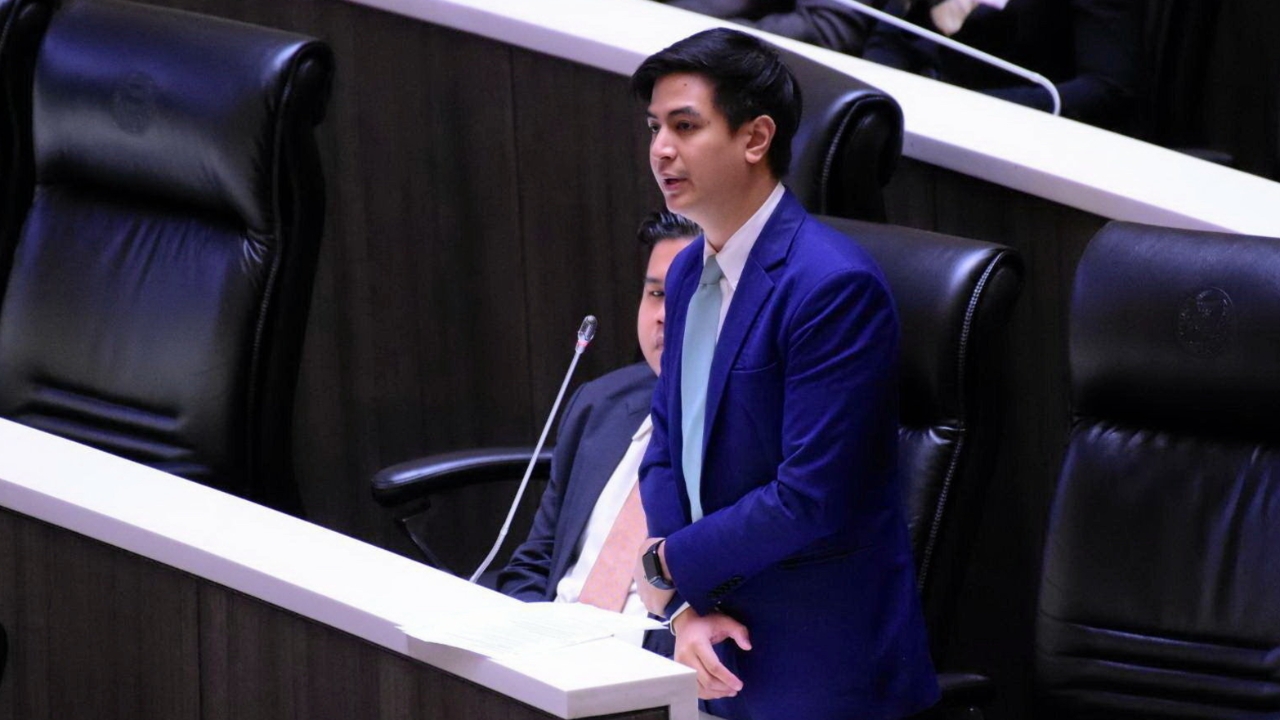
Parit Watjanasuntorn criticized the government for opportunistically combining two funds within the loan decree, arguing that it is using public relief money as leverage to sneak energy projects past parliament. The People's Party plans to propose establishing a special committee to monitor and audit the fund usage.
On 11 May 2026, Parit Watjanasuntorn, party-list MP of the People's Party, posted on Facebook his views on the 400-billion-baht loan decree. He stated that bundling two funds into a single loan decree equates to the government exploiting the public's hardship by using relief funds as hostages to sneak energy projects past parliament. The People's Party proposes that parliament promptly set up a special committee to monitor and audit the fund usage under the decree.
Following the loan decree's enforcement last weekend, today the People's Party and opposition parties will submit signatures to the Speaker of the House to invoke constitutional mechanism under Article 173, requesting the Constitutional Court to decide whether the decree complies with Article 172, paragraph one of the Constitution — that is, whether it is something "that must be done now" and whether "if not done, the country's economic security cannot be maintained."
Parit noted that while the power to interpret laws in this manner exists in courts or constitutional courts in some democratic countries, and is not an authority expanded by the 2017 Constitution, the intent is to protect against executive overreach by passing laws or borrowing money "bypassing" parliamentary scrutiny. However, he understands concerns about the current Constitutional Court's legitimacy and acknowledges differing views on the People's Party's decision to use this mechanism.
Nonetheless, he emphasized that the root problem stems from the government's lack of straightforwardness in issuing the loan decree by bundling two separate funds into one decree.
- Fund 1 = Measures to assist and relieve the public (200 billion baht)
- Fund 2 = Projects promoting energy transition (200 billion baht)
In principle, because issuing a loan decree allows the government to spend money immediately without parliamentary approval or scrutiny, such decrees should be used only when the government urgently needs funds to maintain economic security, cannot find money elsewhere, and cannot wait.
Therefore, although there are concerns about details in Fund 1 (such as broad relief measures risking vulnerable groups being missed, or stimulus spending amid cost-of-living pressures), Parit and the party find the government's approach highly inappropriate regarding Fund 2—the energy transition projects. The issue is not disagreement with energy transition itself, but rather that there is no reason for the government to implement these projects without prior parliamentary approval, since these projects are not immediate or instantly effective. Normally, they should be processed through the annual budget cycle (e.g., the 70-billion-baht bill effective October 2026) or a separate loan bill submitted to parliament. The government deliberately avoided these to bypass parliament.
Thus, the government's deliberate bundling of the two funds into one loan decree (instead of separate loan decrees or bills for each fund) forces MPs or opposition members who oppose the decree to risk being labeled as opposing both funds simultaneously—whether by voting against approval or other means. This act effectively exploits public hardship by using relief funds as hostages to sneak energy projects past parliament.
Parit said that to scrutinize the government with focus on this lack of transparency,
1. The petition to the Constitutional Court will focus on Fund 2—the energy projects—because the government has no valid reason to bypass parliament for borrowing in this area, and this prevents the government from claiming that opposition obstruction harms urgent public relief in Fund 1.
2. The party will propose a motion for parliament to establish a special committee to monitor and audit the loan decree fund usage promptly (similar to the special committee set up to audit COVID-19 loan decrees). Even though the constitutional petition might delay parliamentary approval of the decree, since it is already in effect and funds are being used, parliamentary oversight via the committee should begin immediately.