

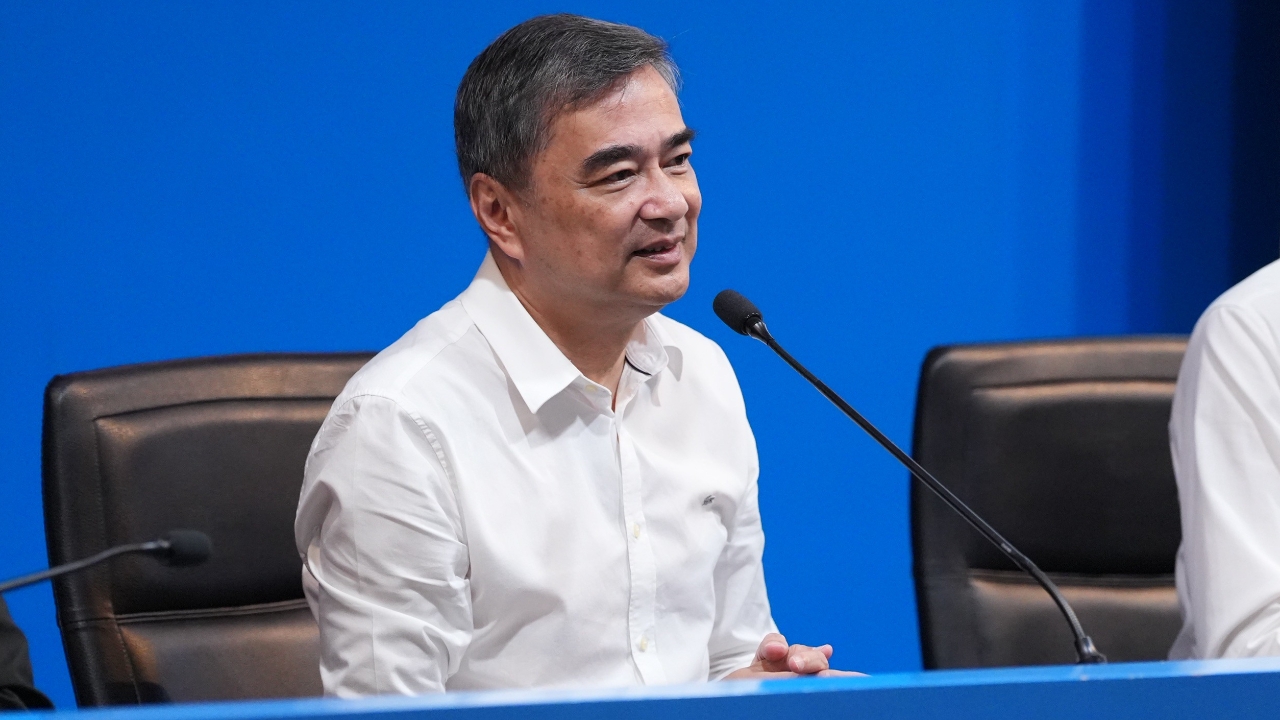
“Abhisit” confirms that the opposition has filed a petition with the Constitutional Court to interpret the 400 billion baht loan decree, pointing out that the reasons for borrowing do not hold and alternatives exist that do not violate the constitution. He challenges “Ekniti” on where the cash handouts to 30 million people are targeted.
At 10:00 a.m. on 11 May 2026, at the Democrat Party headquarters, Abhisit Vejjajiva, leader of the Democrat Party, spoke regarding the opposition's petition to the Constitutional Court to interpret the 400 billion baht loan decree intended to address the energy crisis and transition to clean energy, questioning whether it violates Section 172 of the constitution. He said that at 12:00 p.m. today, the opposition will submit a letter to the Speaker of the House. On 10 May, representatives of the Democrat Party discussed the petition with the People's Party, noting that the decree does not meet constitutional conditions requiring action for economic security. The main point is that at least 200 billion baht of the projects related to energy are hardly connected to current economic security. Regarding the economy, he noted explanations that previous governments also borrowed funds, so facts and legal conditions must be considered. The term “economic security” must be assessed according to international standards.
“In the past, there have been three borrowings: the first during the Tom Yum Goong crisis, when the country's reserves were nearly depleted and the economy contracted sharply; the second during my tenure as prime minister, when tourism and exports declined, unemployment was expected to rise significantly, and the economy shrank. The government attempted to use all legal provisions, such as supplementary budget laws, but was unable to secure funds to assure economic security, so borrowing was necessary. The third was during COVID-19, when all economic activities stopped. Comparing with the current situation, I look at the latest figures announced by the Bank of Thailand at the end of March: exports, investment, consumption, and the overall economy are still positive year-on-year. Revenue collection up to the end of February also meets targets. Therefore, this is not a matter of economic security. I want to emphasize that the Democrat Party's stance is not that the economy is good; we know it is not, and that it is affected by the war. The impact is mainly due to high oil prices, which increase other production costs. If the government plans to spend 200 billion baht over four months, we suggest instead reducing the excise tax on fuel for four months, which would cost only 60 billion baht, immediately lowering fuel prices by 7 baht, already nearly back to 30 baht. Which approach better addresses the problem without violating constitutional conditions?”
Abhisit added that Deputy Prime Minister and Finance Minister Ekniti Nitithanprapas's rejection of reducing excise tax as untargeted aid is questionable. Ekniti explained that “untargeted” means, for example, that wealthy people who drive vehicles benefit because they use diesel. Abhisit responded that if the government were providing targeted aid, such as adding funds to state welfare cards, they would not object, and such programs could be managed within the normal budget. However, the question is how giving money to 30 million people—those who have better phones, better internet, and quicker access—can be considered targeted aid. This is what we question. We never deny economic problems, but economic security has a specific meaning and does not meet the conditions here. We also see that helping the public without incurring enormous debt and avoiding scrutiny can be done in many other ways.
Belief that the Constitutional Court will accept the case and Parliament must suspend proceedings to await the court’s decision.
When asked whether the Kla Party also signed the petition to the Constitutional Court, Abhisit said he understood that the Kla Party did not sign, but he believes that once submitted, the court will accept it for consideration. If the court accepts the case, parliamentary proceedings must be suspended according to the law. He expects this to happen in time for the scheduled review of the bill on 14 May.