

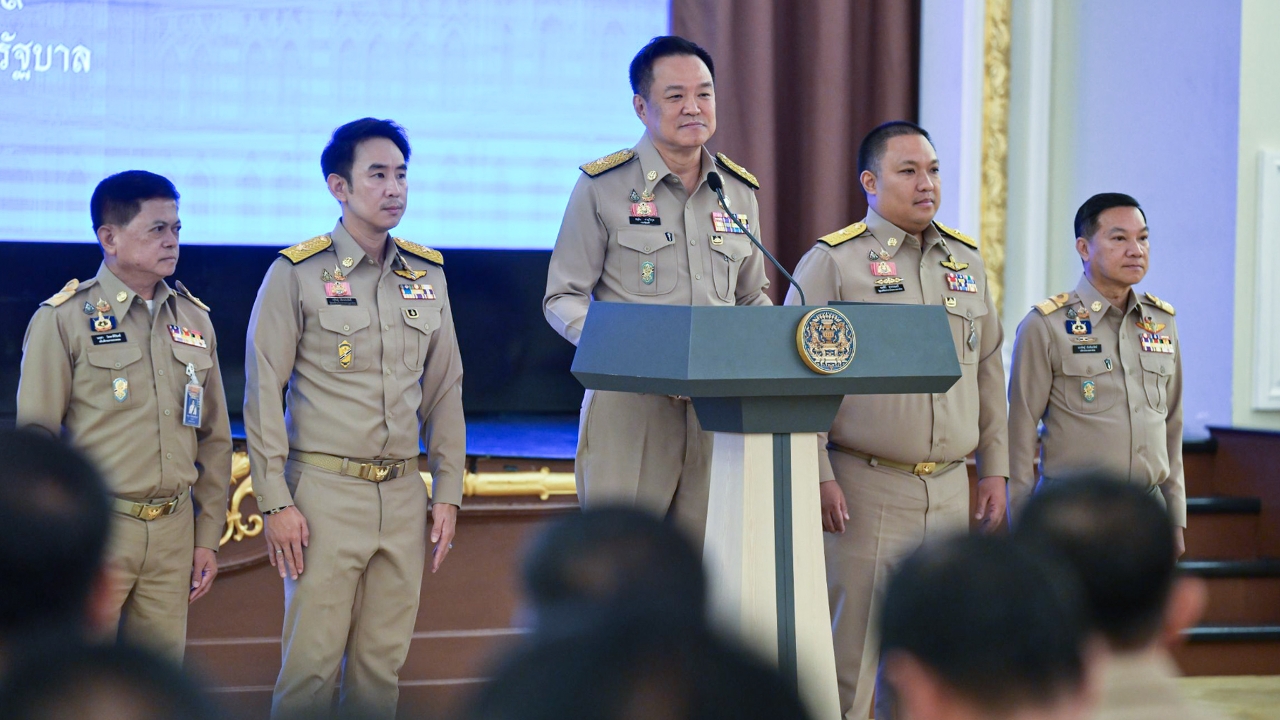
Anutin met with village chiefs and headmen, sweet-talking them by saying, "Without you, I would be helpless." He revealed discussions with the Auditor General to allow local authorities to use budget funds immediately for disaster relief without waiting for provincial governors.
On 11 May 2026 at the Santi Maitri Building (Outer Wing), Government House, Mr. Anutin Charnvirakul, Prime Minister and Minister of Interior, chaired the government's and Ministry of Interior's policy briefing for village chiefs and headmen to drive local operations. Present were Deputy Ministers Polpeer Suwannachawi and Worasit Liangprasit, Permanent Secretary of the Ministry of Interior Atsit Sampanrat, Director-General of the Department of Provincial Administration Narucha Kosaivilai, Director-General of the Department of Lands Pornphot Penpas, and other senior Ministry of Interior officials.
The Prime Minister welcomed the village chiefs and headmen visiting Government House for the first time, noting that previously the Prime Minister and Minister of Interior were different persons. He emphasized that local administrative organizations, including village chiefs, headmen, and local leaders, have long been part of Thai society. He wanted everyone to recognize their role as part of government administration, caring for the people's welfare and being the first people citizens turn to in times of hardship.
“They come to you before coming to us. Therefore, you must act as intermediaries between the government and the people, assisting local operations and driving the government's and Ministry of Interior's work. Please know that you are truly important to me. Without you, we would be helpless.”
Anutin added that they will continue to meet regularly during weekend field visits, as it is better to visit the people than to travel for leisure when there are many pressing issues. This also allows hearing directly from representatives of the people. Given recent changes and events affecting society, he urged everyone to study and understand basic laws, especially those that create peace in the country. Everyone should have knowledge without needing to study law formally. These laws are used to suppress influential individuals. He stressed that village chiefs and headmen should not be influential in a negative sense but should be role models of virtue. He emphasized that everyone has influence with the government, and if their proposals are ignored, the government would not last. This is true positive influence, helping to suppress mafia activities, as influence can be used for good.
The Prime Minister cited a proverb: "Kick a dog, you must consider its owner." If anyone harms the people under your care, the people will be grateful and give us a chance to work. Therefore, no one can bully them. He said he would not allow it either; if those under his care are innocent, they must not be harassed. He will fully protect them, which symbolizes being a good administrator. However, if the people are deprived, it is not a failure of duty but a failure to the people who elected us, damaging public trust.

The Prime Minister also delivered key policies on combating drug problems, stating that community control is the responsibility of village chiefs, headmen, and local administrative organizations. Suppressing drug trafficking is the government's role, providing facilitation. He also emphasized enhancing disaster prevention capabilities. The Ministry of Interior has disaster prevention and mitigation teams and the Department of Local Administration. As local administrators, headmen can declare disasters in their areas without waiting for the provincial governor.
He noted serious discussions with the Auditor General about concerns from headmen regarding audits after floods, landslides, or road damages. The Auditor General confirmed that local authorities can proceed without waiting for provincial governors or district chiefs, as local authorities do not have time to assess situations or contact higher officials. The key is that actions must be honest and explainable as helping the people. These expenses can be audited to ensure budget use is efficient and appropriate.
“If your intention is to relieve the people's hardships and improve their well-being, the government will not allow anyone to prosecute you if you act honestly. If you err, the administrative system collapses, and help to villagers fails. Then what is the purpose of having a government, Ministry of Interior, village chiefs, and headmen? It would be no different than being ordinary residents.”
Regarding crime, he urged vigilance against new criminal methods such as human trafficking and scammers. Some citizens have been tricked to the point of losing everything, including former officials. Prevention at the root is necessary. The government is cracking down on networks but asks headmen to inform villagers that claims like three-wheeled taxis winning the lottery are impossible.
The Prime Minister continued on community economy issues, focusing on reducing expenses and increasing income, supporting the government's economic promotion policies. In early June, the "Thai Help Thai Plus" project will require citizens to register to participate. Unlike the 'Half-Half' project, this is a 60:40 scheme where citizens pay 40% and the government contributes 60%. This funding will help people spend more and obtain more goods while spending less money. Both government and citizens participate in a transparent financial system where buyers and sellers are registered for tax purposes. Transparency and discipline in spending are essential.
“I have observed the 'Half-Half Plus' policy since last November 2025, seeing that people were satisfied and enjoyed using it. It increased money circulation in the economy by 100 billion baht. If this amount circulates in the country’s economy, it will stimulate the overall economy and improve cash flow. This time, the project will be in two phases. Previously, 2,000 baht was given; now 4,000 baht will be provided to citizens—1,000 baht per month for four months—supported at a 40:60 ratio. I believe this will increase citizens’ spending. I urge everyone to expedite implementation. Some say they are reluctant, but when everyone spends together, it’s called joint stimulation, not government stimulation alone. Citizens start it; if citizens don't pay, the government doesn’t pay. This cooperation strengthens Thailand’s economy.”
Anutin further said that regarding the Thai Help Thai project and reducing expenses, several districts have introduced products priced below usual market rates to ease citizens’ burdens. For example, fish sauce with changed labels is not counterfeit but has reduced marketing and advertising costs. Quality fish sauce is bottled by entrepreneurs themselves to reduce costs. The Ministry of Commerce and Ministry of Interior cooperate to separate these products for sale without marketing expenses, enabling prices 20 to 30 percent lower than usual, mostly around 20 percent, benefiting the people. This effort will continue until the crisis eases. These products reach communities via mobile vans that deliver to 10 to 20 villages per subdistrict, maximizing access. Thus, they provide everything villagers need at lower prices with equal quality.
“I personally bought and used these products, including daily necessities like cooking oil. I asked a cook at home how it was, and they said it was exactly the same—high quality and effective—just like well-known brands. These items significantly reduce citizens’ expenses.”
Regarding the country’s situation, he urged everyone to help maintain peace and order in their areas. He asked that law enforcement communicate with district chiefs and at least with provincial governors. Meetings will be arranged within 1–2 weeks for governors and police to meet, cooperate to create peace and safety, eliminate criminals and crime, and maintain order effectively in communities.

Anutin added that everyone should make full use of him. Today, as Prime Minister, he oversees police and security, with the Ministry of Defense also under his purview. If military assistance is needed, he can order it. He has been with the Ministry of Interior for three years, knows all district chiefs personally, and they are like family. If people do not use his position, opportunities will be lost. He will use all powers to ensure national security and peace, integrating cooperation for the people, which is wholly positive.
“Today, I ask for just one thing: no one may oppress others. In this era, citizens suffer from economic crises, disasters, natural hazards, and loss of livelihoods, yet also face oppression. This is intolerable. The Ministry of Interior is well aware of my determination. I work by following up personally—I don’t just issue orders and disappear. I press and inspect myself, so do not worry; if reports come in, I will visit the area. It is not about distrust but seeing with my own eyes to support missions fully and improve efficiency.”
He criticized selfish individuals who allow contraband goods to circulate.
The Prime Minister further said that yesterday he inspected contraband goods in Ranong Province, even checking inside wooden crates to verify their contents instead of just viewing them superficially. He tried lifting crates, but they were too heavy, indicating goods remained inside. Contraband found was initially valued at 50 million baht, but upon inspection, nearly 200 million baht worth of seized goods were discovered.
“I was informed that these were not contraband but goods awaiting shipment to Myanmar. Upon hearing this, I smiled and asked another agency, which replied that shipment was pending approval. Therefore, such excuses are invalid because import licenses are required to order these goods. These goods are tax-exempt and must remain in containers. They have 30 days to export; if not, goods become state property and stored in a free zone warehouse. However, these goods were removed from containers and sorted, including electric pans, refrigerators, tax-exempt chewing tobacco, and worst of all, vitamins. This situation arises because some people are selfish and irresponsible. It is up to us to suppress them. They are society's excess, and only you can eliminate them. Good people have no fear; bad people should fear the village chiefs. Even I fear your goodness.”
At the end, the Prime Minister asked everyone to share a common understanding, noting that all policies have been communicated and acknowledged by everyone.
After delivering the policies, the Prime Minister had lunch with the village chiefs and headmen who attended at the central hall of the Santi Maitri Building. Afterwards, he took group photos with them in front of the Thai Khu Fah Building.