

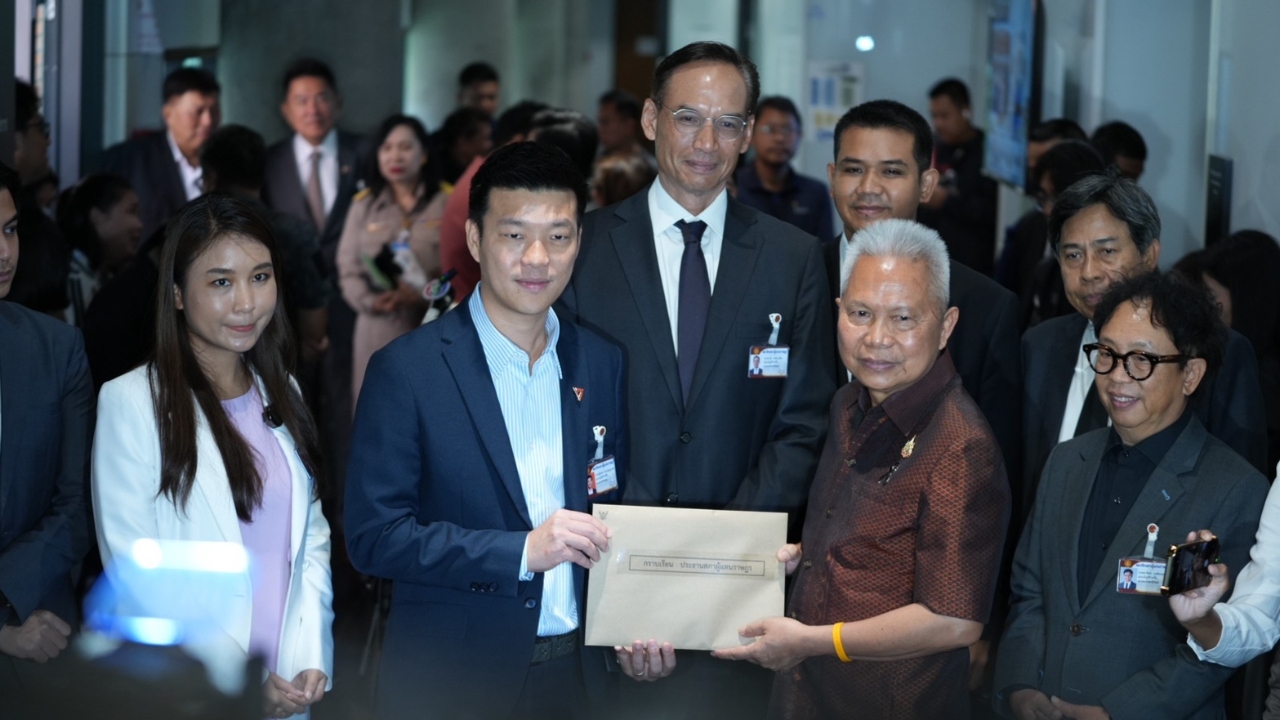
Nattapong, leader of the People’s Party, led the opposition in petitioning the Constitutional Court to push for the establishment of a special committee to investigate the government’s insertion in the 400 billion baht loan decree.
On 11 May 2026 at the Parliament Building, Mr. Nattapong Ruangpanyawut, leader of the People’s Party, together with opposition coalition leaders, submitted a petition to the Speaker of the House under Section 173 of the Constitution, requesting the petition be forwarded to the Constitutional Court. They asked the court to determine whether the issuance of the loan decree empowering the Ministry of Finance to borrow funds to address impacts from the energy crisis and to support the country’s energy transition, totaling 400 billion baht, complies with Section 172, paragraph one of the Constitution.
Mr. Nattapong stated that what he wants the public to examine together is the government’s conduct, questioning whether it has attempted to insert 200 billion baht for the energy transition plan—unrelated to economic security and not urgently necessary—into this loan decree, effectively holding the public’s relief funds hostage.
The petition includes detailed information for the Constitutional Court’s consideration, including that the energy transition plan should be conducted through the annual budget system, requiring several years of continuous implementation. Therefore, issuing a loan decree of this nature is unnecessary and inappropriate.
Mr. Nattapong added that since the loan decree has already been published in the Royal Gazette and is in effect, the petition requests the Constitutional Court to issue a preliminary ruling or order suspending disbursements, especially those related to the non-urgent energy transition. This is to prevent the government from borrowing and spending funds before the court’s decision, which, if the decree is later ruled invalid from the start, could raise questions about how to handle the already spent money and whether it must be recovered.
The opposition coalition carefully crafted the petition because the Constitutional Court has previously faced public scrutiny for rulings perceived as overstepping executive powers, such as suspending the high-speed rail project by arguing that dirt roads should be completed first.
Mr. Nattapong further said that the opposition is simultaneously preparing to propose a motion in Parliament to establish a special committee to monitor the spending under the 400 billion baht loan decree. They hope the government will not vote against setting up this committee, since oversight of the loan spending under this decree involves only a few layers of committee review, unlike the regular budget process which includes multiple requests and parliamentary reviews. If the government has no intention to conceal or misuse funds, there is no reason to oppose the formation of this special committee.