

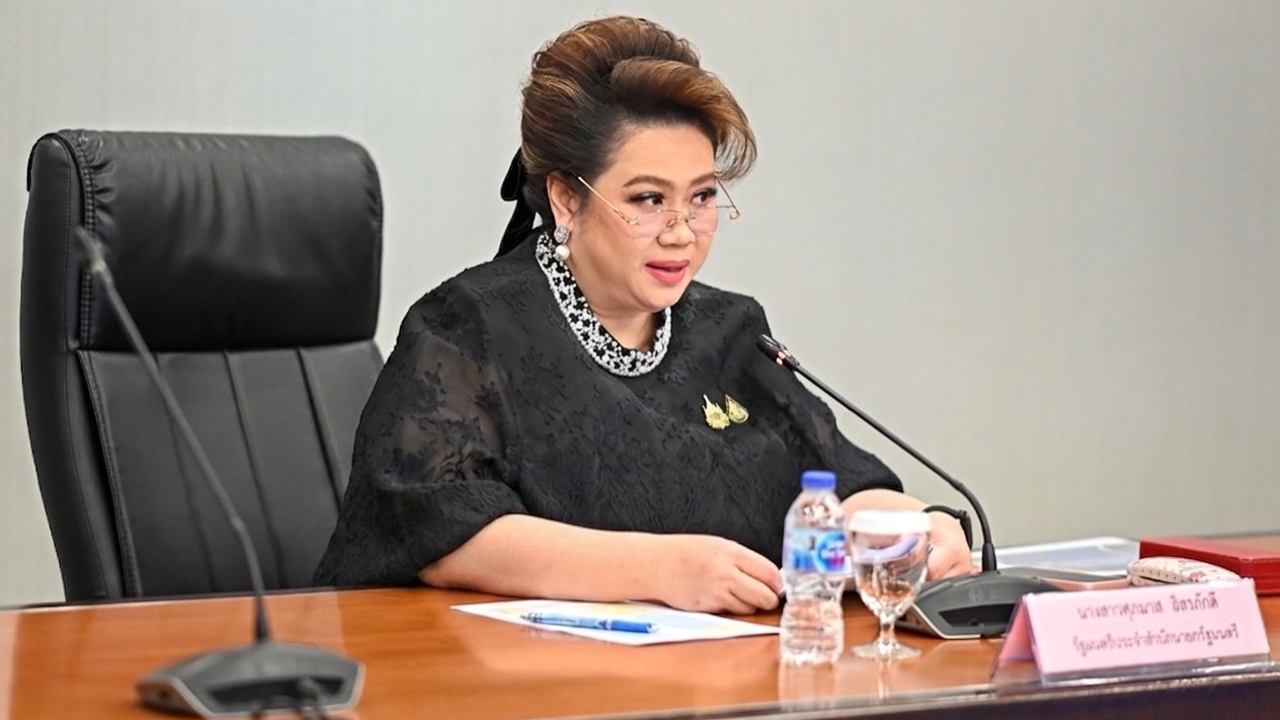
Supamas Isarapakdi has instructed the Office of the Consumer Protection Board (OCPB) to coordinate with manufacturers and importers of every model and brand of electric vehicles to produce complete product labels or e-Books following over 1,000 consumer complaints about defective vehicles, company shutdowns, and lack of repair services.
At 11:00 a.m. on 11 May 2026, Ms. Supamas Isarapakdi, Minister attached to the Prime Minister's Office and supervisor of the Office of the Consumer Protection Board (OCPB), chaired a meeting on consumer protection measures to boost confidence in electric vehicle sales at Meeting Room 301, Government House Building 1. Attendees included Mr. Pradermchai Boonchuayluang, advisor to the Minister attached to the Prime Minister's Office; Dr. Patcharin Samsiripong, Secretary to the Minister; Mr. Ronarak Poolpipat, Secretary-General of the OCPB; Associate Professor Dr. Yupadee Sirisinsuk, Deputy Secretary-General of the Consumer Organizations Council representing the public sector; and electric vehicle business operators from the private sector. The meeting aimed to listen to consumer grievances regarding electric vehicle purchases.
Ms. Supamas stated that she intended to hear from citizens who decided to buy electric vehicles, in line with government policies led by Prime Minister Anutin Charnvirakul encouraging the public to adopt alternative energy amid the energy crisis. However, buyers have faced three major issues: defective vehicles; being abandoned after companies or service centers shut down, leaving no repair options; and rapid price depreciation after purchase. These problems have caused consumer distress and concerns regarding safety, quality, component standards, vehicle assembly, and after-sales service. These issues require urgent consideration to develop clear and fair consumer protection and remedy measures.
"I have been informed by the OCPB that from 2024 to 2026, there have been 556 consumer complaints about electric vehicles filed with the OCPB, plus an additional 792 complaints submitted to the Consumer Organizations Council representing the public, totaling 1,348 complaints. The OCPB has resolved 402 cases, accounting for 72.3%. The five most common problems are defects (47.3%), failure to refund deposits (18.2%), price reductions after purchase (14.7%), failure to deliver promised extras (13.1%), and accidents or delayed repairs (2.9%). These issues should not happen to consumers. Every consumer voice is heard and cannot be ignored. A vehicle is a crucial family asset; consumers deserve fairness, not burdens to bear," she said. Ms. Supamas said.
The OCPB has categorized consumer problems into three main issues: after-sales problems, which are the most frequent at 288 cases (52%); sales process issues at 183 cases (33%); and delivery problems at 85 cases (15%). Public concerns include 329 cases (41.5%) fearing service center closures, 164 cases (20.7%) reporting damaged equipment, 94 cases (11.9%) experiencing long waits for spare parts, and 52 cases (6.6%) unable to return vehicles after company closures. To protect consumer rights, the Consumer Protection Committee has decided to pursue civil lawsuits against businesses to recover damages totaling over 103.1 million baht for consumers.
Electric vehicles are classified as "label-controlled products" under the Consumer Protection Act B.E. 2522 (1979). Businesses must provide accurate and complete product labels that are clearly displayed and legible. Violations carry penalties of imprisonment up to six months, fines up to 100,000 baht, or both.
The meeting resolved to assign the OCPB to produce an e-Book titled "Electric Vehicle Labels" and requested cooperation from manufacturers and importers to submit labels for every electric vehicle model sold in Thailand to the OCPB for compilation. The e-book will present label information for all electric vehicle brands, explain key label content, consumer rights, and how to verify information before purchase, enabling the public to access information conveniently and quickly for comparison before deciding. It will be distributed through all OCPB public relations channels, including websites and applications, and social media pages on various platforms. The OCPB will also monitor advertising and enforce requirements for businesses to prepare reservation contracts in a standard format. Additionally, feedback from the Consumer Organizations Council as the public representative was considered to improve protection for electric vehicle users. Measures include requiring manufacturers and sellers to advertise detailed information on quality, technical specifications, performance, warranty terms, and limitations on key components; setting standard repair timeframes in contracts; ensuring service centers are distributed every 150-200 kilometers; maintaining adequate spare parts; developing recall systems to fix safety-related defects; promoting the Right to Repair so owners can maintain vehicles after warranty expiration; and establishing a specialized complaint coordination center for electric vehicles under cooperation between the OCPB and the Department of Land Transport. A working group comprising all parties will be appointed to further develop consumer protection measures for electric vehicles.
"I thank the Consumer Organizations Council for bringing the voices of the people. I urge all operators to treat customers who buy electric vehicles as family members. Please address problems promptly and fairly, keep sufficient spare parts, maintain widespread service centers, set clear repair timelines, and do not abandon consumers. I will closely monitor this issue to ensure consumers are not left to fight alone. For those considering purchasing electric vehicles, please check product labels, warranty terms, standard repair periods, service center availability, and spare parts readiness. Read reservation contracts thoroughly, keep receipts, reservation forms, brochures, and all advertising documents as evidence. If you are exploited, you can immediately file complaints with the OCPB. I am ready to listen and stand by all consumers," Ms. Supamas concluded. Ms. Supamas concluded.
Consumers harmed by electric vehicle purchases or other goods and services can file complaints via the OCPB hotline at 1166, the OCPB Complaint system, the OCPB Connect application, the website ocpb.go.th, or the "Government Channel" application. Regional and local complaints can also be submitted at Damrongtham Centers located at provincial halls throughout the country.