

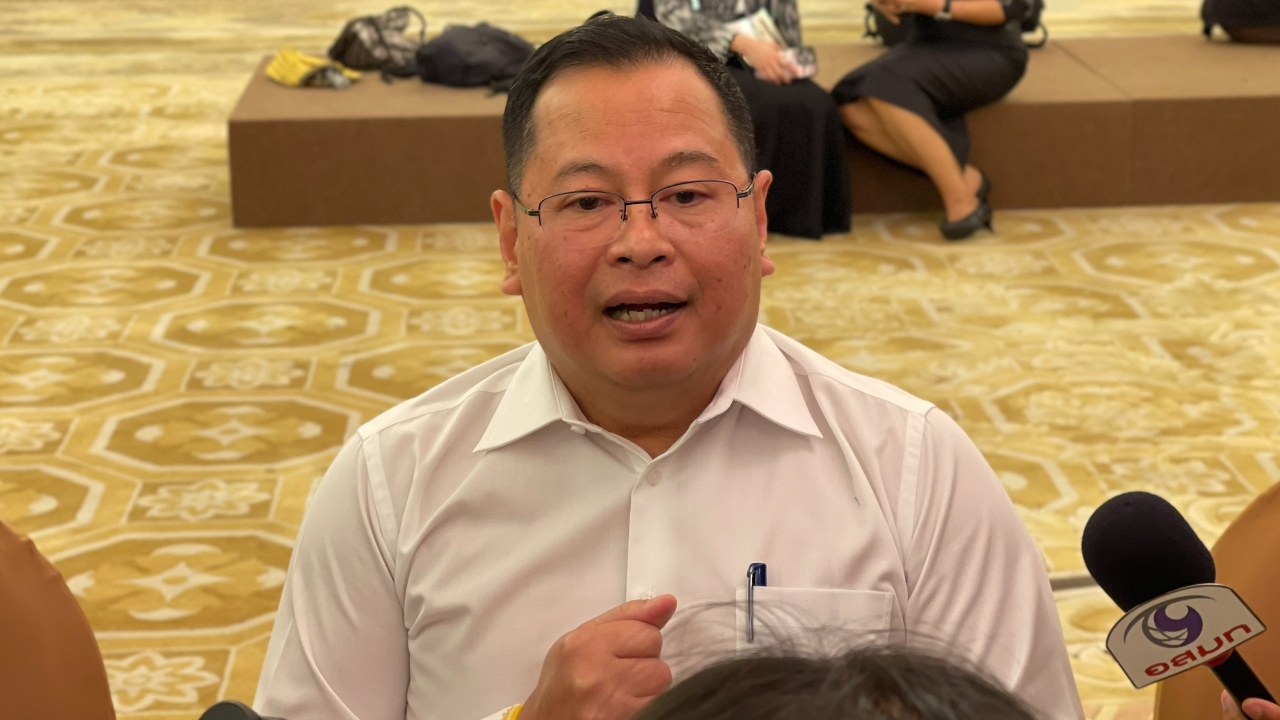
Pakorn is confident the government’s 400 billion baht loan will proceed smoothly. He advised critics to verify whether oversight is accurate and constructive. He declared that the Cabinet would not sign blank checks, as that would lead to imprisonment.
At 9:00 a.m. on 12 May 2026 at the Government House, Pakorn Nilprapunt, Deputy Prime Minister for Legal Affairs, addressed concerns about the opposition’s plan to ask the Constitutional Court to interpret the 400 billion baht loan decree and whether it would affect public problem-solving. He explained that each decree must be carefully considered because if the court rules it invalid, it will have retroactive effect, causing issues with actions already taken. Therefore, the government must ensure the decree truly protects the country’s economic security and is urgently necessary before proceeding. He expressed confidence based on information from the Ministry of Finance, the Budget Bureau, and related agencies that current funds are insufficient and uncertain future developments—such as ongoing war—make this a critical issue.
Pakorn said the law is in effect and projects will continue unless the court orders a suspension. Meanwhile, the government will submit the law to the parliament for further action and approval. He believes the parliament will await the court’s decision within 60 days.
Asked why the government sees no constitutional conflict, Pakorn explained the constitution divides the loan into two parts that can be interchanged. The government is pursuing two simultaneous goals: 1. relief and assistance, and 2. energy transition. These are inseparable and must be implemented together to help the people, including mechanisms and systems development. Therefore, spending is not separated by fund but aligned with these objectives.
Regarding the opposition’s view that the matter lacks urgent necessity and thus violates the constitution, Pakorn discussed constitutional history. He noted that the 1997 constitution required only economic and national security review, not urgent necessity. During that time, loan decrees were issued under governments of Chuan Leekpai and Thaksin Shinawatra, despite questions about urgency. The 2007 constitution added two conditions: economic security and urgent necessity. The government of Abhisit Vejjajiva successfully borrowed once but withdrew a second loan proposal due to urgency concerns.
He continued that during Yingluck Shinawatra’s government, a loan succeeded during the great floods. A second attempt to borrow 2 trillion baht for seven-year infrastructure development faced questions about urgency, sparking political controversy over whether to prioritize rural roads instead. The 2017 constitution reverted to the 1997 principle, focusing only on economic security. Pakorn stressed that urgency is best known to the government and the Ministry of Finance, which he likened to a housekeeper holding the wallet—aware if funds are lacking.
Therefore, under Article 172, paragraph one of the constitution, the key is whether the action serves the country’s economic security, without considering urgency. Pakorn is confident the court will judge within this framework. Regarding urgency, the government would not bypass parliament if not necessary, as failure would force the government to resign, which is normal. All Cabinet members bear responsibility.
When pressed whether the law is legally sound, Pakorn confirmed his view. Responding to opposition claims of issuing blank checks, he asked reporters rhetorically if there were blank checks again, then said, “Where would anyone give a blank check? There is none. I affirm there are no blank checks. The phrase ‘issuing blank checks’ is a misleading term that should not be used. Issuing a blank check risks imprisonment; the government would not do that.”
Pakorn added that detailed project requests must be approved by a screening committee chaired by the Permanent Secretary of the Ministry of Finance.
Asked if the court case should focus on whether funds are spent according to their purpose, Pakorn said the key is to verify if spending matches the stated objectives and whether the outcomes are constructive.