

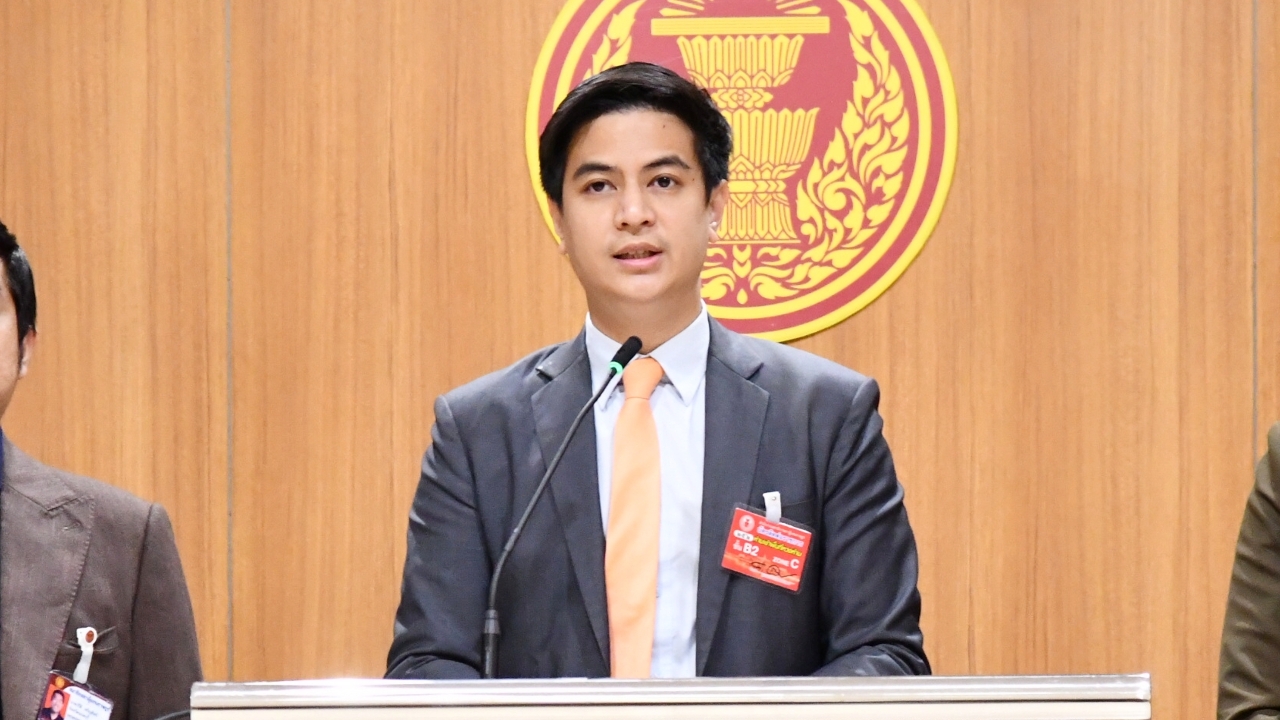
Prits criticizes the government’s two-pronged ‘Parliament Escape Plus’ tactic, emphasizing the concealment of two separate funds within a single emergency decree. He focuses on the 200 billion baht energy transition project, plans to establish a special parliamentary committee to investigate the fund usage, and is preparing to file a no-confidence motion against the government.
At 09:45 on 12 May 2026 at the Parliament, Prits Watcharasindhu, a party-list Member of Parliament from the People’s Party, commented on the opposition’s petition to the Constitutional Court regarding the government’s issuance of an emergency decree (P.R.G.) to borrow 400 billion baht, to compensate for the impacts of the Middle East crisis, saying, “Our petition is clearly and rigorously written, targeting the latter 200 billion baht that the government claims will be used for the energy transition project.
The People’s Party is concerned that the government’s actions lack transparency and evade parliamentary scrutiny. I use the term that it may constitute the phenomenon ‘Parliament Escape Plus.’” This means, Escape number one, refers to the government’s deliberate bundling of two separate funds into one emergency decree, forcing the opposition to respond to both funds simultaneously. In our petition to the Constitutional Court, we clearly separated the two funds. We believe the government’s intent in combining these two funds into one decree is to exploit the public’s hardship, holding the compensation funds hostage while sneaking in the energy project. This avoids parliamentary scrutiny by bypassing the normal budget process.
Prits continued, saying he questions, if what he says is untrue and the government is not trying to hold public compensation funds hostage or sneak in energy projects, why combine the two funds in one decree? Why not include the latter 200 billion baht in the regular budget? If they claim it cannot go through the normal budget process, they could have separated it into another borrowing act. Combining them clearly shows an attempt to evade parliamentary scrutiny by sneaking in extra items.
, Escape number two, must be given fair consideration as it has not yet occurred but raises concerns. On 14 May 2026, the People’s Party will submit a motion to establish a special parliamentary committee to monitor and audit the spending under this borrowing emergency decree. Although the petition is before the Constitutional Court, the decree is already in effect, and the government insists on proceeding with spending. Since the spending is imminent, it is appropriate for Parliament to have a special committee to oversee transparency, similar to the special committee established for COVID-19 borrowing. Therefore, while the court petition may delay the decree’s approval vote, once spending begins, there is no reason Parliament should not set up a committee to audit it. We hope government MPs will cooperate and not use their majority to block oversight.
When asked about Krawee Prisananantakul, an Ang Thong MP from the Bhumjaithai Party, who said he would welcome the opposition’s motion and whether the opposition would submit the motion on 13 May, Prits responded that the motion is ready. If the government is ready, we can submit it verbally. If government MPs and whip teams agree, it can be established on 14 May. The opposition already has mechanisms to delay, such as budget oversight in July. But now we focus on immediate scrutiny of the borrowing decree and have noted several irregularities by the government.
However, when asked if the opposition would file a no-confidence motion once leadership procedures are complete, Prits said the opposition can act immediately. The timing depends on constitutional limits, such as Article 151 permitting only one no-confidence motion per year. We have time from now until March 2027 to use it. The opposition leader must discuss with coalition partners first.