

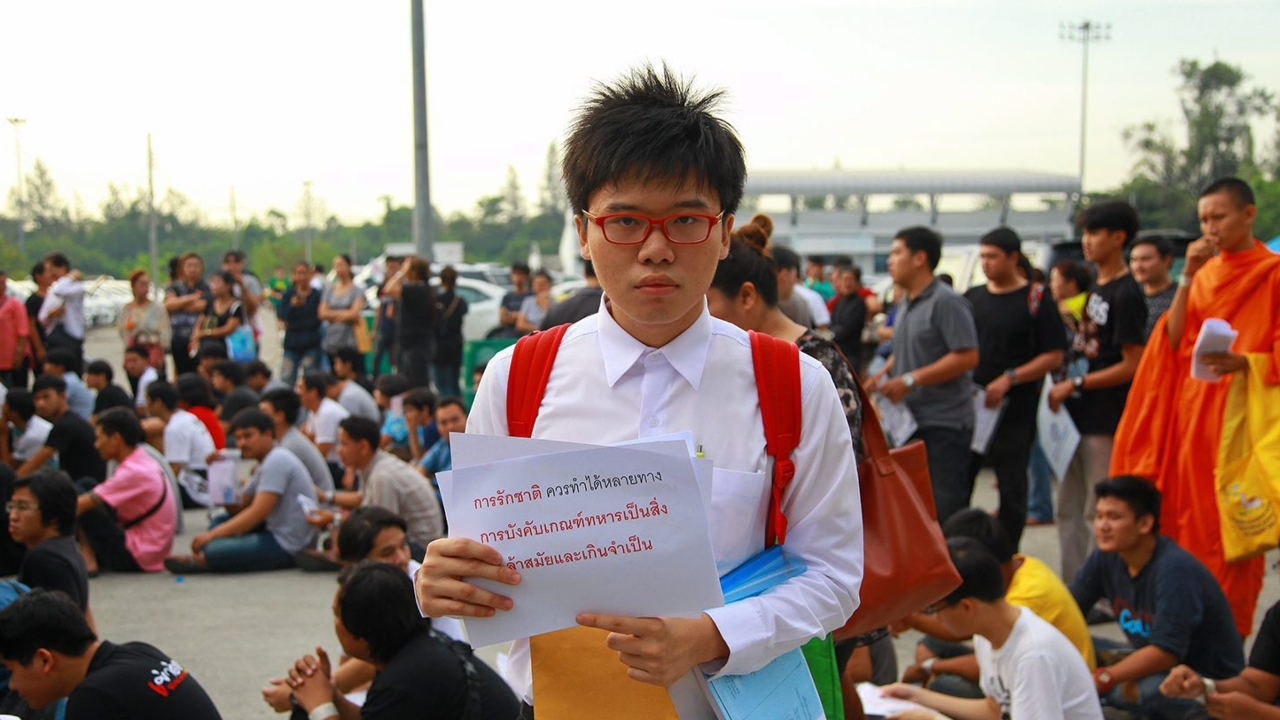
The Constitutional Court unanimously ruled that the Military Service Act does not violate the Constitution after Netiwit submitted objections citing Section 45, which prescribes imprisonment up to three years for anyone who avoids or resists military conscription.
On 12 May 2026 at the Constitutional Court, the panel of judges unanimously ruled that Sections 27 and 45 of the Military Service Act 2024 do not conflict with Articles 26 (paragraph one) and 31 of the Constitution. This ruling followed from a petition filed by Netiwit Chotiphatphaisal.
The Samut Prakan Provincial Court forwarded the objections of Netiwit Chotiphatphaisal, a political activist and defendant in case number A.3118/2568, who was prosecuted for evading military conscription under Section 45 of the Military Service Act 1954. On 5 April 2024, Netiwit went to the military conscription office at Bang Pu Municipality, Samut Prakan Province, where he read a statement of civil disobedience refusing to participate in conscription, arguing that it violated human rights principles and was a discriminatory system that failed to ensure equality. He stated that all Thai citizens should have the freedom to choose whether to serve in the military without coercion.
The Samut Prakan Provincial Court completed the witness examination on 11 September 2025, and on the same day, Netiwit filed a petition requesting the court to send his case to the Constitutional Court to determine whether Sections 27 and 45 of the Military Service Act, concerning the call-up of Thai men aged 18 and over for military selection and penalties for non-compliance, violate the Constitution.
Sections 27 and 45 of the Military Service Act 2024, which the Constitutional Court ruled do not conflict with Articles 26 (paragraph one) and 31 of the Constitution, state that Section 27 requires conscripts called to undergo selection to present their conscription certificate, ID card, and educational certificates. Failure to appear, refusal to undergo selection, or leaving before completion is deemed evasion or resistance, except in certain specified cases.
(1) Government officials ordered by their superiors for urgent important official duties or foreign missions as ordered by the minister.
(2) Students studying abroad under conditions specified by ministerial regulations.
(3) Government officials or workers in government agencies or factories during times of war or military operations under the control of the Ministry of Defense.
(4) Persons performing duties alongside military units in the field.
(5) Cases of force majeure.
(6) Those who attend military selection at another location.
(7) Those who are ill and unable to attend, with a credible adult notifying the selection committee on the selection day.
Cases (1) through (4) require special exemption granted by the Minister of Interior or an authorized delegate.
Section 45 states that anyone who evades or resists the military selection committee’s conscription process, refuses to undergo selection, leaves before completion, or tries to avoid conscription by any means, or who serves in the military in place of another, or offers or accepts money or other benefits to avoid conscription, shall be punished by imprisonment of up to three years.