

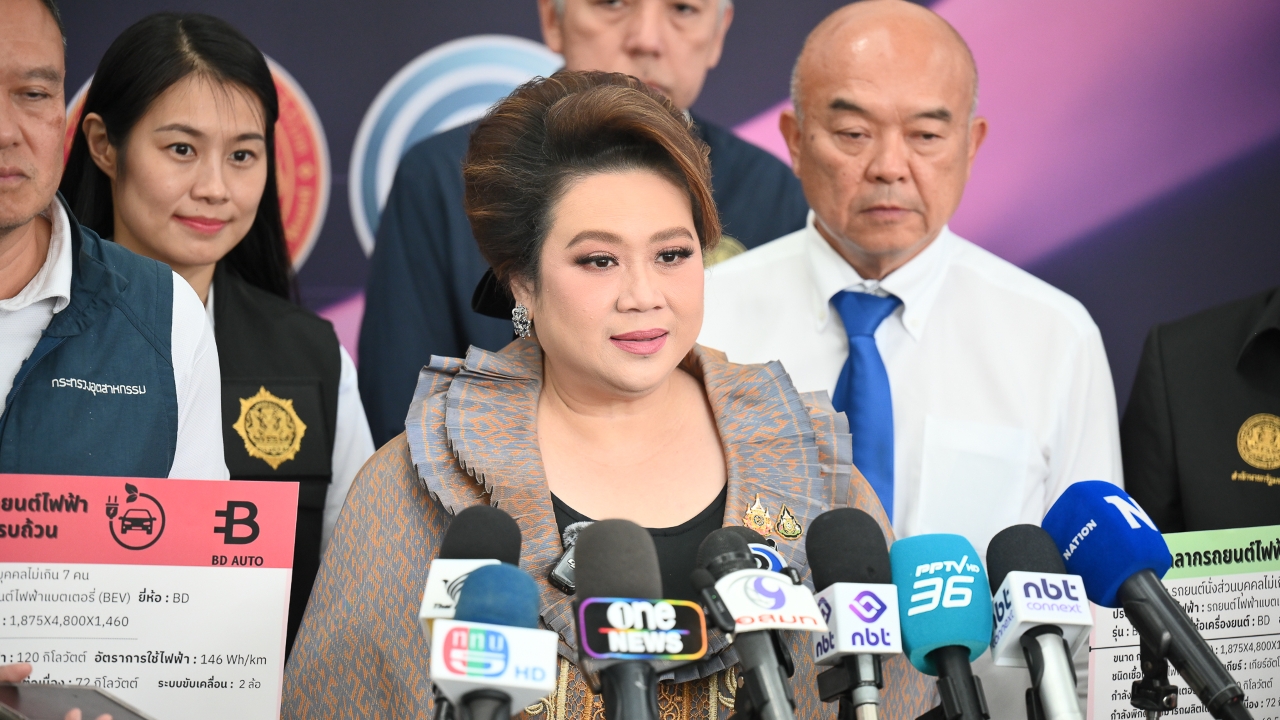
“Supamas” inspects EV showrooms enforcing mandatory labeling, specifying clear mileage test standards to prevent consumer disappointment in real use. Violators face up to 6 months imprisonment, a 100,000 baht fine, or both.
On the afternoon of 12 May 2026 GMT+7, Ms. Supamas Isarapakdi, Minister attached to the Prime Minister's Office and overseer of the Office of the Consumer Protection Board (OCPB), led a team to conduct on-site inspections of the display of electric vehicle labels at the BYD Hi-Class showroom, Lat Phrao branch, followed by the OMODA & JAECOO showroom, Lat Phrao branch. Accompanying her were Mr. Pradermchai Boonchuailue, Advisor to the Minister attached to the Prime Minister's Office; Dr. Patcharin Samsiripong, Secretary to the Minister; Mr. Ronarong Poolpipat, Secretary-General of the Consumer Protection Board; representatives from the Industrial Product Standards Office; and representatives from the Consumer Organizations Council as public representatives. The group aimed to urge operators to strictly comply with product labeling laws to build consumer confidence when purchasing electric vehicles.
Ms. Supamas said today's inspection was a direct follow-up after yesterday's (11 May 2026 GMT+7) meeting where she invited EV operators and consumer organizations to jointly discuss and urgently resolve three key consumer issues: “defects, abandonment, and steep price drops,” with over 1,348 complaints recorded. She personally inspected the “electric vehicle labels” immediately because labels are the primary and most important tool consumers use to verify information before buying. This aligns with government policy led by Mr. Anutin Charnvirakul, Prime Minister and Minister of Interior, who emphasizes consumer protection alongside supporting the growth of Thailand’s EV industry, aiming for a responsible, standardized, and fair EV market for consumers.

“I have instructed operators to comply with three key consumer protection laws. First, electric vehicles are controlled-label products. Operators must clearly display complete label information on the vehicle itself, including product name, model, trademark, manufacturer or importer, technical details, battery information, performance, driving range, usage instructions, safety warnings, price, and warranty conditions.
Second, regarding advertising—especially the “driving range per full charge,” which is critical for purchasing decisions—sellers must clearly state the testing standard referenced, whether EPA, WLTP, NEDC, or CLTC, along with test conditions such as average speed, temperature, route conditions, and driving style. Additionally, any promotions, benefits, or battery warranty terms must specify criteria, methods, conditions, and exact start and end dates clearly.
Third, the new car sales business is contract-controlled. Operators must use the standard vehicle reservation contract defined by the OCPB, specifying type, brand, model, production year, price, delivery date, and cancellation rights completely. From today’s inspection, operators generally cooperated well and complied with the law.”
Electric vehicles are controlled-label products under the Label Control Committee’s announcement declaring cars and EVs as label-controlled goods, published in the Government Gazette on 22 September 2025 GMT+7. This is enforced under the Consumer Protection Act B.E. 2522 (1979 CE), requiring businesses to display accurate, complete, and clearly visible labels on vehicles. Violations carry penalties of imprisonment up to 6 months, fines up to 100,000 baht, or both, according to Section 52 of the Consumer Protection Act B.E. 2522.

“I urge all EV operators that product labels are not just stickers but promises to consumers. Please ensure label information is complete, accurate, and not exaggerated—especially the driving range per charge. Clearly specify the test standard used so consumers are not disappointed when using the vehicle. For consumers considering buying EVs, use labels as a tool to verify all information before purchase. Read labels thoroughly, inquire about mileage test standards, carefully review reservation contracts, and keep receipts, booking slips, brochures, and all advertising documents as evidence. If labels are incomplete, information is inaccurate, or consumers are exploited, report immediately to the OCPB. I am ready to listen and stand by every consumer.”
Consumers harmed by EV purchases or other goods and services can file complaints via the OCPB hotline 1166, the OCPB Complaint system, the OCPB Connect application, the website ocpb.go.th, or the “Government Way” application. In regional and local areas, complaints can be submitted at the Damrongtham centers located at every provincial hall.
