

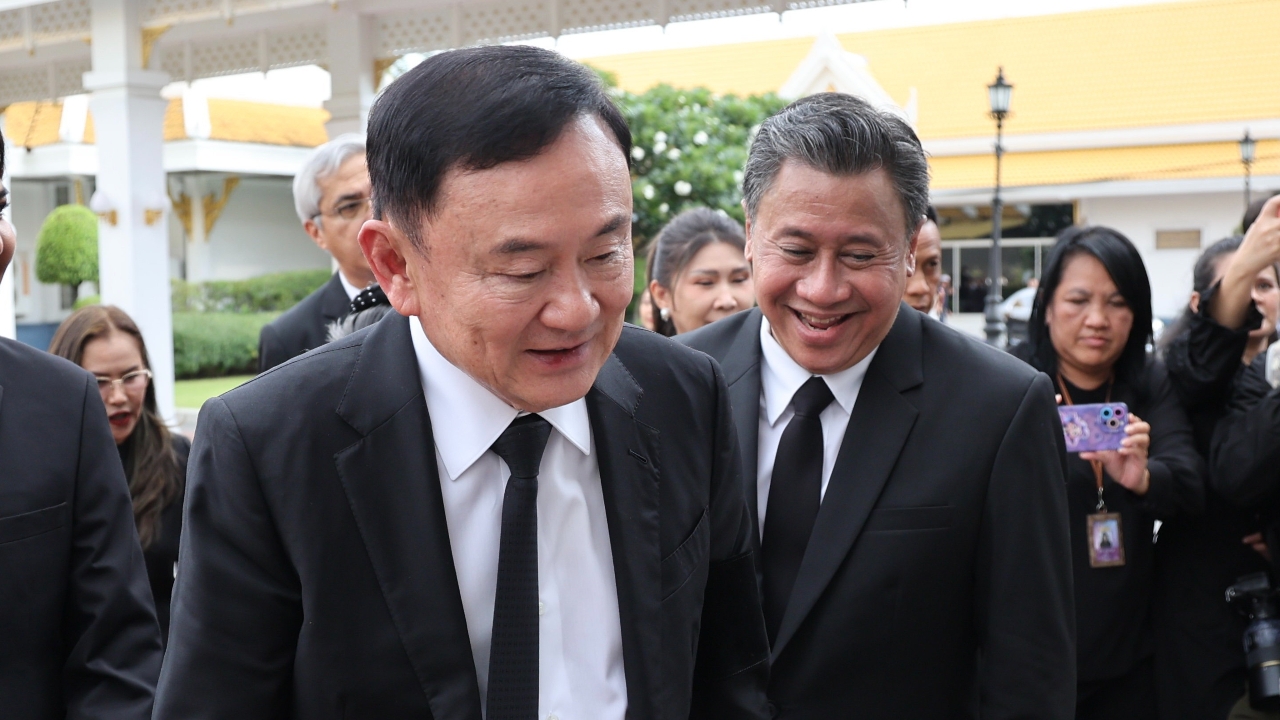
Chakraphob Penkhae points out that Thaksin Shinawatra has learned hard life lessons from events over the past several years. He views the country's future as more important than personal grudges, believes Thaksin still has a role to play, but will not pursue politics in the same way as before, and stresses that he is a capable individual.
12 May 2026 GMT+7 Mr. Chakraphob Penkhae, former Minister attached to the Prime Minister's Office, revealed after Mr. Thaksin Shinawatra, former Prime Minister, was granted parole that he personally felt pleased and believes Thaksin has learned hard life lessons from the events over the past several years. He sees that Thaksin will continue to have a role in the country but probably will not engage in politics in the same old style.
Chakraphob added that from observing Thaksin’s facial expressions and demeanor, it is clear he is aware of the severity of what he has endured. Yet, with a determined personality, no matter what happens in business, politics, or family, he can always move forward. The strength is not the issue; rather, it depends on what Thaksin chooses to do next.
“Regarding health and contributing to the country, even if it is not directly through politics, I think he will definitely continue. Personally, Thaksin has been very kind to me, but I have not rushed to meet him yet because I want to wait until he is ready. If we do talk, I want to discuss not personal matters but the political direction and the country’s future.”
Regarding Thaksin’s phrase “went into hibernation,” Chakraphob explained that the word “hibernation” may mean “normalcy,” as his life had been full of instability and upheaval. Although no one wants to be in prison, that time might have given him a chance to reflect, meet people he wanted to see, and gather new information from recent years, which is important for future decisions.

, Chakraphob also sees that Thaksin deeply loves the country. Looking at Thailand today—economy, trade, security, even population issues—the country is not at the level it should be for global competition. Thaksin likely has to consider how he can contribute to the nation. He does not want this to be seen as an excuse to return to politics, but it is impossible for someone like Thaksin to stop thinking about the country. By nature, when he sees problems, he wants to solve them and find solutions. However, some parties in the past may have wanted Thaksin to accept the status quo and stop political movements. Part of Thailand’s political issues stem from misinterpretation and a patronage culture where confident people may be seen as rigid or ready to fight, even though that may not be true.
When asked about Thaksin’s role in the Pheu Thai Party as a coalition partner, Chakraphob said Thaksin is skilled at assessing and positioning people according to circumstances. He gave the example that when asked why Thaksin chose Paethongtarn Shinawatra as prime minister candidate, Thaksin simply said, “She is tough enough.” He did not specify in what area she was skilled. Therefore, in some situations, people must be chosen according to the needs of the moment—sometimes a strong hammer is needed to strike, but if too hard, it may not suit the situation. However, Chakraphob believes Thaksin’s future role will be more about quietly using his experience and skills in placing people rather than taking the forefront as in the past.
Regarding conflicts between the Pheu Thai Party and Bhumjaithai Party, as well as relationships with Anutin Charnvirakul and Newin Chidchob, Chakraphob believes there is unlikely to be any revenge because Thaksin is not a vengeful person. He tries to balance things back to where they should be. He acknowledges that in the past, Thaksin may have been too direct or neglectful in explaining to those who disagreed, which increased political enemies.

Chakraphob also observed that Thailand has lost more than 20 years to political conflicts while the world rapidly changes. Many domestic problems remain unresolved, such as waste management, water infrastructure, and agriculture-food systems. Thailand should be leading ASEAN by now, instead of wasting time on internal conflicts and having to explain its relationships with neighboring countries. It has caused Thailand to appear immature internationally, losing much of its stature over the past 25 years.
In closing, Chakraphob emphasized that Thaksin still has international-level capabilities, as he can communicate with many world leaders, past and present. If this potential is used properly, it will benefit the country more than worrying about Thaksin’s political role. “All parties should use this moment to reconsider their roles—not only Thaksin but all groups in society—because the world and circumstances have changed. Clinging to the same characters in the same roles may cause the country to stagnate. Today, anything that moves the country forward is welcome, even if differences remain, we must find ways to coexist. If the country remains stuck in old conflicts, we will weaken in an increasingly competitive world.”