

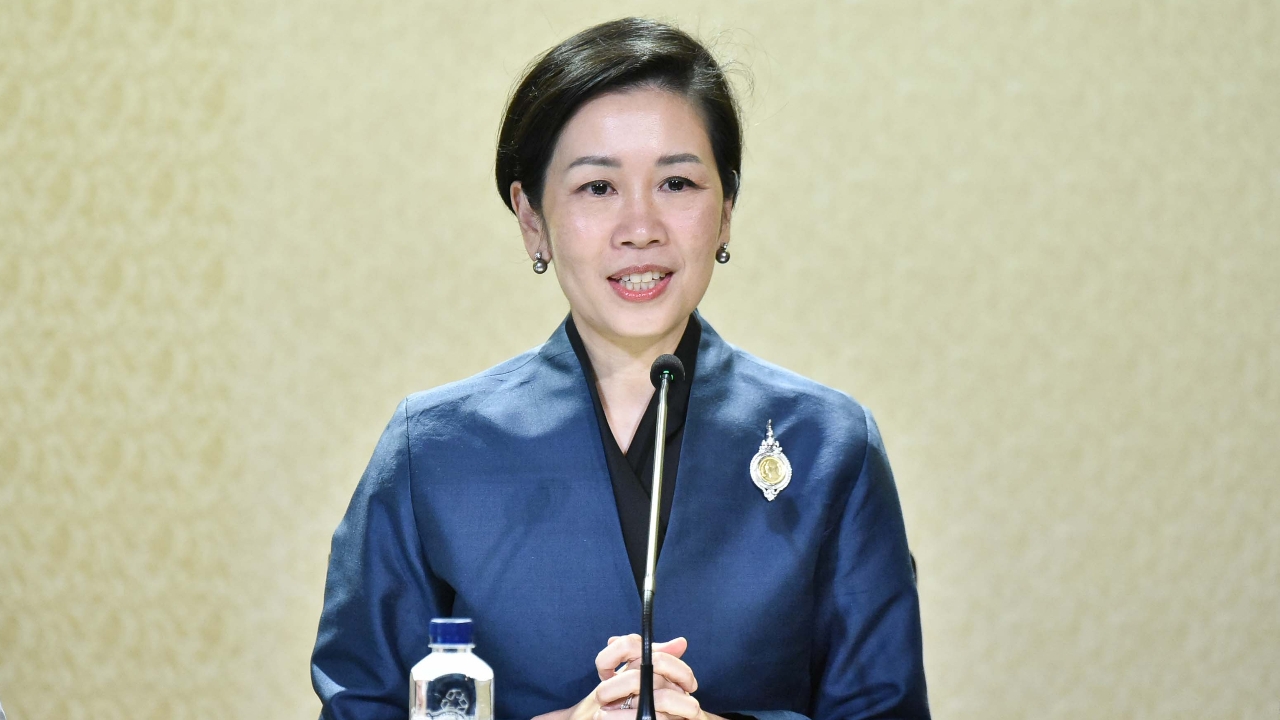
The government spokesperson revealed that the government is collaborating with the private sector to revive the Joint Public-Private Committee (กรอ.) mechanism to enhance the country's competitiveness and solve comprehensive economic challenges in finance, infrastructure, and law, while also discussing the management of over 200,000 Cambodian workers.
On 13 May 2026 GMT+7, Ms. Ratchada Thanadirek, spokesperson for the Office of the Prime Minister, stated that the meeting on 12 May 2026 GMT+7 between Prime Minister and Minister of Interior Anutin Charnvirakul, along with ministers responsible for legal and economic affairs, and executives of the Federation of Thai Industries (FTI), marked a significant starting point for close cooperation between the government and private sector to restore the country's competitiveness in line with the Prime Minister's policy.
Ms. Ratchada said the Prime Minister listened comprehensively to proposals from the industrial sector covering issues such as production costs, SME access to financing, infrastructure, logistics systems, clean energy, legal adjustments to support business, and labor problems. He emphasized that the government must shift its role from regulator to supporter and facilitator so that the private sector can fully realize its potential.
The Prime Minister agreed to revive the Joint Public-Private Committee (กรอ.) mechanism by inviting three key economic institutions—the Federation of Thai Industries, the Thai Chamber of Commerce, and the Thai Bankers' Association—to participate regularly as a platform to highlight problems, propose solutions, and drive effective economic policies, recalling past successful state-private cooperation that was crucial to the development of the Eastern Economic Corridor.
Ms. Ratchada stated that the Prime Minister is concerned about SMEs facing liquidity issues, non-performing loans (NPLs), and some falling into informal debt. The government will consider unlocking mechanisms to reintegrate these entrepreneurs into the formal economy as much as possible, alongside developing their capacity to produce competitive products. Additionally, it will promote public procurement through the Made in Thailand (MiT) policy to generate orders for Thai goods, helping SMEs increase income, secure guarantees, and gain easier access to bank loans.
Regarding infrastructure development to support private sector efficiency, the Prime Minister prioritizes addressing various missing links, not only building transportation routes but also establishing continuous industrial bases, logistics, and agricultural and food product exports to restore Thailand as a regional production and trade hub.
Ms. Ratchada noted another important issue is labor. The FTI proposed joint discussions between the Ministry of Labor and the private sector to design proper systems for registration, control, and utilization of foreign workers, especially the over 200,000 Cambodian workers currently outside the system. Since workers from each nationality possess different skills and expertise, the industrial sector seeks a labor management system aligned with actual production needs.
The Ministry of Labor has taken the proposal to work further with the private sector, aiming to organize the workforce properly and clearly in terms of security, labor protection, welfare, and production continuity, while also preventing intergovernmental issues from affecting citizens and businesses that rely on this essential labor group.
“The Prime Minister views this meeting with the FTI not merely as a hearing of proposals but as establishing a systematic working mechanism. The government will move forward to resolve issues concerning infrastructure, finance, law, energy, and labor so that the private sector can compete effectively, people can have jobs, and Thailand can regain its high potential position in the region,” she concluded.