

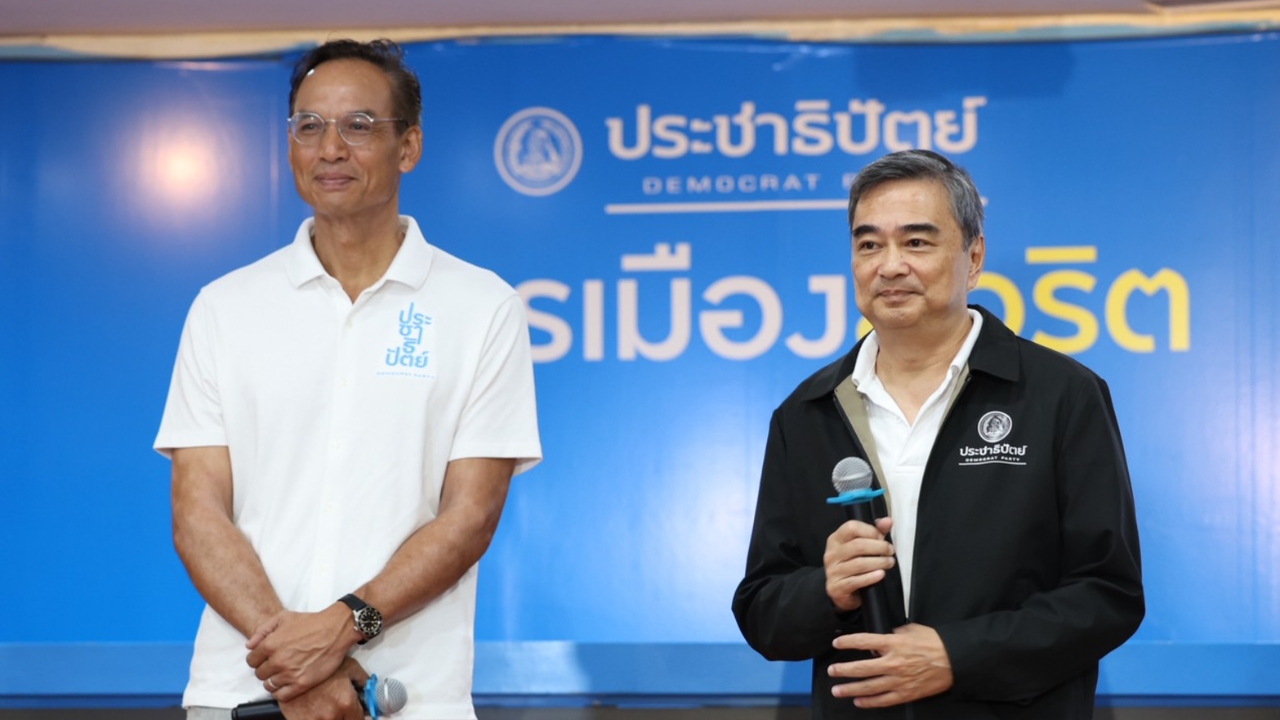
Abhisit warned Anutin's government that issuing a 400 billion baht loan decree risks entrapping the nation. He urged the swift passage of a budget transfer law to address issues more appropriately. Korn criticized oil refineries for profiting excessively and worsening public hardship, calling for a windfall tax.
At 10:00 a.m. on 13 May 2026, Mr. Abhisit Vejjajiva, party-list MP and leader of the Democrat Party, held a press conference at the Democrat Party office. He cautioned the government regarding the rushed issuance of a royal decree authorizing the Ministry of Finance to borrow 400 billion baht to address the energy crisis and facilitate the country's energy transition in 2026. The Democrat Party opposed this loan decree, believing there are better ways to assist the public.
He noted that while others have borrowed in similar situations, Thailand's current economic conditions show GDP growth of 1.5%, an industrial index increase of 0.8% in March, and Moody's improving its credit outlook. The Bank of Thailand reported that one month after the Middle East war, there is no sign of economic instability.
He explained that just because others borrowed doesn't mean the situations are identical. He used the analogy of rain varying in intensity to illustrate that one should not apply the same measures indiscriminately. Regarding the deputy prime minister's statement about the government's discretion under the constitution, he stressed that the government must exercise this discretion honestly and constitutionally, respecting fiscal discipline. If violated, the opposition is prepared to scrutinize and use constitutional mechanisms.

On the borrowing and government plans, the Democrat Party sees the loan decree as economically unstable and worsening risks. For example, using 200 billion baht for a 'Half-Half' subsidy within four months raises questions: if the budget is exhausted but crises persist, such as rising inflation and prices, what then? The government would have exhausted its tools, increasing economic insecurity by pressuring consumer prices.
With public debt nearing its ceiling due to rapid spending, the question arises: what will the government do if it hits the debt limit? The Democrat Party believes there are alternatives without issuing the loan decree: 1. Reducing or exempting excise tax on oil, lowering diesel prices to 33 baht per liter. This tackles production cost root issues, benefiting not just vehicle users but also consumers affected by transportation and product costs. Using this method for four months would reduce oil prices while costing only a third of what the government plans to borrow, importantly lowering prices.
2. Imposing a windfall tax on oil refineries could reduce oil prices to 30 baht per liter, increase government revenue, and strengthen economic stability. Meanwhile, the government's plan to spend 200 billion baht supporting electric vehicles and solar roofs is expected to add limited value to Thailand, as it still relies heavily on imported technology.
3. The party recommends supporting the energy transition by promoting biodiesel blends B20 and B50, increasing the use of palm oil in biodiesel. Investment should also support vehicle operators to adjust engines for B20 and B50 compatibility, reducing diesel dependence and boosting palm farmers' incomes.
4. Passing a budget transfer law to release stalled funds could provide financial support for the state welfare card, a proposal the party agrees with. The Democrat Party understands the public's hardship but insists that solutions must be legal, constitutional, and economically sound without borrowing that risks national economic stability or serving political interests that evade parliamentary scrutiny.

When asked about the government's apparent disregard for opposition to the 400 billion baht loan decree, Abhisit said the government has already approved and enacted the law, so disputes must follow legal processes. However, if the government listens and chooses not to borrow despite having the legal authority, instead adopting proposals to reduce oil prices, impose windfall taxes, lower consumer prices, manage welfare card funds prudently, and pass the budget transfer law, it would benefit everyone—especially the public—by addressing root causes without indebting future generations or requiring symbolic acts from the prime minister.
Meanwhile, Mr. Korn Chatikavanij, deputy leader of the Democrat Party, commented on Thai Oil's first-quarter 2026 performance, highlighting that, as he has consistently said, refineries enjoy windfall profits from high oil prices—an obvious government failure in management.
1. The government allowed oil stockpiling before the war without monitoring inventories. After the war, it permitted oil companies to sell to the public at elevated post-war prices.
2. Refining margins increased significantly to 16-17 baht per liter.
3. These higher refining margins boosted refinery profits. In Q1 2026, Thai Oil earned 19.481 billion baht—4.5 times higher than Q1 2025 and about 30% higher than its full-year 2025 profit. This clearly shows abnormal profits from selling oil at higher prices, reflecting the public's suffering from high energy costs.

Korn said the government's loan decree cites high energy costs as the main economic problem, but beyond rising global oil prices, two major causes of excessive energy costs are: 1. Lack of government oversight on oil pricing methods. The government appointed a pricing committee chaired by Deputy Prime Minister and Finance Minister Ekniti Nitithanprapas to study fairer pricing methods, but the current formula still relies on the Singapore benchmark unchanged, causing unnecessarily high oil costs.
2. The government could easily reduce energy costs by lowering or exempting oil excise taxes, which contribute significantly to high oil prices. Instead, the government used this as an excuse for the loan decree, failing to do what should be done. This neglect forced higher energy prices, then justified borrowing to compensate the public—measures that would have been unnecessary if the government had followed the Democrat Party's longstanding recommendations.