

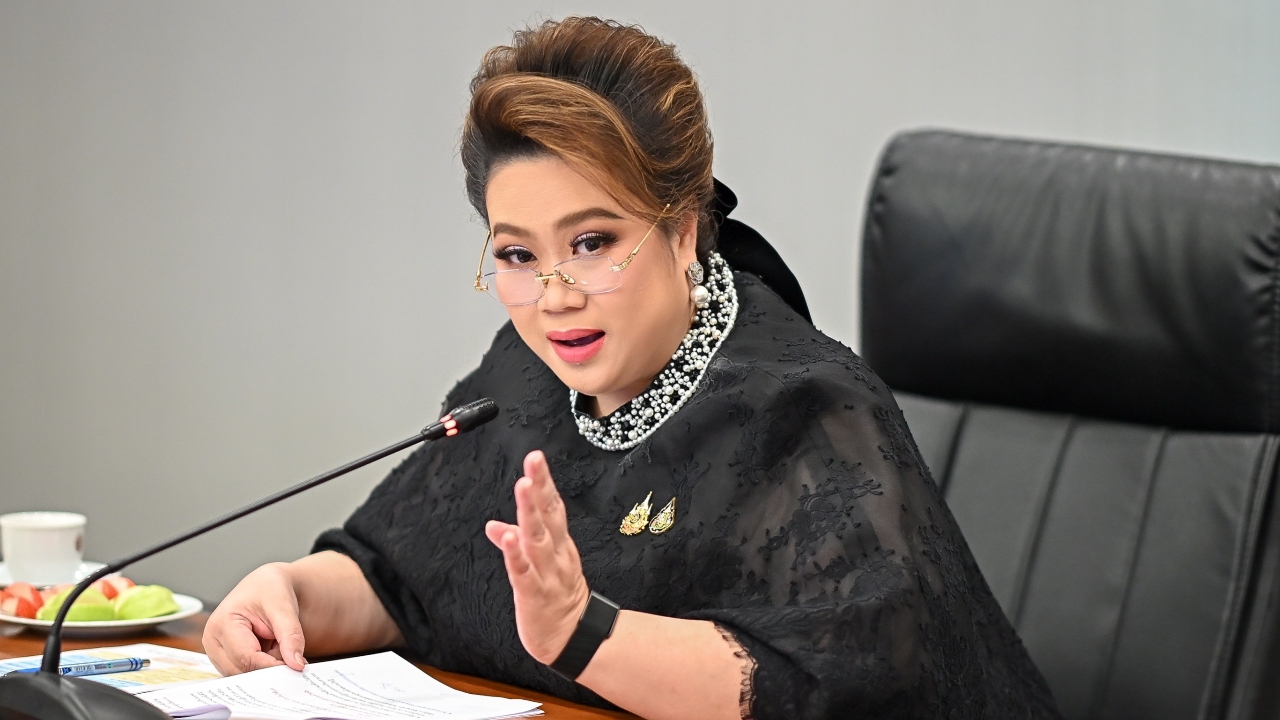
Supamas has ordered the Office of the Consumer Protection Board (OCPB) to urgently investigate reports of substandard solar panel installations that risk fires and have caused losses exceeding 500,000 baht. She warned the public to check product labels and TIS marks before deciding to purchase.
On 14 May 2026, Ms. Supamas Isarapakdi, Minister attached to the Prime Minister’s Office and overseer of the Office of the Consumer Protection Board (OCPB), revealed that following reports of providers installing substandard solar panel systems—resulting in equipment melting, burning smells, fire risks, and no reduction in electricity bills, causing consumer losses over 500,000 baht—she ordered Mr. Ronarong Poonpipat, Secretary-General of the OCPB, to urgently verify the facts. He was also instructed to inspect labeling on solar equipment—including solar panels, inverters, and batteries—sold nationwide.

Ms. Supamas stated that labels are the primary tool consumers use to verify information before purchasing, especially for electrical equipment that directly impacts public safety and property. Solar panels, inverters, and batteries are products requiring labels under Section 30 of the Consumer Protection Act of 1979. Businesses must display accurate and complete labels. Violations incur penalties under Section 52: sellers face up to six months imprisonment or fines up to 100,000 baht, or both; manufacturers or importers face up to one year imprisonment or fines up to 200,000 baht, or both. This aligns with government policy emphasized by Prime Minister Anutin Charnvirakul for all consumer protection agencies to act proactively.

Regarding the complaint, it was found that installers used substandard equipment, altered the electrical system from three-phase to single-phase, and replaced copper wiring with aluminum wiring, causing voltage drops, blackouts, equipment melting, and fire risks. The victim has filed a criminal complaint, case number 743/2568, at Thapra Metropolitan Police Station. Investigators have completed the case file and forwarded the suspect to the public prosecutor.
Ms. Supamas added that today the OCPB contacted the complainant by phone to gather additional facts. Initially, it was found that the business used online channels to offer installation services and contracts lacked detailed equipment specifications, creating a loophole preventing consumers from verifying equipment standards before installation. The OCPB has scheduled a further fact-finding interview with the complainant on 15 May 2026 to consider legal action against the business. Additionally, the OCPB will consider upgrading solar panel installation businesses to “contract-controlled businesses” and solar equipment to “label-controlled products” specifically. Cooperation will be sought with the Industrial Product Standards Office (IPSO), Metropolitan Electricity Authority (MEA), Provincial Electricity Authority (PEA), Energy Regulatory Commission (ERC), Engineering Council, and Consumer Organizations Council to comprehensively protect consumers.

“I urge the public planning to install solar panels to check all equipment labels before purchasing: look for the manufacturer’s name, importer, origin, TIS mark, and keep all contracts as evidence to claim rights if problems arise. Do not be misled by unusually low prices or online advertisements without certification, as this risks losing money, property, and personal safety. For businesses, if the OCPB finds products without labels, incorrect labels, or false label claims, strict legal action will be taken,” she said.
Consumers experiencing problems from unfair goods or services can file complaints via the OCPB hotline at 1166, the OCPB Connect application, the website www.ocpb.go.th, or the Damrongtham Centers in every province.