

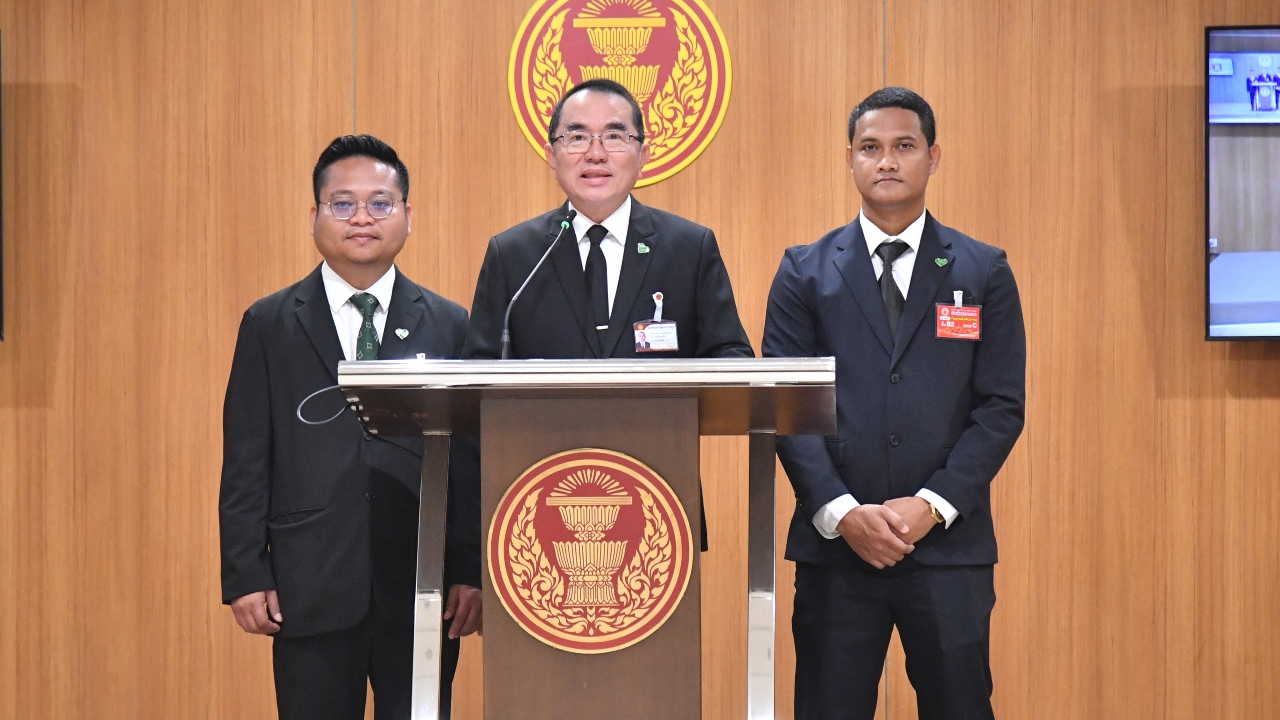
Dr. Warong from the Thai Pakdee Party questions the four energy transition projects under the 400-billion-baht loan decree, asking whether the benefits go to the public or investors. He points out no urgent need and fears that citing clean energy serves investor interests.
At 10:00 a.m. on 14 May 2026, in the press room on the first floor of the Parliament building, Dr. Warong Dejkitvigrom, MP of the Thai Pakdee Party, held a press conference regarding the Royal Decree empowering the Ministry of Finance to borrow money to address the energy crisis and advance the country’s energy transition for 2026, with a budget of 400 billion baht. He explained that this loan is divided into two parts: the first 200 billion baht is to assist citizens, farmers, and entrepreneurs; the second 200 billion baht is for transitioning to clean and renewable energy. He emphasized that he has no objections to the first portion intended to aid the people.
However, he intends to monitor whether the government's policy proves worthwhile. He expressed particular concern about the second 200-billion-baht loan portion for energy transition, which, according to the government, includes only four projects: 1. Installing Solar Rooftops on government agency buildings; 2. Replacing government vehicles with electric vehicles (EVs); 3. Installing EV charging stations for agencies using electric vehicles; and 4. Developing public skills and innovation to support the new economy.
He questioned the government and agencies about what benefits the public will receive beyond skills development, which he sees as non-urgent. Given Thailand’s commitment to achieving net-zero greenhouse gas emissions by 2050—24 years away—he asked why there is a rush to transition energy within one year. This raises suspicion that the loan projects might favor investors rather than the public, who would be left to repay the debt. He urged the government to fully disclose all plans to the public, as current projects do not reflect worthwhile justification for urgently borrowing funds via this decree, seeming to benefit investors more than stimulating the economy or aiding citizens.
He stated that the government is being influenced by a group of investors, resulting in a clean energy approach focused mainly on solar power, which is limited by only five hours of daily electricity production and requires imported equipment. Meanwhile, Thailand, an agricultural country, can utilize alternative energy from energy crops and biogas without relying on imports. This is Thailand’s greatest strength for self-reliance. If the government allows energy crops and biogas to participate in national development, it could sustainably lead the country to carbon neutrality.