

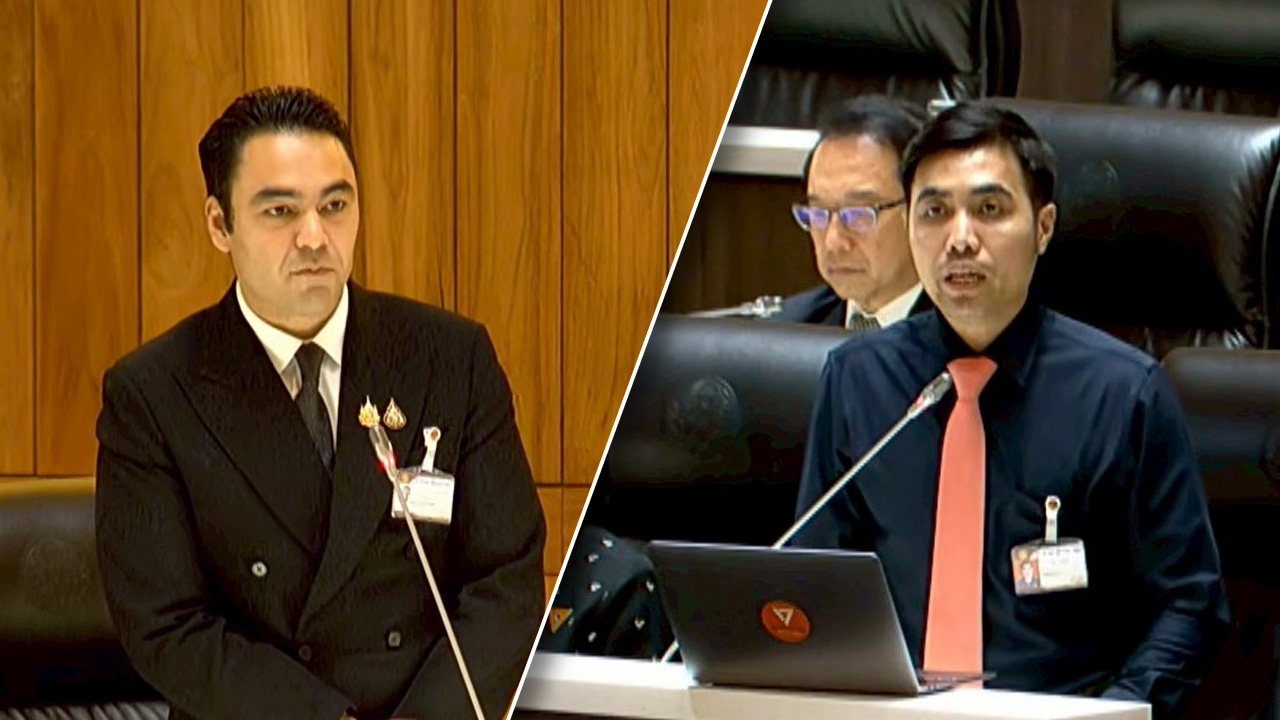
Piyarat criticized the government for intelligence failure in the Ming Chen Sun case and urged investigation into involved officials and the underlying background. Deputy Minister Je Seth, assigned by the Prime Minister, stated this is not a failure and affirmed plans to expand the investigation to uncover the background. The government is actively cracking down on nominees and foreign networks related to the case.
On 14 May 2026, during a parliamentary session, Piyarat Jathep, a party-list Member of Parliament from the Prachachon Party, raised an oral question to Anutin Charnvirakul, Prime Minister and Minister of Interior, regarding the discovery of a large cache of weapons at a residence in Pattaya, Chonburi Province, belonging to Ming Chen Sun, a Chinese suspect linked to a scammer network in Cambodia. The Prime Minister had assigned Je Seth Thaiset, Deputy Minister of Interior, to respond on his behalf.
Piyarat stated that on 8 May 2026, Ming Chen Sun was arrested. If the weapons were ordinary, it might not have been newsworthy, but the incident alarmed society because of the discovery of a large amount of military-grade weapons, including bombs capable of sabotage, army-exclusive firearms, and numerous passports. The arrest was not the result of proactive security work but stemmed from a vehicle carrying weapons that had an accident, leading police to notice suspicious activity and subsequently search and seize the weapons.
Such an arrest should not have resulted from an accident. After the arrest, different officials gave conflicting responses. The question is whether the government admits that this case represents a failure in intelligence or information by government agencies, reflecting a systemic failure in security agencies. How will the government take responsibility to assure preparedness against new security threats?
Je Seth stood to answer that he had just received the information and inquired with intelligence agencies. They traced the suspect's movements across multiple countries and continents. The intelligence agencies contacted these countries, which stated they had no information indicating the suspect was a terrorist or planning serious attacks in any country. Regarding intelligence, if someone intends to commit terrorism, there should be contacts, background, or supporting organizations, but none of these were found in this case.
The Deputy Minister of Interior further stated, , he preferred not to use the term 'failure' but described it as a gap due to incomplete integration. The government has instructed agencies to minimize gaps and overlaps to prevent such incidents. Information indicates that if the suspect intended to carry out serious attacks, the targets and purposes would be clear. The government has thoroughly checked all information and close persons, but so far no links to such plans have been found.
Piyarat then followed up with a second question. He noted that although the minister said there was some information, the suspect was not previously identified as a criminal or person to be monitored. Yet, it is well known that Thailand has many foreigners entering and exiting, welcoming all with goodwill. There have been suspicions about those who enter and exit frequently without stable employment, living in luxury homes and having tens of millions of baht circulating in accounts. The government should be able to monitor such cases using existing tools.
Thailand has no fewer than seven security agencies handling intelligence, more than half reporting directly to the Prime Minister. Similar incidents have happened before, such as in early January 2025, when a serious crime occurred in Bang Lamphu district—a shooting that killed a former Cambodian opposition leader. The perpetrator, 'Sergeant M,' a navy soldier, was convicted but fled to Cambodia and was later extradited to Thailand. More recently, in Narathiwat province, MP Kamonsak Liwamo of the Prachachat Party was attacked but survived; suspects, also navy soldiers, were arrested. Now, in the Ming Chen Sun case, summonses and arrest warrants have been issued for involved individuals who are also navy personnel.
If state officials were not involved, such weapons could not have been procured. He asked the minister whether the investigation will expand to uncover motives or masterminds behind this, since the three cases mentioned ended with arrests but never traced to those behind the scenes. How will the government pursue and deal with state officials who allowed such war weapons to be brought into various areas in Thailand?
Je Seth replied that the Minister of Justice is preparing to classify this as a special case, allowing all agencies to integrate their efforts. The local administration is tracing origins, including document transfers, with arrest warrants to be issued tomorrow (15 May 2026). Officials involved have been charged by police. A deep investigation into lifestyles and foreign connections is ongoing, identifying involved individuals. Whether this resembles the previous two cases requires time for verification. If there is a behind-the-scenes party, it is a serious matter; no one can conceal or dismiss it. Such background must be revealed and legally resolved.
For the final question, Piyarat said he felt somewhat reassured hearing the government's efforts but emphasized that all efforts carry risks every moment. Without clarity, it is uncertain how officials will proceed or how serious they will be. He asked what measures and plans the government has going forward—not only for this case—to restore public confidence that the government can protect citizens' safety. Especially today, when tourism is the single economic engine driving the country, loss of confidence and fear among tourists could lead to economic consequences for Thailand. He also asked how the government plans to address this in the broader national strategy for the future. Je Seth responded that foreigners exploiting Thailand's open tourism policy to engage in illegal activities were subject to recent operations to root out nominees, including in Koh Phangan, Surat Thani, and Phuket, with further actions planned. For foreigners with long-term permits, the Ministry of Interior is verifying their registered addresses against actual residences and their intentions. The Prime Minister has instructed all relevant agencies to address these longstanding problems, and many have been resolved. Today, the government can clearly integrate all departments and ministries.
Regarding Piyarat's question, it relates to security and ongoing legal processes, so he may not fully answer yet but has provided information accessible as the Prime Minister's representative.
The public worries about recurrence. The government works in an integrated manner with checks. The Ministry of Defense emphasizes strict monitoring of all weapons, especially after incidents, reporting no leakage within its agencies. The police have clear operations to suppress and dismantle nominees. The government is ready to protect the people in all dimensions. At the end, Piyarat thanked the minister for answering, though some strategic and future specifics remain unclear. He suggested this is a significant issue and the opposition will monitor and offer constructive advice for the public's benefit. Currently, government intelligence and forces are sufficiently secure. If the government uses these tools effectively and assigns missions appropriately,
"but security agencies may still focus mainly on Thailand's political conflicts, such as police harassment of political activists at home. These should stop. The focus should shift to new threats posed by foreign investors and tourists who use Thailand as a transit or exchange point for illicit goods and money. The government should reassure the public by cutting off these networks now. Without financial and state power support, these groups cannot obtain such weapons and influence. I urge the government to adjust its strategy to proactively and defensively confront emerging threats."