

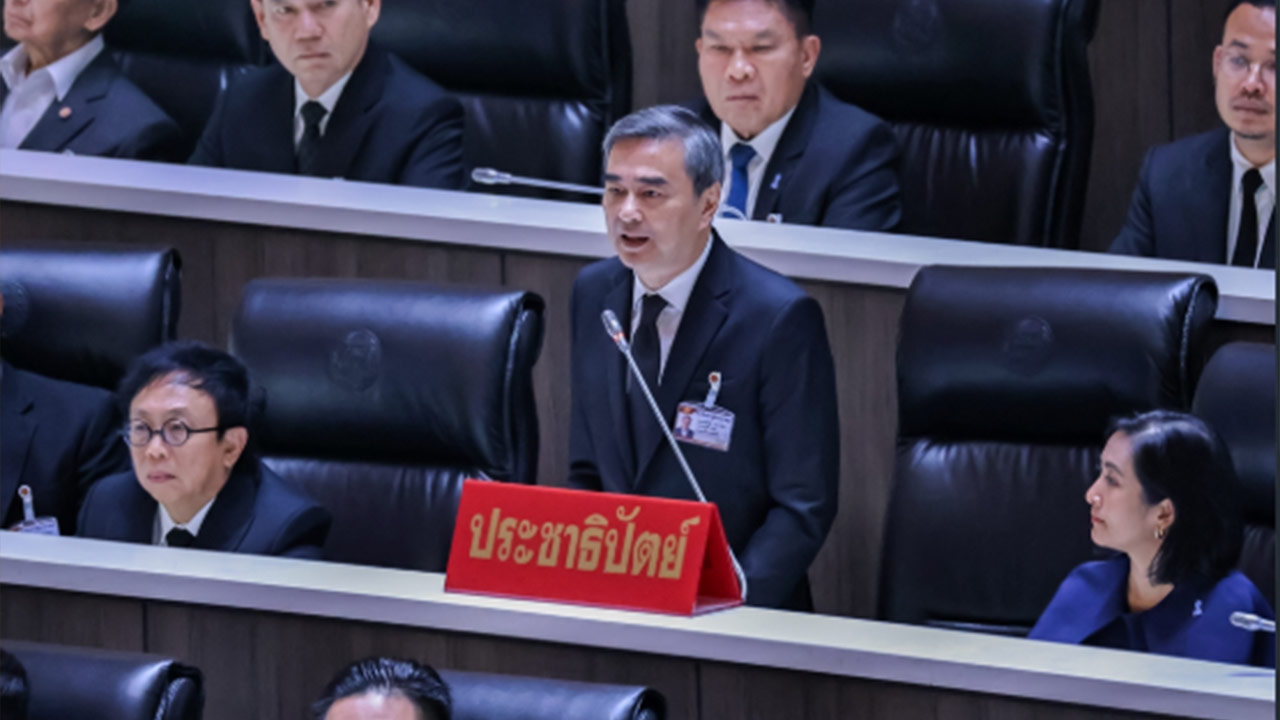
Abhisit lashes out at the government for selective enforcement, favoring legislation that benefits allies while abandoning bills proposed by the public, warning this will reignite ongoing conflicts and bring the issues back to square one.
On 15 May 2026 at the Parliament, Abhisit Vejjajiva, leader of the Democrat Party, delivered a fierce debate regarding the approval process of pending bills from the previous parliamentary session under Article 147 of the Constitution. He stated this process reveals the government’s political attitude and intentions most clearly. While he expressed support for the government’s decision to advance laws that enhance the country’s competitiveness—such as laws facilitating permit approvals, bankruptcy laws that aid business rehabilitation, and competition laws that empower committees to manage monopolistic price-cutting tactics without waiting to prove market dominance—he also acknowledged the government’s commitment to clean air and education personnel laws.
Abhisit pointed out irregularities in the list of laws the government chose not to confirm, especially constitutional amendments that the public had overwhelmingly approved. Unfortunately, the government decided not to continue with the previously agreed process, which will force negotiations on Chapters 1 and 2 to restart from scratch. He warned this could reopen sensitive conflicts and create a vicious cycle in society once again.
He also mentioned the Pollution Release and Transfer Register (PRTR) law, which civil society groups had gathered signatures for and which had passed the committee stage in alignment with OECD standards that the government wishes to join. However, it was suspended solely because it originated from the public, reflecting the current authorities’ "lack of open-mindedness."
Abhisit further contrasted the government's contradictory selective treatment, noting that while it allows amnesty laws favoring politicians to proceed, it has aborted amnesty laws for citizens suffering from land encroachment caused by the state itself. Similarly, labor protection laws addressing the exploitation of platform workers in the new economic structure are ignored. Most disappointingly, the bill to enhance welfare for community health volunteers, which all parties had warmly endorsed during campaigns, was abandoned and forced to start over after the government took office.
Abhisit concluded by urging the government to reconsider its approach. Despite having executive power, it must respect the will of overlooked minority groups, rather than selectively endorsing only laws that benefit their allies.