

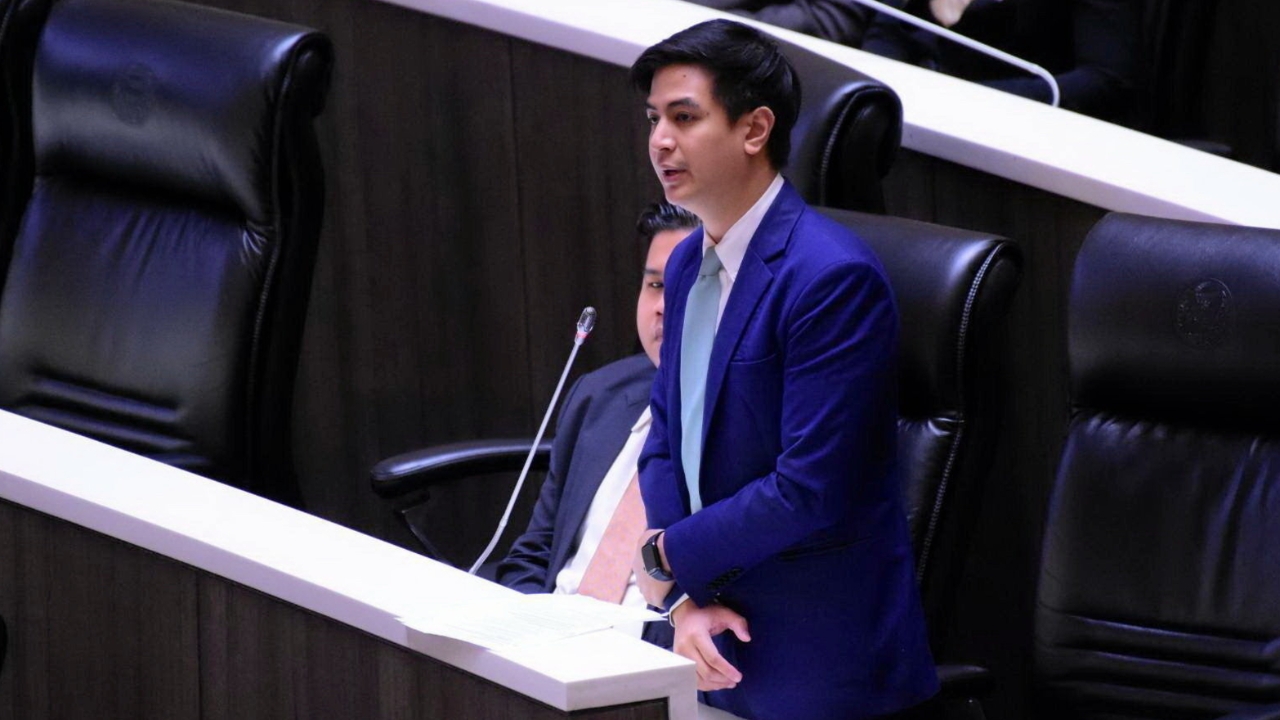
Pritth, a list MP from the Prachachon Party, pointed out that the government is insincere about making a new constitution because the 2017 Constitution serves as fertile ground for the "Blue Ticket Regime." He questioned that if the government is not ready to follow the referendum results, then whose orders is it currently following?,
On 15 May 2026 GMT+7, Pritth Watcharasindhu, a list MP from the Prachachon Party, spoke during a joint parliamentary session on the agenda to approve consideration of draft acts that parliament has not yet approved or completed, according to Section 147, Paragraph 2 of the Constitution of the Kingdom of Thailand. Pritth raised concerns about the constitutional amendment drafts, noting that the Cabinet had not resolved to send these drafts back to parliament for further consideration.
Pritth stated that on 8 February, people nationwide voted in a referendum, the results of which clearly showed that the majority of the country—not just supporters of any single political party—agreed that the 2017 Constitution has problems. Amending only certain articles is insufficient; a completely new constitution must be drafted.
Since 8 February, society has become more aware of the problems with the 2017 Constitution. We have seen the Election Commission (EC) report results late, make counting errors, and insert barcodes into ballots, yet the public was powerless. We saw the Office of the Auditor General use the first anniversary of a building collapse to release a music video instead of demonstrating concrete accountability. We witnessed a former parliamentary speaker dismiss complaints about leaked videos involving himself and the National Anti-Corruption Commission (NACC). We observed the NACC issue statements seemingly whitewashing former ministers involved in stock-hiding cases. We also saw the EC move closer to dismissing cases involving the Prime Minister and several senators accused of colluding in senatorial elections.
With such serious national problems and a clear public voice, the government remained silent, denied responsibility, and claimed constitutional matters are the "parliament's" concern. I understand that legally, under Section 256, Chapter 15/1, to add mechanisms for drafting a new constitution, the process must be carried out in "parliament." But to say the Cabinet has no role in this process is incorrect.
Practically, the Cabinet had two options. Option one: before 12 May, the Cabinet could have resolved to submit the two previous drafts, which had already passed the first reading, back to parliament for confirmation today. If the Cabinet disagreed with the previous drafts, option two was to clearly state its objections and explain why, and to announce when it would propose a new draft to parliament on behalf of the Cabinet. But the problem is, to date, the Cabinet has chosen neither path. The previous drafts were left to lapse without reasonable explanation, and no clear new draft has been proposed. Not even the policy statement to parliament mentioned this issue.
I deliberately listened to the excuses the Prime Minister and government have offered over the past week and frankly found none convincing. First, the Prime Minister said this is a "parliamentary" issue unrelated to the Cabinet. I find it confusing how parliament's stance could be independent of the Cabinet's, given that over 300 MPs come from parties forming the Cabinet. Not to mention senators, many of whom are said to be influenced by the Prime Minister's thinking.
Second, government MPs said they would address this issue in the government's later term. I ask: how do you know this is not the government’s later term now? I am no Nostradamus, but I believe any government that exploits the people's hardship and allows profiteering from oil hoarding will not remain in power long.
Third, some ministers and government MPs say they cannot move on constitutional matters yet because they must address livelihood issues first. This excuse made me realize that our country has a government apparently incapable of handling more than one issue at a time. If livelihood concerns are the priority, I must question why the government used public relief funds as leverage to insert a 200-billion-baht energy project into a single emergency decree to avoid parliamentary scrutiny. How does this align with prioritizing citizens' welfare?
Pritth continued, saying he believes the government knows these excuses do not hold. When society rejected their reasoning, yesterday the government backtracked by announcing that although the Cabinet would not submit a draft, the Bhumjaithai Party plans to meet next week to finalize and propose a constitutional draft to parliament. Certainly, I will closely monitor the content of that draft and whether it attempts to monopolize control over the new constitution's content.
However, I also wonder: if we accept the government's logic that constitutional reform cannot proceed because livelihood issues must come first, does that mean Bhumjaithai MPs no longer care about livelihoods? This government backtracking does not dispel the public's sense that past government actions have not demonstrated sincerity in moving forward with drafting a new constitution.
Today, I conclude that the government's insincerity about drafting a new constitution is not because they want to prioritize livelihood issues first. The real reason is that the Prime Minister, the government, and their networks benefit from the 2017 Constitution, which acts as fertile soil and a breeding ground for the "Blue Ticket Regime," a persistent problem in Thai politics today.
Is it because the Prime Minister benefits from the rules for selecting senators, who are not accountable to the public and which open the door to collusion? Is it because the Prime Minister benefits from having the EC, which, no matter how poorly it manages elections or handles cases involving him, the public cannot act? Is it because the Prime Minister benefits from the NACC, which, if it chooses to protect his network and allies, makes it difficult for the opposition to challenge it, since complaints to the NACC cannot reach the courts without permission from the parliamentary speaker, who belongs to the ruling party?
Therefore, now that the Cabinet has let the two original constitutional drafts lapse, I see that unless the government can convincingly prove to the public that it is ready to follow the "orders" of the people to move forward with drafting a new constitution that truly addresses the people's needs and involves genuine public participation, the public cannot help but wonder: if this government does not listen to the "orders" of the people, then whose "orders" is it following?