

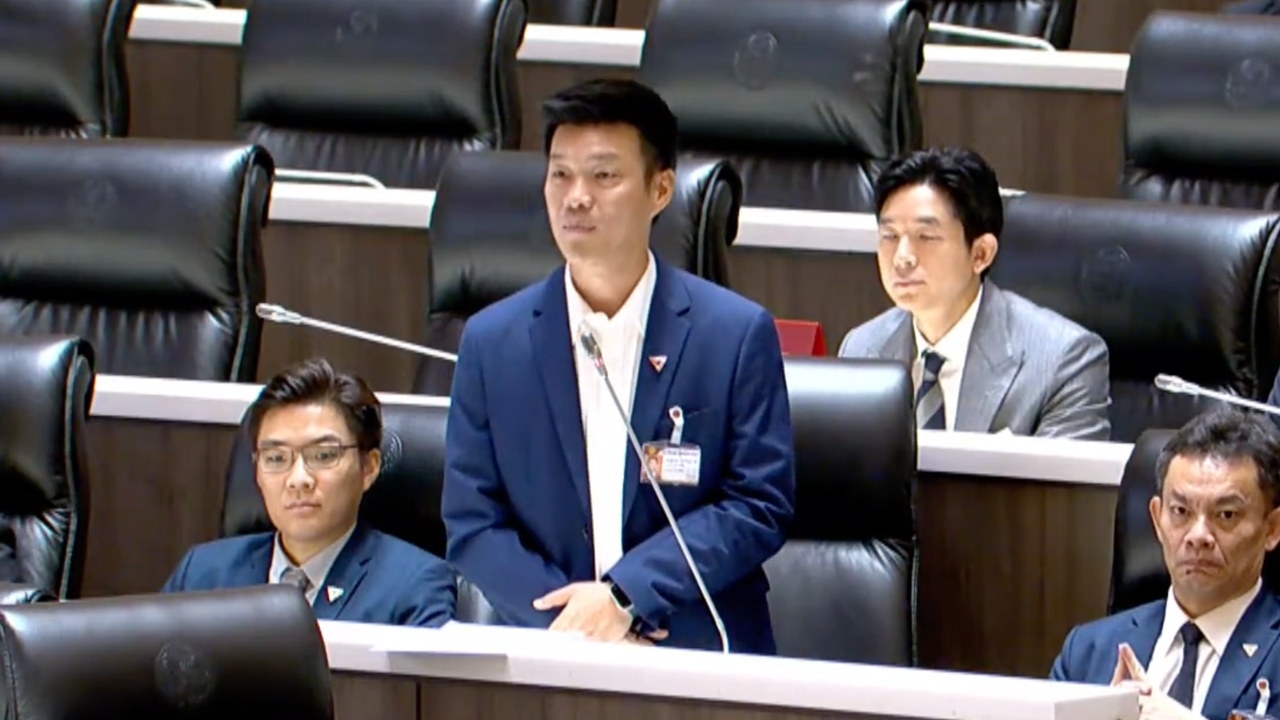
'Nattapong' questioned whether the authority to review legislation rests with the government or parliament, noting that the government believes resubmitting the previous constitutional draft would likely fail, and expressed a desire to know the criteria used to select which laws are sent back to parliament.
On 15 May 2026, during a joint parliamentary session, consideration was given to approving the review of bills that parliament had not yet approved or completed, under Article 147, paragraph two of the constitution, including unfinished bills from the previous parliament. Members of the People’s Party debated bills they had proposed, but the cabinet chose not to resend these for consideration in this parliamentary term.
Mr. Nattapong Ruangpanyawut, leader of the People’s Party and opposition leader in the House of Representatives, stated he wanted to ask the cabinet what principles it used to decide which bills would be sent back for reconsideration and which would not—especially important bills that were rejected, such as environmental laws, the land amnesty law, labor protection laws, military reform laws, and the constitutional amendment draft.
Starting with environmental laws, the government has shown uncertainty several times regarding the Clean Air Act draft, but it is welcome that the cabinet ultimately agreed to resend this draft for consideration. However, what they want is a clear explanation about other environmental protection laws, including the PRTR law and the Factory Act draft, which are crucial for disclosing pollution emissions and hazardous chemical possession to ensure transparency. The government has clearly stated its intention to join the OECD, which requires member countries to have strict laws controlling pollution transparency. Therefore, the cabinet’s principles need clarification, especially since it claims to prioritize environmental issues but rejected the PRTR and Factory Act drafts.
Mr. Nattapong further said that regarding the land amnesty law aimed at restoring justice for many people in rural areas—especially ethnic groups and communities in the Northeast—there are numerous problems where the state declared forests overlapping with people’s land, particularly under the previous NCPO government’s forest reclamation policy. Many residents have lived on that land since their ancestors’ time, but the state declared it forest, and many are still prosecuted or imprisoned unfairly, despite having no involvement in the unjust government actions.
Next is labor protection. Although the country is facing economic crisis, energy problems, and trade wars, government representatives have said that the government prioritizes solving economic issues. However, this reasoning is separate from protecting labor rights. Workers are a vital part of the economy, both as consumers and as the engine of economic activity. The challenge is not choosing between fixing the economy and protecting labor, but how to create fair economic growth for everyone.
Mr. Nattapong added that concerning the Military Court Code Bill, corruption is widespread at all levels and organizations in Thailand. The key to resolving this is establishing a system of checks and balances that meets standards. The essence of this bill is whether military personnel guilty of corruption in military procurement should continue to be judged within the military justice system—where they investigate and decide among themselves—or whether they should be subjected to ordinary criminal courts, like civilians and other civil servants.
Finally, regarding the constitutional amendment draft, government representatives explained that they believe resubmitting the previous constitutional draft from the last parliament would fail this parliament because some members might disagree. This raises the question of whether the authority to review laws belongs to the government or parliament. Can the government truly decide on behalf of parliament members, or should parliament debate and vote together on which bills should proceed? If the government uses the same method to reject the previous constitutional draft, Mr. Nattapong questions the 34 bills the cabinet has sent back: how can it be assured that all 34 will be approved by parliament today? Or has there been prior behind-the-scenes agreement ensuring their passage?
Mr. Nattapong said he does not want to hear legal technical opinions from the Council of State representatives but rather political answers from government representatives responsible for policy decisions. He wants to know what criteria the government uses to select which laws to return for parliamentary consideration, or whether it is because some laws threaten the government’s power structure—such as military reform, labor protection involving vested business interests overlapping with the government, environmental laws raising concerns about burdens on businesses, or the constitutional amendment draft, which critics say is turning the country's highest law into a power base for the Blue Regime government.