

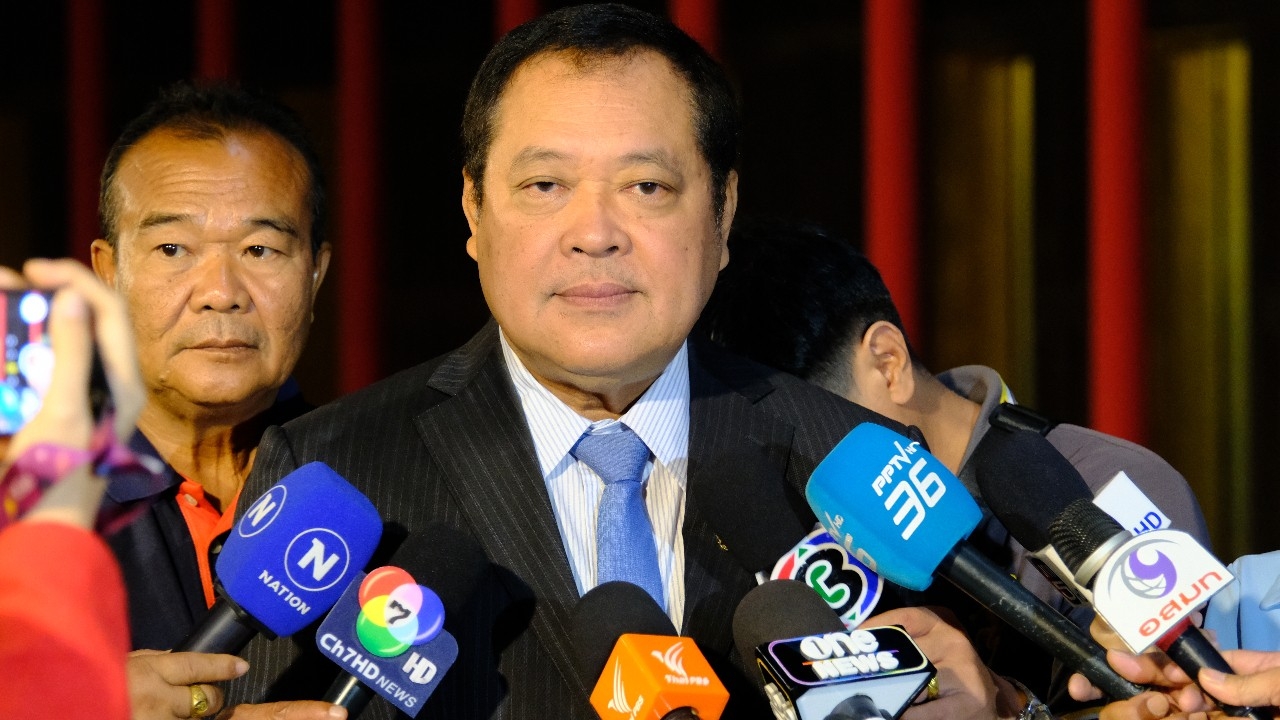
Tawee criticizes the new Trade Competition Act draft as likely to fail, reducing criminal penalties and favoring capitalists worth hundreds of billions to operate above the law, leaving the public powerless to negotiate.
On 18 May 2026, Police Colonel Tawee Sodsong, former Minister of Justice and leader of the Prachachat Party, posted on Facebook that the draft amendment to the Trade Competition Act, currently under first reading in the House of Representatives, can be summarized into seven points:
1. Expands authority to cover state enterprises, public organizations, and other government agencies conducting commercial business, including business groups regulated by specific laws such as telecommunications and energy, all equally subject to this Act. It also enforces jurisdiction over behaviors outside the kingdom if such acts affect or influence the domestic market.
2. Amends the Trade Competition Commission (TCC) selection process to be approved by the House of Representatives, instead of the Cabinet. It reduces the number of commissioners to seven, including the chairperson and deputy, clearly defines expertise requirements in law, economics, and consumer protection, and mandates at least 10 years of experience. It also introduces performance indicators (KPIs), with removal from office if commissioners fail evaluations.
3. Requires mergers that may reduce competition or create market dominance to obtain approval from the commission beforehand. Definitions and evaluation factors are revised to include current competition conditions and future trends, comparing with other businesses in the system.
4. Enhances transparency and public accountability by mandating full disclosure of decisions, including individual commissioners’ separate opinions, to the public within 15 days. During case proceedings, the office must regularly publish monthly progress reports for public review.
5. Abolishes criminal imprisonment penalties for monopolistic offenses under Sections 50, 54, 55, and 57, replacing them with administrative fines. The fines are calculated as a percentage of annual revenue during the offense year, such as up to 10 or 20 percent, or based on the value of merger transactions, aiming for harsher economic sanctions against large capital.
. "Whistleblowers" Adds criteria for exemption or reduction of administrative fines for co-offenders who repent and submit evidence first, facilitating the crackdown on collusion or secret agreements. Also transfers jurisdiction for criminal cases, damage claims, and administrative offenses to the Intellectual Property and International Trade Court, instead of administrative or traditional courts.
7. Grants victims the right to claim damages up to three times the actual loss, with courts able to order no less than three times but not exceeding four times the real damage. Extends the statute of limitations to three or five years from the date the victim knew or should have known of the incident. Filing a complaint with the office immediately suspends the limitation period. Increases fee caps, such as 5 million baht per merger approval and 500,000 baht per advance ruling request.
Police Colonel Tawee further stated that Thailand has never lacked economic laws, including the Trade Competition Act, special laws, national supervisory committees, and most importantly, the constitution, which clearly mandates in Section 75 that the state must establish an economic system benefiting the people fairly, eliminating unfair monopolies, and that the state must not compete with the private sector. Yet, about 55 state enterprises still compete with private businesses. Section 56 stipulates that essential public utilities must remain at least 51% state-owned and must not affect citizens’ livelihoods, such as electricity and fuel prices. However, these laws are poorly enforced and dishonestly applied, becoming mere "paper tigers," allowing influential powers to operate above the law and public suffering, holding market dominance, for example.
He also observed that retail and wholesale trade systems dominate local communities economically. In the past, cash spent by villagers at small shops or fresh markets circulated locally, creating economic multipliers that strengthened communities. Now, major capitalists have completely changed these rules. Annual reports from major corporations as of 31 December 2025 illustrate the impact on grassroots economies nationwide, which are being "drained of cash" from communities into large companies based in Bangkok, causing cash shortages locally. There are as many as 15,945 convenience stores, increasing annually by 600–700 branches, leading to monopolies where companies hold 78.8% market share. The greatest threat is not just expansion but control over wholesale, retail, online platforms, and consumer behavior data. Small shops and markets have no competitive tools, resulting in community income flowing to central headquarters, turning communities into consumption centers rather than capital accumulation sources.
Regarding energy such as fuel and electricity, the law requires the state to hold at least 51% ownership. Yet, the state fails to uphold the rule of law, allowing concessionary energy capitalists to monopolize up to 70% of production. These private investors become among the country’s wealthiest tycoons, while citizens suffer from expensive electricity and fuel. In telecommunications, the state grants private monopolies and allows mergers of major telecom companies, leaving only two main providers for over 133 million mobile subscribers, resulting in a market without choice. Although the Administrative Court upheld the National Broadcasting and Telecommunications Commission’s decisions as procedurally correct, the Trade Competition Act has not adequately covered telecommunications businesses.
In transportation, rail systems, and logistics, state projects are concentrated among a few large capital groups. The top company’s total contract value exceeds 337.396 billion baht, the second over 315.016 billion, and the third about 117.948 billion baht. This concentration of monopoly concessions seizes public assets from citizens, with concession periods often extended indefinitely upon expiry.
Police Colonel Tawee expressed concern and personal disagreement with the draft’s removal of criminal imprisonment penalties. Controlling large capital groups with market dominance is already difficult, and this change amounts to "a serious economic crime." These groups have money, influence, and skilled lawyers exploiting loopholes. The draft reduces penalties to civil fines or administrative measures, which for capitalists worth hundreds of billions, a fine of 1–10 million baht is minimal compared to the ongoing profits from market monopolies and exploitation of public wealth. This is disproportionate to the offenses committed. Imprisonment penalties, as used internationally, should be retained.
Meanwhile, the country needs strong leaders, law enforcers, and justice systems willing to apply laws fairly and equally, and to break the cycles of interests and influences above the rule of law. True justice must also control government corruption and unfair use of power, preserving space for small citizens to have markets, capital, opportunities to compete, and economic dignity equally.