

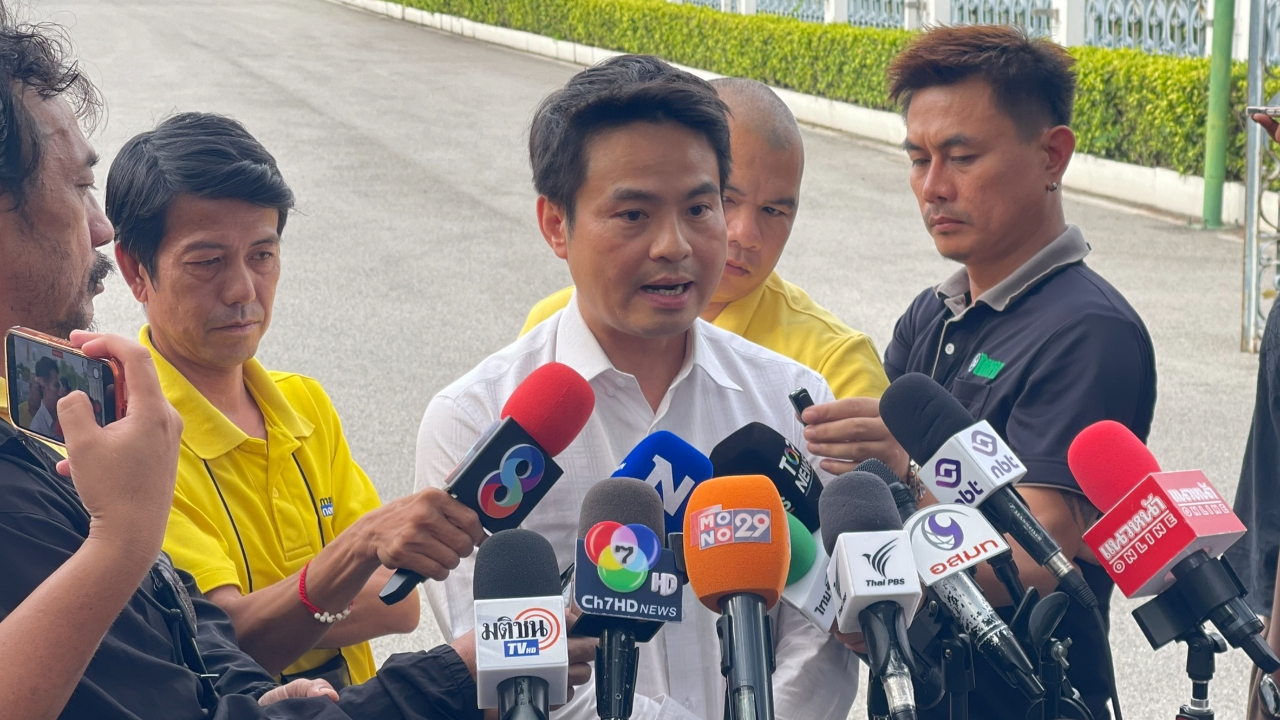
Minister attached to the Prime Minister's Office acknowledged the government is carefully considering spending 1.7 billion baht to purchase the broadcasting rights for the 2026 World Cup, emphasizing the need to assess whether this investment will help develop Thai football. A decision is expected soon before the tournament begins on 11 June.
At 16:05 on 18 May 2026 GMT+7. Mr. Pradorn Prissanantakul, Minister attached to the Prime Minister's Office, gave an interview at the Government House regarding reports that the government was preparing to withdraw from the plan to purchase the broadcasting rights for the 2026 World Cup. The tournament will be held from 11 June to 19 July in the United States, Canada, and Mexico as co-hosts, he said, "In fact, we are neither backing down nor moving forward hastily. The Prime Minister announced last week that efforts are ongoing to find the best possible approach. The Public Relations Department has been instructed to coordinate with the National Broadcasting and Telecommunications Commission (NBTC) to explore all feasible options to broadcast this World Cup for the Thai audience."
Mr. Pradorn further revealed, from initial discussions between the Public Relations Department and the NBTC, the main obstacle is the cost: purchasing the World Cup rights will cost about 1.3 billion baht, with approximately 300 million baht in taxes and an additional 100 million baht in operational expenses, totaling over 1.7 billion baht that the Thai government would need to fund.
Meanwhile, there is public feedback questioning how sustainable this 1.7 billion baht investment in World Cup rights would be for Thai football. Does it inspire Thai youth and help the sport grow toward the common goal of qualifying for the World Cup finals? Could the funds be better spent supporting youth programs or other initiatives that build Thai football more sustainably? Currently, discussions continue because the 1.7 billion baht comes from taxpayers’ money, so careful consideration is necessary to determine which option would better sustain Thai football.
Regarding the latest steps, the Public Relations Department and NBTC are discussing after receiving the Cabinet’s assignment. However, given the high budget, the Thai government is expected to think carefully about the 1.7 billion baht rights fee. Additionally, the broadcast would last about a month, and the match times are in a time zone that is not convenient for Thailand, so thorough review is needed. Concerning private sector support, Mr. Pradorn said the government appreciates any assistance in funding or purchasing the rights and has no objection. Nonetheless, the decision to buy or not must be made soon, as the tournament will start in 15 days.
"Anything that benefits Thai football, the 1.7 billion baht could be invested in development over several years. For example, there used to be a football training event organized by the Ministry of Tourism and Sports called the Prime Minister Cup. This program likely requires less funding but can inspire and develop youth in the provinces extensively. Also, professional football promotion projects at the Thai League 3 level, which exist in nearly every province, could build upon the Prime Minister Cup, allowing talented players to progress further in T3. Such initiatives might cost no more than 200-300 million baht annually and would promote sustainable football development nationwide. Therefore, spending 1.7 billion baht requires very careful reconsideration."