

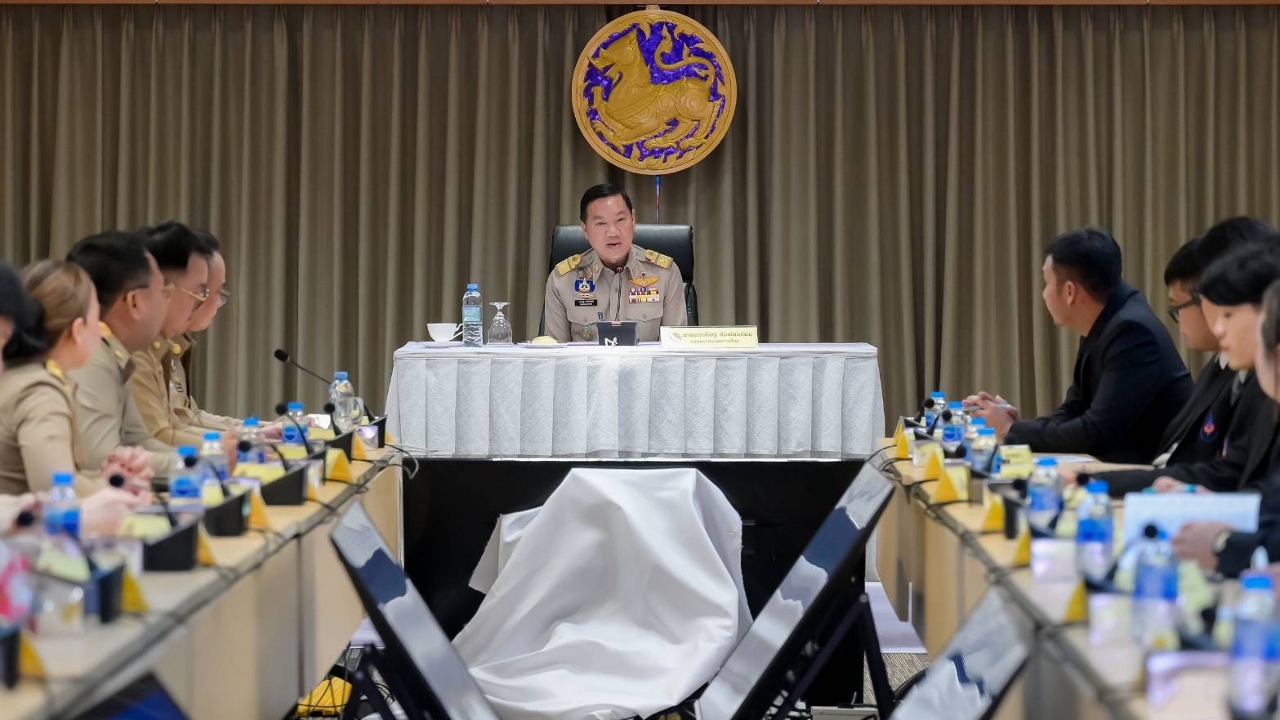
The Permanent Secretary of the Interior Ministry welcomed students from the special Law and Political Science class at Hat Yai Witthayalai School, emphasizing that the role of "governors" is to protect and safeguard the people by reaching out to communities with knowledge, care, and unity.
At 09:30 on 18 May 2026 at the Interior Ministry, Prime Minister and Minister of Interior Anutin Charnvirakul assigned Permanent Secretary of the Interior Ministry Atthasit Sampanrat to welcome and give a special lecture. "The Interior Ministry's mission to relieve suffering and promote well-being." This was presented to students and teachers from the special Law and Political Science class of Hat Yai Witthayalai School in Songkhla Province. Also attending were Deputy Permanent Secretary for Administration Chotinrin Kerdsom, Assistant Permanent Secretary Athaya Nuanuthai, Director of the Damrong Rajanupab Institute Chakraphan Rattanasathien, along with directors of bureaus, centers, experts, group directors, and officials from the Office of the Permanent Secretary. They welcomed the group and guided them through important sites and antiques related to the 134th anniversary of the Interior Ministry’s founding at Sirindhorn Pirom Garden and the Damrong Rajanupab Museum in the ministry building, which houses the statue of Prince Damrong Rajanubhab, the ministry’s first minister. Exhibits include his biography, works, personal books and belongings, and displays honoring the monarchy.
The Permanent Secretary stated that the Interior Ministry was pleased to welcome the students of Hat Yai Witthayalai School, a group interested in studying political science and law. These young people represent the next generation aiming to pursue university degrees in political science and law and become civil servants within the ministry in various roles such as policy analysts, human resource officers, general administrators, public relations officers, district chiefs, community developers, land academics, legal officers, and positions in government agencies or the private sector.
"The Interior Ministry is one of 20 ministries but the only one managing government administration across three levels: 1. The central level—ministries and departments; 2. The regional level—provinces and districts; and 3. The local level—overseeing provincial administrative organizations (PAO), municipalities, subdistrict administrative organizations (SAO), Pattaya City, and Bangkok Metropolitan Administration (BMA). The ministry plays a crucial role in all aspects of regional administration and local governance supervision. Civil servants under the Interior Ministry serve as the highest commanders of provincial officials, namely the 'provincial governors,' whose official career title is 'governor.' Their duty is to 'protect and safeguard the people,' a central responsibility of the ministry. At the district level, 'district chiefs' operate under the governors’ leadership. District chiefs, as Interior Ministry civil servants, are supported by local leaders—subdistrict headmen and village chiefs—who assist in overseeing citizens in subdistricts and villages. Local government organizations, as legal entities led by elected heads such as PAOs, municipalities, and SAOs, operate under supervision based on the principle of relieving suffering and promoting well-being by regularly visiting the community. The principle is 'wear out your shoes before your pants,' meaning officials should engage closely with the people with knowledge, care, and unity, working with understanding, accessibility, and development.

The Permanent Secretary added that the Interior Ministry has key duties in honoring the nation's foundational institutions—nation, religion, and monarchy—and responsibilities covering all aspects of citizens’ lives, including: 1. Internal security tasks such as combating drug problems, protecting rear areas, maintaining public order, land surveying, and issuing land title deeds; 2. Community development and local governance promotion including career development, strengthening grassroots economy, developing OTOP products, promoting Thai textiles for income generation, and enhancing local government capacities to provide public services; 3. Disaster management and urban development including warning systems, disaster management, road accident prevention, urban planning support, and developing smart livable cities. Additionally, state enterprises under the ministry handle services and development of electricity and water systems, promote market channels for local products, and support knowledge and wastewater management operations for local governments on behalf of the people.

At the end of the session, the Permanent Secretary invited students to ask questions. They showed keen interest and asked about various topics such as the most common issues faced by provincial governors, strategies for personnel development to support the mission of relieving suffering and promoting well-being in the 21st century, cooperation with various sectors to enhance community product sustainability, development of warning systems and proactive disaster management for faster public information dissemination, and advancing tasks aligned with the United Nations Sustainable Development Goals (UN SDGs).