

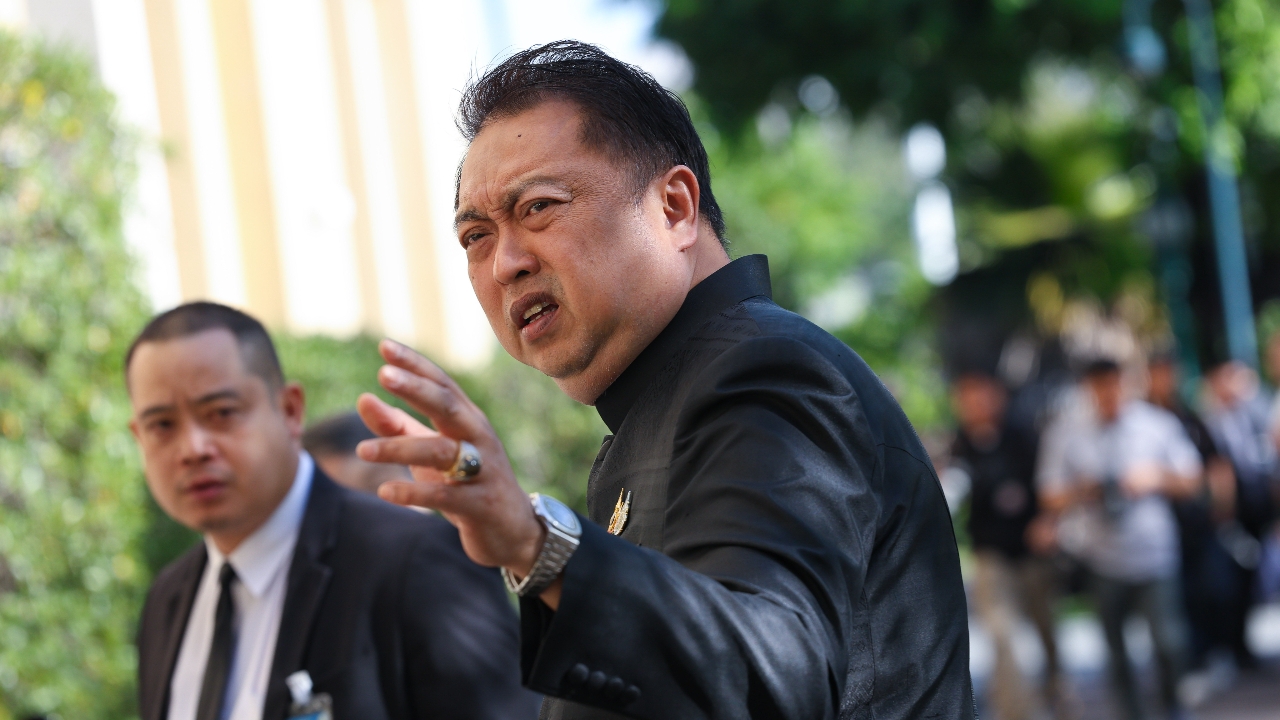
Suhat angrily shoved a reporter, saying "You don’t know me well enough," when pressed about why he hadn’t set up a committee to investigate the Pollution Control Department. He clarified it is a technical agency without licensing duties and mentioned he personally called the Chamber of Commerce president, telling them to bring evidence.
At 09:50 on 19 May 2026 at the Government House, Suhat Chomklin, Minister of Natural Resources and Environment, commented on a private sector survey about government transparency conducted by the Zero Corruption Task Force and allies. The survey identified the Pollution Control Department as the agency with the highest average bribe value per case, at 102,160 baht. Suhat said that while surveys and criticism are allowed, if they cause reputational damage or lower morale without evidence, questions arise: What were the payments for? What benefit was gained from corruption? As head of a family with nine departments under his supervision, he likened them to nine children he knows well. Before punishing a child, there must be evidence. Similarly, legal action requires proof. Following the news, he assigned the Pollution Control Department director to clarify the situation.
“As the head of the family, I have entrusted the eldest sister, the Permanent Secretary, who acts as guardian, to manage and clarify matters publicly. She is coordinating with the Zero Corruption Task Force to bring information to the Permanent Secretary for explanation. This is her duty as guardian and senior official. My style is not to refuse cooperation in investigations, but to say that polls accusing certain people of corruption must be supported by evidence. If a poll claims journalists’ families or anyone’s families are good or bad, would the media accept that? No one would. Evidence must be examined. That is the standard I accept as a man. If wrong, punishments must follow. But if someone accuses our child of misbehavior and we punish them without proof, wouldn’t that cause rebellion? We must investigate and protect our children, because we live with them daily and know their character,” Suhat said.
Suhat said he never protects corrupt officials. He noted that since his appointment, the Department of National Parks, Wildlife and Plant Conservation has set up committees to investigate and dismiss numerous wrongdoers, regardless of rank, including those harming resources or colluding with capitalists. Regarding the Prime Minister appointing Pakorn Nilprapunt as deputy prime minister to coordinate, Suhat said this is positive but the issue is demoralizing for workers.
When asked if it is necessary to sue to obtain evidence, Suhat said he was not calling for a lawsuit but that the director had already sent an open letter requesting evidence of payments to the Pollution Control Department, emphasizing that the department is academic and does not issue permits or grant rights to open factories. When asked if the ministry should have investigated first, Suhat said this is a political issue, with some politicians using it as a point of contention and denial. He said polls cannot conclusively prove corruption as they rely on questioning and multiple-choice answers, comparing it to Google searches. Asked if as minister he should have investigated first, he said he had asked the director to explain, and all departments must defend their dignity. If a child denies wrongdoing, parents protect them first, then ask accusers for evidence before taking action.
Asked why he did not form an investigative committee and why he rejected the poll outright, Suhat said he had already asked the Permanent Secretary to clarify. He compared his nine 'children' (departments) and said he knows their character. If a child has misbehaved, you investigate. But if your child has no authority and is accused of theft, would you punish them without proof? A reporter pointed out that a minister should not compare this way because this concerns official work. Suhat replied that if someone insults your subordinate, you must defend them first. The reporter said that is unacceptable; proper investigation is necessary. Suhat said the Permanent Secretary is already investigating. The reporter said the minister's refusal to accept the poll seems to reject the investigative process. Suhat responded that as the department is academic and cannot grant licenses, clarifications do not imply wrongdoing.
The same reporter asked if the minister’s remarks indicate disagreement with the Zero Corruption Task Force. Suhat asked how he should respond. The reporter said they were not advising but suggesting the matter should be investigated first. If the minister rejects the poll immediately, it undermines acceptance of the process. Suhat said he had already asked the director to explain first. He spoke only after the department’s explanation, having not known all authority details before.
The reporter pressed that explanation is not the same as investigation, seeming more like a statement. Suhat said the task force must produce evidence for their poll claims, such as payments for licenses. When asked if he had conducted any investigation, Suhat showed strong displeasure, pointed at the reporter, and said, “I asked, I personally called Poj (Poj Aramwattananon, President of the Thai Chamber of Commerce) to bring evidence. I called myself to verify.” When asked if the Permanent Secretary was instructed to investigate, Suhat confirmed he asked the Permanent Secretary to summon the task force today and bring documentary evidence. The reporter said the matter will proceed according to process, prompting Suhat to emphasize, “From day one, I called Poj to ask if he really called. Someone like me doesn’t back down. I asked him to bring evidence. Knowing each other, you know the character.”
When asked if the task force would present evidence to the Permanent Secretary today, Suhat said he did not know and that the Permanent Secretary handles this now, as head of the agency responsible for uncovering the truth. Suhat considers himself the family head, the Permanent Secretary the guardian. It is the Permanent Secretary’s duty to act, since Suhat does not appoint senior civil servants at grades 8 or 9; that falls to the Permanent Secretary and directors. Suhat appoints directors and knows their character, but the Permanent Secretary manages subordinate officials.
After the interview, Suhat showed clear displeasure and pushed through the group of reporters, colliding with the reporter who had asked many questions. The reporter said, “Did you just bump into me like that?” Suhat turned and said, “You don’t know me well enough.”