

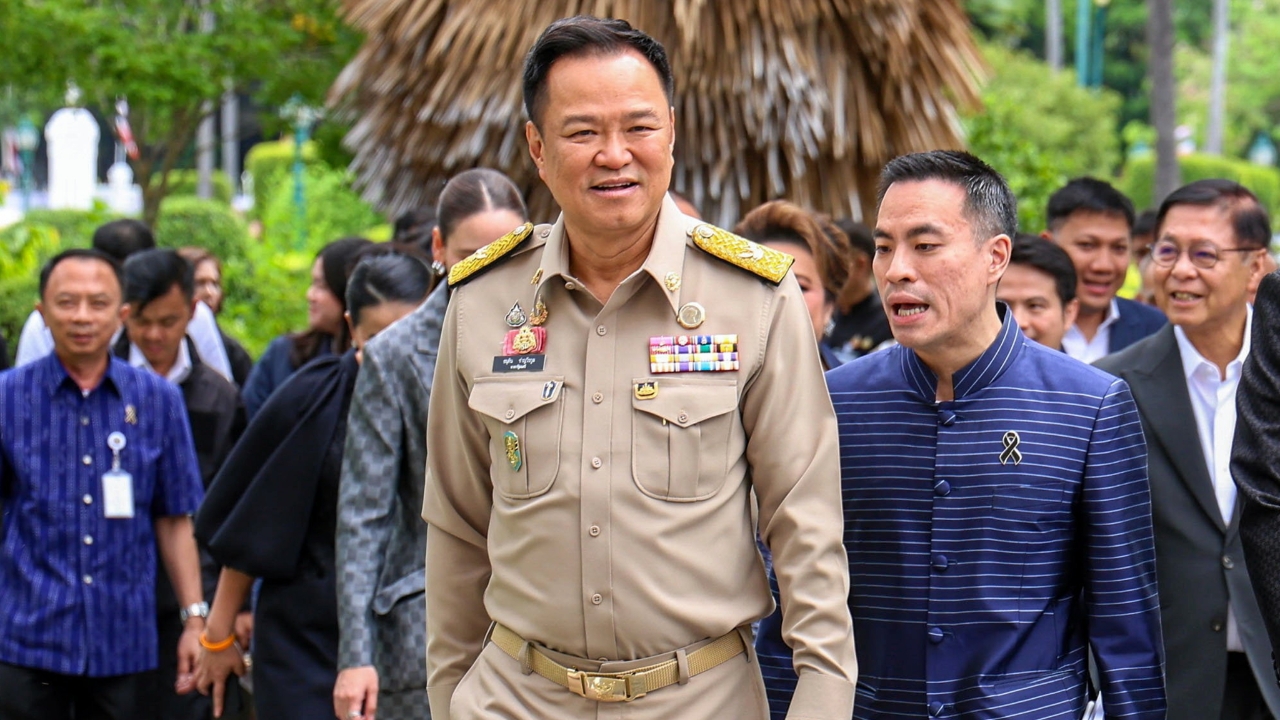
The government is accelerating Thailand's entry into the OECD. The Cabinet has approved the establishment of a national board chaired by Prime Minister Anutin to drive the goal of becoming a member by 2028, enhancing the nation's competitiveness and attracting investor confidence worldwide.
19 May 2026 GMT+7 Ms. Ratchada Thanadirek, spokesperson for the Office of the Prime Minister, revealed that the government is actively advancing the process to join the Organisation for Economic Co-operation and Development (OECD). At today's Cabinet meeting, approval was given to establish a supervisory committee for Thailand's accession to the OECD, which Prime Minister and Minister of Interior Anutin Charnvirakul will chair to guide direction, expedite progress, and monitor operations across all agencies in a unified manner.
This committee includes three deputy prime ministers as vice chairs: Mr. Anek Nithanapaprasert, Mr. Sihasak Puangketkaew, and Mr. Pakorn Nilprapunt, along with heads of key agencies in budget, bureaucracy, economy, foreign affairs, and legal sectors. These include the Director of the Budget Bureau, Secretary-General of the Office of the Public Sector Development Commission (OPDC), Chair of the Joint Public-Private Sector Committee (JSCC), Chair of the National Economic and Social Development Council (NESDC), Permanent Secretary for Foreign Affairs, Secretary-General of the Office of the Council of State, and Director-General of the Department of International Economic Affairs. Additionally, external members such as Mr. Kitti Tangjitmanisakda, Mr. Twilap Ritthiprom, Mr. Saran Charoensuwan, and Special Professor Kittipong Kitiyaraks support efforts in economic, legal, governance, and international cooperation dimensions.
Ms. Ratchada added that joining the OECD is a key government agenda as it elevates the country across multiple dimensions—economy, law, governance, investment, competition, innovation, environment, and quality of life—to align with international standards. This will boost investor confidence and prepare Thailand to compete globally.
Regarding the latest progress, Thailand is currently in the technical evaluation phase, which requires compiling data, responding to questionnaires, and assessing the alignment of Thai laws, policies, and practices with OECD standards across various sectors. Thai agencies are collaborating closely with OECD committees and working groups.
The new committee will set policies, advise on directions, supervise, expedite, and monitor operations to meet criteria, conditions, and plans for OECD accession. It includes deputy prime ministers and key agencies in economy, law, foreign affairs, budget, and national development to ensure cohesive progress. The government aims for Thailand to join the OECD by 2028, accelerating key tasks such as revising laws, regulations, data systems, and public sector standards to comply with OECD recommendations step by step.
The government spokesperson concluded that the Prime Minister regards this as a vital tool for national elevation, not merely a symbolic goal but a reform process that will make Thailand's economy transparent, competitive, and directly beneficial to citizens in the long term. The government will continuously communicate progress to the public to demonstrate that the path to OECD membership is a concrete advancement of Thailand's future.