

Siripong warned that railway tracks are dangerous areas after a man was grazed by a train while urinating nearby. He clarified that the plan to study a trial of trains avoiding inner Bangkok for three months is not a final decision. Compensation for those killed in the train-bus collision is set at 2.39 million baht, and up to 1 million baht for the injured.
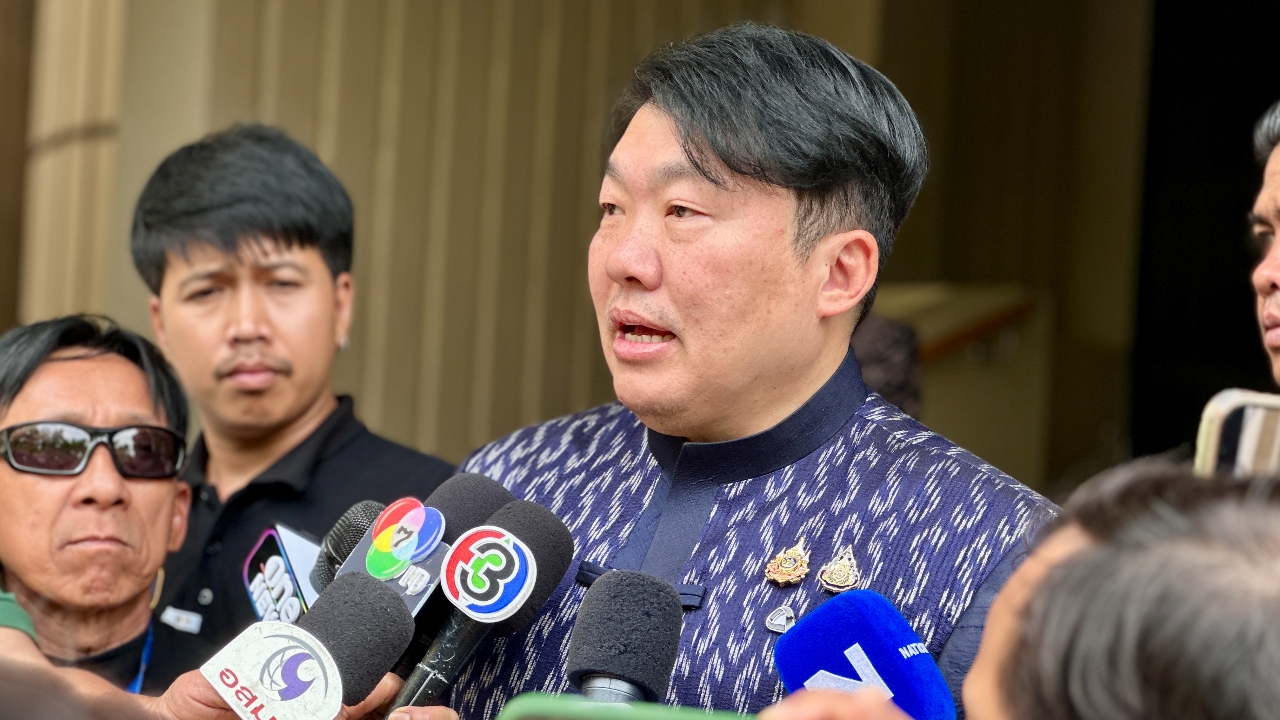
19 May 2026 GMT+7 Mr. Siripong Angkasakulkit, Deputy Minister of Transport, said at the Government House regarding the case of a man grazed by a train near the Makkasan railway tracks that he regrets the incident. However, this case differs from previous ones because it did not occur at the main railway crossing equipped with barriers. The injured person had entered the railway area to urinate, which caused the grazing incident. The law will handle the matter accordingly. The railway is not a safe area but a dangerous place. This event differs from previous ones in that trains at railway crossings require extra caution, but in this case, the train was running at normal speed along a route that is not a crossing. The incident occurred very suddenly, preventing timely braking. Legal procedures will proceed accordingly. He emphasized, “The railway is not a safe place. The public should exercise caution.”
. The trial measure to prevent trains from entering inner Bangkok for three months has drawn feedback from affected commuters, city workers, and students. Mr. Siripong said that Transport Minister Pipat Ratchakitprakarn has instructed the State Railway of Thailand (SRT) to present a plan within two months, with a total consideration period of three months to decide how to proceed. He confirmed that this is not a new issue; it has been addressed in the past. Various objections have been discussed, such as running Bangkok Mass Transit Authority (BMTA) buses parallel to trains, which resulted in delays, or switching to electric trains that increase passenger costs.
Therefore, this effort is a study proposing options without any trial implementation yet. If tested, it will be only a short-term trial. The plan has not yet been submitted. All feedback is being considered, but the main approach to transport management has been to elevate rail systems, like the Bang Sue to Rangsit line, which has proven effective in easing traffic. The next step is completing the missing link system, which will create a fully elevated rail network. This is currently under study by the SRT.
Later, Mr. Siripong spoke about today's Cabinet meeting, saying that regarding the train-bus collision on 16 May, the Prime Minister expressed deep sorrow and urged the Ministry of Transport to quickly clarify all public doubts. New evidence is emerging daily, and societal questions are increasing. The ministry was ordered to promptly conclude issues such as whether the train driver was in the cabin and the impact of any drug use, as the government prioritizes drug suppression. A thorough investigation is requested.
Regarding compensation, it does not require Cabinet approval because it falls under the Ministry of Transport's responsibility, involving funds from the Bangkok Mass Transit Authority (BMTA) and the State Railway of Thailand (SRT). For this case, compensation for the deceased is approximately 2,390,000 baht, while the maximum compensation for the injured is about 1 million baht. The Ministry of Transport reported to the Prime Minister that the SRT has formed a fact-finding committee, expected to conclude today and submit a report no later than 20 May 2026.
On the issue of railway driver licenses, Mr. Siripong revealed that it is not that the Department of Railways refuses to issue licenses. The new Rail Transport Act took effect on 27 March 2026, with a 120-day period to implement the licensing process gradually. For this case, the driver has not yet registered with the Department of Railways, though some are in the process. Practically, the individual holds a driving license issued by the State Railway.
However, licenses issued by the Department of Railways will not influence the penalty in this case. Any offense will be dealt with on its own merit. The delay in issuing licenses is due to the remaining 60-day legal grace period and will not be considered in this case. Regarding drug detection in the train driver, Mr. Siripong said that while skill was the main focus before, future discussions must also address drug use.
Regarding the State Railway Union's concern about staff shortages and whether to increase personnel, Mr. Siripong said the structure needs review. Since the 1990s, staff numbers followed the government downsizing law, retirement rates, and replacements. Past staffing levels may have seemed excessive for duties. Questions arise, but areas with problems or shortages should be addressed. The SRT governor has proposed restructuring. Whether to adjust or add staff depends on budget limits and discussions with the Office of the Public Sector Development Commission. Options include permanent staff, contractors, or leveraging technology.
Mr. Siripong added that the State Railway of Thailand has repainted high-risk railway crossings, including the accident site. Traffic condition checks have been completed. He elaborated on the phrase “Railway tracks are not safe areas.” Regarding the case of a man urinating on railway tracks and being injured,
he said, “The train itself is safe, but the railway tracks are not safe areas. It is not acceptable to urinate on railway tracks whenever needed or to walk on them at will, especially outside crossings where trains run normally. I urge the public to be cautious. Saying that railway tracks are unsafe does not mean passengers are unsafe, but that those entering the tracks are at risk, similar to crossing a road, which is also unsafe for careless pedestrians.”
On coordinating with traffic police about traffic lights near railway crossings close to intersections and whether joint management is needed, Mr. Siripong said the police are already enforcing this strictly, though enforcement may have lessened somewhat. During traffic congestion, enforcement must intensify. Recently, new road markings have been painted at many railway crossings, especially high-risk locations including the accident site.
When asked if barriers should be enlarged or strengthened, Mr. Siripong said this is under consideration along with incorporating technology, but not in the near term due to bureaucratic procedures. Currently, personnel management is emphasized while waiting for budget approval. The Rail Innovation Institute previously installed CCTV linked with AI, and the next step is integrating this with traffic signals. Fully automated railway systems are a medium-term goal, likely requiring 1-2 years to implement.