

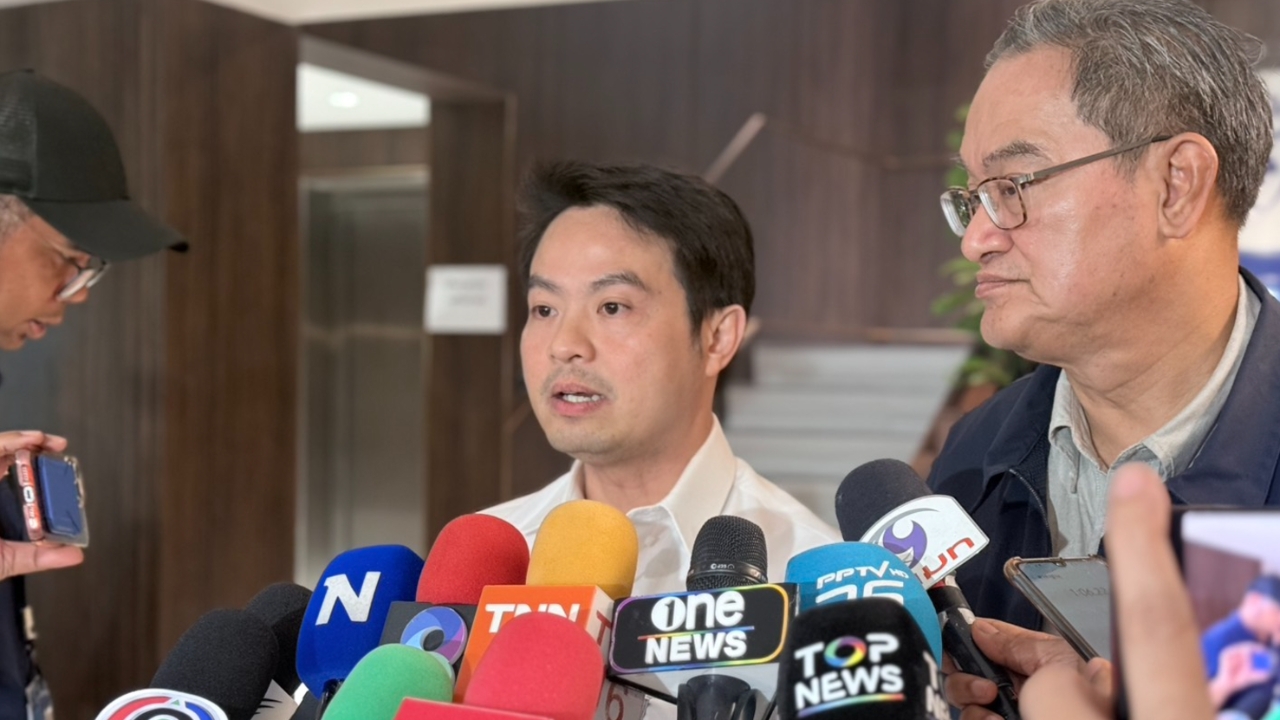
Pradorn revealed that Anutin will lead the Bhumjaithai Party team to submit a constitutional amendment draft on 20 May to the Parliament Speaker. Nikorn disclosed the draft proposes a 100-member Constitution Drafting Assembly and claims Bhumjaithai's approach is the fairest, highlighting that this is how the people have chosen.
At 3:00 p.m. on 19 May 2026, the Bhumjaithai Party held its weekly meeting of Members of the House of Representatives (MPs), with full attendance. At 4:23 p.m., Mr. Pradorn Prissanantakul, Minister attached to the Prime Minister's Office and Bhumjaithai MP for Ang Thong, stated in an interview that the party MPs resolved with 190 votes to collectively sign and propose the party's constitutional amendment draft. This draft seeks to amend Article 256 by adding Section 15/1 to draft a new constitution in line with the referendum results of 21 million votes. On 20 May 2026, Mr. Anutin Charnvirakul, Prime Minister and Minister of Interior, as leader of the Bhumjaithai Party, will lead the party's executive committee and MPs to submit the amendment draft to the Parliament Speaker, expected between 10:30 and 11:00 a.m.
Meanwhile, Mr. Nikorn Jamnong, a party-list MP for Bhumjaithai, explained that the party's draft sets the Constitution Drafting Assembly (CDA) at 100 members, comprising 23 experts and 77 elected from nationwide applicants, with an additional 300 reserves. The drafting committee will consist of 45 members: 30 from the CDA and 15 reserves. The public hearing committee will also have 45 members: 15 from the CDA, 15 reserves, and 15 citizens. The CDA's term is set for 360 days to allow thorough public consultation.
Principally, members will not be directly elected to comply with the Constitutional Court's ruling. Instead, parliamentarians will select them, with CDA proportions reflecting parliamentary representation, similar to selecting standing committees. Parliament has 700 members: 500 MPs and 200 senators. MPs would have about 71 seats, senators 29. Regarding the contentious issue of senatorial approval for the constitution, Bhumjaithai previously proposed reducing the requirement from one-fifth to one-quarter, approximately 50 senators, to foster compromise. This will be further discussed in committee. The draft explicitly leaves Chapters 1 and 2 untouched.
When asked about prior senator proposals to include a transitional clause protecting senatorial powers until their five-year term ends, Nikorn responded that this will be discussed further in committee. Regarding accusations that Bhumjaithai would dominate the amendment process, Nikorn said it reflects parliamentary proportions, which is the fairest approach, respecting how the public elected their representatives.
On whether Bhumjaithai's 192 MPs and senators' votes could dominate the CDA selection, Nikorn explained they cannot be combined as they belong to separate chambers. He added that opinions vary, but the proportions align with parliamentary representation: senators for senators, MPs for MPs, following majority principles.
Regarding obstacles to pushing the constitutional amendment, Nikorn said there should be none because the proposal is as fair as possible. Following this path will ensure the new constitution is ready before the next election. After Bhumjaithai submits the draft to the Parliament Speaker, the first reading will begin in the current or June session. Once the CDA process and a second referendum are completed and approved by the public, the constitution will take effect. If the House dissolves, the CDA will remain active and not be dissolved.