

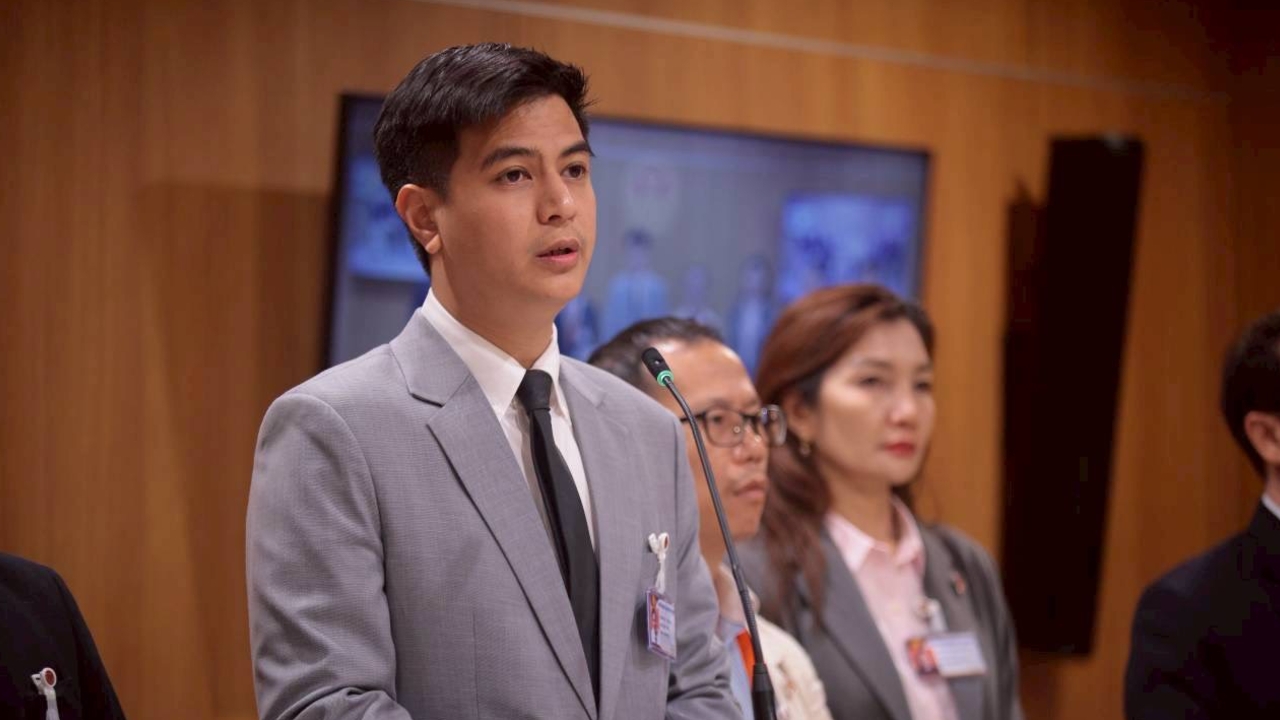
The People's Party is advancing by resubmitting six bills rejected by the Cabinet back to Parliament. Pravit hopes to create space for bills proposed by MPs, as previously envisioned by the Speaker of the House. He revealed plans to submit an amendment to Section 256 by next week at the latest.
On 20 May 2026, Mr. Pravit Watcharasindhu, Opposition Whip and party-list MP of the People's Party, along with Ms. Komontras Kittisunthornkul, Rayong MP for Constituency 1, Mr. Krit Silpachai, Rayong MP for Constituency 2, Mr. Ekrach Udomamnuay, Bangkok MP for Constituency 10, Mr. Laofang Banditteordsakul, and Mr. Sia Champathong, party-list MPs of the People's Party, held a press conference announcing their intention to resubmit six bills rejected by the previous Cabinet back to Parliament. These include the draft Pollution Release and Transfer Register (PRTR) Act, the Factory Act, the Amnesty Act for Cases of Reclaiming the NCPO Heritage Forest, the Labor Protection Act, the Military Court Charter Act, and a constitutional amendment bill.
Mr. Pravit said today they were here to reaffirm the party's intent in submitting the six bills for Parliament's consideration, which had been pending from the previous parliamentary session. Last week, it became clear that the Cabinet had no resolution to endorse these bills, leading to their rejection. They debated the reasons why all six bills should proceed at Parliament last Friday, but the government's explanations were insufficient. Therefore, they are making this statement today to reaffirm their intent to bring these six bills back for parliamentary consideration. Some bills may be resubmitted in their original form, while others might have minor content revisions.
Meanwhile, Ms. Komontras explained that the key point of the draft Pollution Release and Transfer Register Act is to establish a system for pollution and chemical substance data. Holders of chemicals and polluters must report to regulatory agencies, allowing the Pollution Control Department to collect and disclose this information publicly so citizens can access it conveniently and free of charge. The advantage of this database is that Thailand will have a systematic registry of pollutants and chemicals to assess environmental management and risk in each area, ensuring people live in a safe and healthy environment.
From the perspective of the private sector or operators who emit pollutants or possess hazardous chemicals, this data system will foster good governance and provide a transparent database to enhance global market competitiveness. It will strengthen and stabilize private sector operators. For Thailand, this law is necessary and important since, upon joining the OECD, the PRTR system is recommended for member countries to establish transparency in environmental data disclosure and management.
The core content from the original draft submitted by the Move Forward Party was reviewed by the parliamentary committee in the previous session, with improvements made to foster cooperation between the private sector and regulatory agencies. This draft, agreed upon by all parties, will be resubmitted by the People's Party to Parliament again.
Mr. Krit said the Factory Act draft is important to the People's Party because pollution problems have occurred in many areas, especially from hazardous factories, which ultimately lack accountability and require public tax funds for cleanup and rehabilitation of contaminated sites.
The key point of this draft is to increase public and community participation in receiving information about the types of factories planned for establishment. It mandates public hearings to consider which factory types may be permitted and strengthens factory inspections. It will reinstate the factory license renewal system, especially for hazardous factories, which had been previously enforced but later abolished.
These measures will elevate industrial and environmental standards to international levels and foster friendly relations with communities to prevent negative impacts from industrial factories as experienced before. As the person responsible for this bill, I will resubmit it to Parliament.
Mr. Sia affirmed that the People's Party's labor protection law draft was developed according to the will of working people, including public hearings and gathering citizens' concerns into the bill submitted to Parliament. However, it was rejected in 2024. They are resubmitting the bill, which recently passed its first reading and had a cross-party committee formed to review it. The committee agreed it benefits working people. However, the parliamentary dissolution delayed progress, and the new Cabinet must reconsider it. He expressed disappointment that the Cabinet did not endorse the bill, which also disappointed working citizens.
Key provisions include reducing working hours, increasing weekly rest days to two, extending annual leave from six to ten days, prohibiting employment discrimination, providing nursing rooms in workplaces for postpartum mothers, allowing leave to care for ill close relatives, and menstrual leave. These reflect the hopes of working people entrusted to the People's Party. Despite past disappointments, they will persist in proposing this bill again, hoping the current Parliament will schedule it for consideration and enact it to improve citizens’ quality of life.
Mr. Laofang said the Amnesty Act for Reclaiming the NCPO Heritage Forest aims to restore justice to people unfairly prosecuted or evicted for allegedly encroaching or occupying forest lands, including those who lived there before or who were temporarily allowed use under government policy while awaiting formal rights verification. The target group includes those prosecuted from 30 June 1998 to 20 February 2023, who occupied land before forest zone declarations or are protected under existing government policies. This law is necessary to restore fairness to these citizens.
Mr. Ekrach stated that over the past 20 years, Thailand has experienced multiple coups, each accompanied by military courts shielding impunity. During crackdowns on citizens, those ordering actions were never held accountable, including some politicians. Therefore, military courts, as a mechanism supporting these issues, must be reformed. The People's Party’s Military Court Charter Act draft focuses on two core points: 1) victims can file lawsuits themselves to seek justice; and 2) in cases of military misconduct, military courts will lose jurisdiction, transferring cases to the Criminal Court for Corruption and Misconduct instead.
Many military-related cases have stalled in military courts, including enforced disappearances and torture in military camps. These two principles are crucial for reforming the armed forces to prevent military courts from protecting future military wrongdoing.
Mr. Pravit discussed the proposed amendment to Section 256, adding Chapter 15/1 as a mechanism for drafting a new constitution. The draft the People's Party will submit aligns with what party leader Natthapong Ruangpanyawut previously stated, based on three principles: 1) maximize public participation throughout the new constitution drafting process—from start to finish, including electing drafters; 2) prevent monopolization so no single side controls the constitution's content, ensuring acceptance by all parties; and 3) avoid adding conditions or special powers for Senators to determine the constitution’s content, specifically not requiring a certain proportion of Senate approval before parliamentary endorsement and referendum.
Mr. Pravit said the draft from the Bhumjaithai Party differs considerably, conflicting with two or three of these principles. Regarding public participation, Bhumjaithai's draft lacks an open process for citizens to participate. Concerning the third principle, it grants the Senate extra power by requiring at least one-quarter (50 Senators) support for the new constitution draft to pass Parliament. If any political group can control over 150 Senators, that group could dictate the constitution’s content. These three principles are fundamental to the People's Party's stance and mark a clear difference from Bhumjaithai’s draft.
The six bills the People's Party will resubmit for parliamentary consideration are the PRTR Act, Factory Act, Labor Protection Act, Land Act, Military Court Act, and the constitutional amendment. These cover economic, social, and political dimensions. These six will join more than 30 bills previously proposed by People's Party MPs in the last Parliament.
Mr. Pravit concluded by saying several of their bills have completed public consultations. He hopes that next week's three-day parliamentary session will allocate time to consider bills proposed by MPs, not only those from the Cabinet, aligning with the Speaker's stated intent before assuming office.