

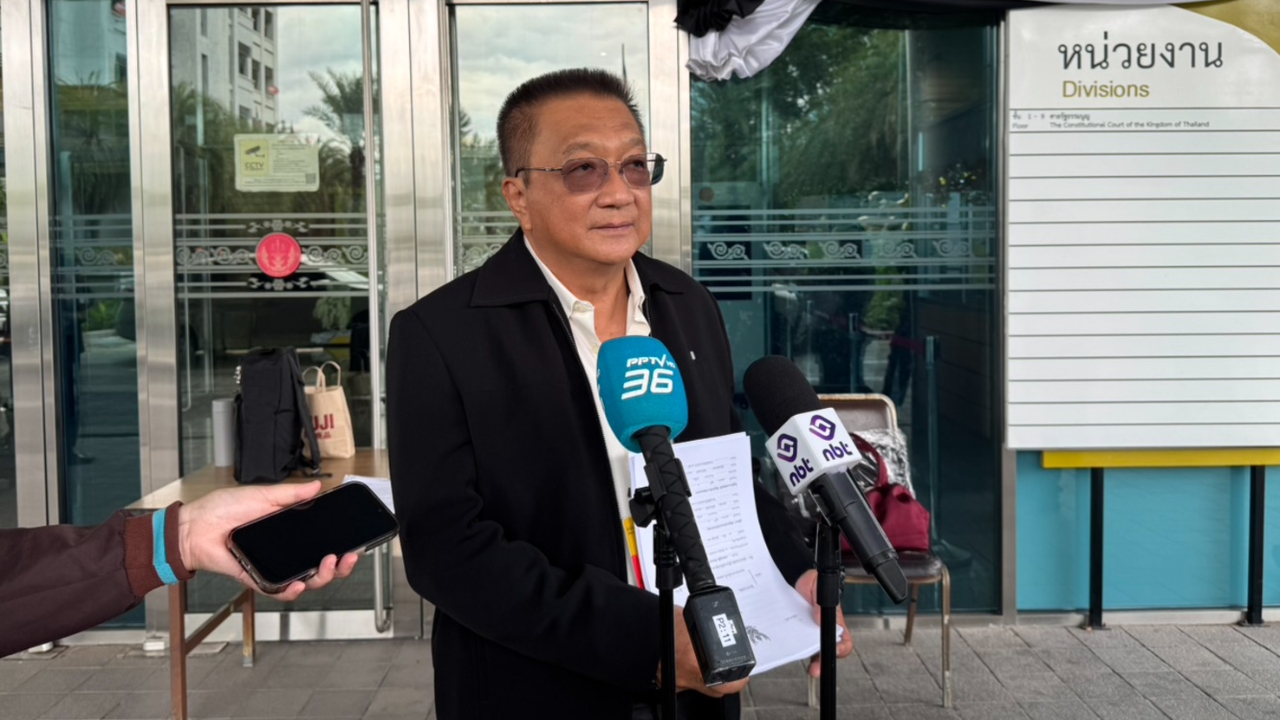
“Chanchai” has submitted additional clarifications to the Constitutional Court concerning the QR code and barcode on election ballots, emphasizing that the Election Commission (EC) has admitted these ballots can be traced back, implicating themselves. He requests to call “Somchai and his team” as witnesses to provide further information.
At 10:50 a.m. on 20 May 2026 GMT+7, Mr. Chanchai Isarasena Rak, former Member of Parliament (MP) for Nakhon Nayok, told reporters at the Constitutional Court office that he had submitted additional clarifications as the petitioner to the Ombudsman, asking the Constitutional Court to rule whether the Election Commission's printing of election ballots containing QR codes and barcodes violated the constitutional principle of secrecy in general elections under Article 85. He said the court requested clarifications on five points, such as whether he saw the use of barcodes or QR codes on election day and how the presence of these codes could compromise the secrecy of the election. He explained that he had seen such ballots on election day, which seemed unusual compared to previous general election ballots, and submitted evidence of past ballots without barcodes or QR codes for the court’s consideration.
An interesting point is the case where the EC itself admitted in its clarification to the Ombudsman dated 13 March 2026, complaint numbers 544/2569 (black) and 342/2569 (red), appearing on page 8 line 24 and page 9 line 26, that the QR code can be scanned to retrieve information to verify printed ballots, prevent ballot stuffing or election fraud, and protect against ballot forgery. This confirms that the printed ballots with barcode and QR code can be traced back to identify the voter.
“Importantly, the Terms of Reference (TOR) for the printing contract clearly states that the ballot printing is to prevent fraud such as forgery, overprinting, and unauthorized use outside the district, listing at least six minimum conditions. Clause 2 specifies that printing with ink, patterns, or other methods must prevent forgery. The TOR forbids contractors from printing barcodes and QR codes on ballots, requiring the use of invisible ink and blocking scanning. This means the EC violated the TOR in printing ballots with barcodes and QR codes, yet still used these ballots in the election. This may violate the principle in Article 85 of the Constitution.”
He also requested the Constitutional Court to summon witnesses including Mr. Somchai Srisutthiyakorn, former EC member, Mr. Thamthee Sukchotirat, Mr. Thanarat Kuawatthanaphan, and Mr. Chaipon Chawalavanich, experts on barcode and QR code implementation on ballots, to provide factual testimony to demonstrate that scanning ballots could trace the voter’s identity. This would allow the court to see why the election process is not impartial or secret.
When asked if the EC had explained to the Ombudsman about the scanning condition that could trace voters, Mr. Chanchai replied that the EC admitted it was to prevent forgery and that the law grants such authority. He said that although there are laws against vote buying, it cannot be fully prevented. He had previously sued to obtain all ballots, used and unused, and immediately knew who voted for whom. He questioned whether polling station officials who distribute ballots know who receives which numbered ballot, and if fraudsters watch the vote counting, they can know who cast each ballot.
Mr. Chanchai concluded by saying, “I have written detailed explanations for the court to see each step. We have known for a long time that embedding codes in ballots enables tracing. So, if laws are said to prevent access, we actually knew this on election day. I believe the court wants facts from all sides and will thoroughly consider this important matter as it affects public trust. If elections are not fair, just, and secret, the system breaks down and loses credibility. The election system would then undermine democracy, and those who control elections would be the ones destroying the system. I thank the Constitutional Court for accepting this case and the Ombudsman for forwarding it. The EC’s clarifications to the Ombudsman helped us understand more, confirming what we already knew. We just want to hear from the EC directly on how they will rectify their mistakes.”