

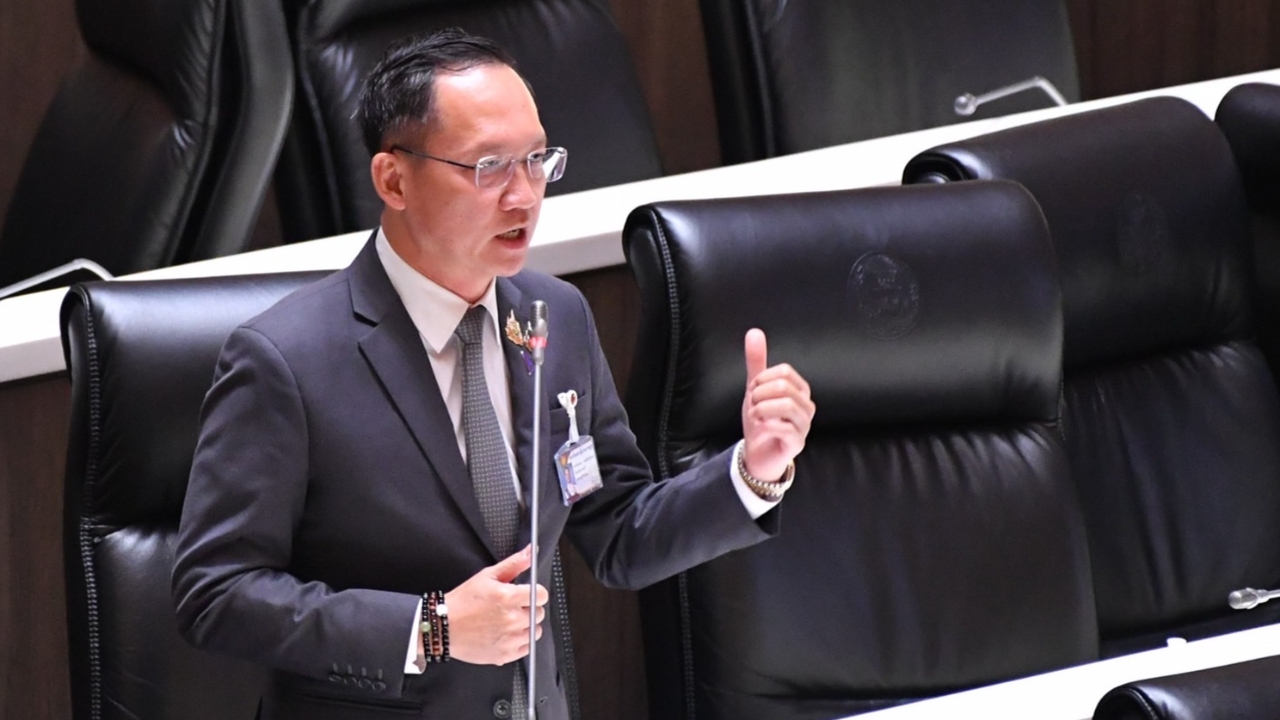
Akkharadej, MP for Ratchaburi from the Bhumjaithai Party, has proposed amending the law to increase the authority of railway officials to directly manage traffic within railway zones, aiming to reduce accidents and promote road user discipline.
On 20 May 2026 at the Parliament, Mr. Akkharadej Wongpitakroj, MP for Ratchaburi from the Bhumjaithai Party, spoke in support of an urgent motion calling on the House of Representatives to consider studying ways to resolve issues and raise safety standards for rail transport in urban areas, as well as to provide relief to victims of an accident where a train collided with a public bus near the Asoke-Din Daeng intersection. He emphasized that the main cause of road accidents in Thailand is the lack of traffic discipline. If road users strictly follow the law, such losses and other accidents would significantly decrease. However, as a legislator, he sees the need for systemic legal reforms to create mechanisms that enforce and instill traffic discipline effectively.
Mr. Akkharadej added that the Railway of Thailand’s law has been in place for several decades, while the organization itself is over 100 years old. He proposed amending the law to grant railway officials the authority to manage traffic directly within railway zones without relying solely on police officers.
"Today, we must reconsider whether we have fully empowered railway executives and officials. Currently, they still depend on traffic police, who have many duties and limited personnel. If the law is amended to allow railway officials to enforce traffic discipline, issue tickets, or detain and fine violators at railway barriers and crossings immediately, this would be an important measure to instill traffic discipline among the public," he said.
Furthermore, Mr. Akkharadej cited the example of the Department of Highways, which in the past relied on police to apprehend overloaded trucks that damaged roads. After legal reforms empowered the department’s officials to set up weigh stations and prosecute offenders independently, enforcement became more effective. He believes this model could also be applied to railway law.
Mr. Akkharadej also noted that many accidents occur because people violate railway zones, such as removing barriers to graze cattle or illegally creating their own crossings. He said that having strict law enforcement and dedicated officials to oversee these areas would reduce risks and prevent losses. He therefore submitted this proposal to the government, relevant agencies, and fellow parliament members to collaboratively amend the law to increase railway officials’ authority to strictly manage traffic violators in railway zones.