

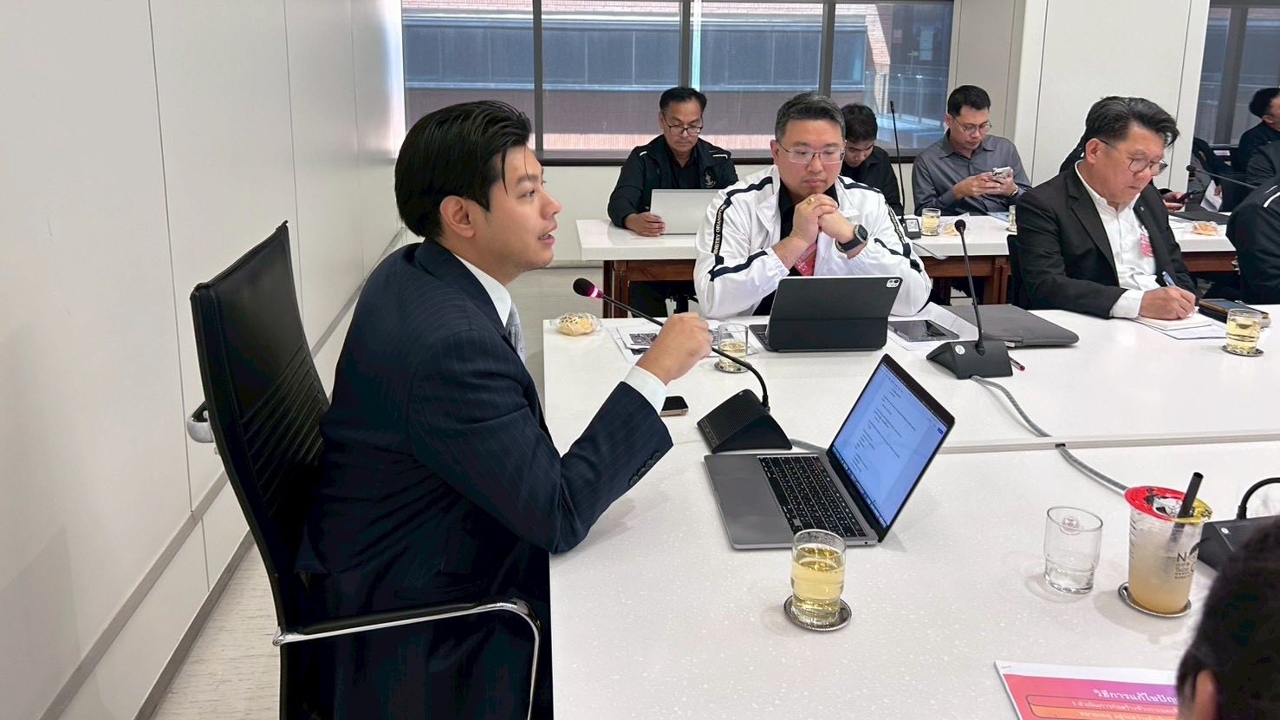
Suphanat pointed out that the train-bus collision was caused by systemic shortcomings, revealing numerous problems. He proposed that insurance companies and related agencies review insurance coverage limits.
At 14:30 on 20 May 2026 at the Parliament, Mr. Suphanat Meenachainan, Chairman of the Transportation Commission, held a press conference presenting the results of a meeting regarding compensation for fatalities from the train-bus collision at the Asoke-Din Daeng intersection. The meeting included explanations from relevant agencies such as Mr. Pichet Khunathamrak, Director-General of the Department of Rail Transport; Mr. Thayakorn Chantrangsu, Director of the Safety and Maintenance Standards Division, Department of Rail Transport; Mr. Cheep Nomsian, Deputy Director-General of the Department of Land Transport; Mr. Anan Phonimdang, Acting Governor of the State Railway of Thailand (SRT); Mr. Kittikan Jomduang Jaruworapolkul, Director of Bangkok Mass Transit Authority (BMTA); Police Major General Thawat Wongsanga, Deputy Commissioner of Metropolitan Police; Police Colonel Kampol Rattanaprateep, Deputy Commander of Metropolitan Police Division 1; and Police Colonel Uramphon Kundetsamrit, Superintendent of Makkasan Metropolitan Police Station.
The meeting concluded that the total compensation per fatality is 2,390,000 baht, divided as follows: 1,750,000 baht from insurance companies and related firms, 340,000 baht from the State Railway of Thailand, and 300,000 baht from the Department of Rights and Liberties Protection. However, full payments have not yet been made because two deceased individuals’ identities remain unverified, and six others have issues with inconsistent or missing ID numbers in the system, preventing insurance claims. Coordination is ongoing, especially with the police, to provide data needed for disbursement.
There was a proposal for insurance companies and relevant agencies to review insurance coverage limits and premiums to better align with the actual level of protection and risk. The State Railway of Thailand confirmed that its current railway signalling system complies with international standards, featuring signal lights that control train movements. A green signal authorizes travel, while other signals serve as warnings to proceed cautiously but do not directly require stopping, except when a red flag is displayed or no staff are present at the point, which demands stopping or maximum caution.
Regarding the investigation, discrepancies were found in the CCTV footage timestamps. This was due to each agency using different time systems, causing some data to be incomparable and revealing a systemic issue that must be addressed.
As for communication between train drivers and station staff, operations followed standard procedures, but suggestions were made to improve by installing cameras and display screens to enhance visibility and safety.
Regarding drug testing, there is currently no regulation requiring routine tests during work shifts. Tests are conducted only at the start of employment and when renewing licenses. However, new regulations are being considered to increase testing frequency and strictness.
Recommendation to jointly manage railway crossings.
Concerning train braking distances, the railway explained that braking distance depends on load and operating conditions. Some proposed distances do not reflect actual operating conditions because sudden braking could compromise train safety.
Regarding railway crossings, there are many crossings across various areas. Requiring trains to stop at every crossing would disrupt the entire rail system. Therefore, coordinated management among relevant agencies is necessary.
Concerning traffic management, it was found that local officers must handle multiple roles simultaneously, including traffic control, signal operation, and coordination, resulting in heavy workloads. Some traffic light systems operate on fixed timers rather than adapting to real traffic conditions. Bangkok still faces limitations in automatic traffic signal systems, which are not yet widely installed, leading to reliance on traffic police for on-site management.
Lack of a central standard.
Law enforcement coordination between police and the railway still lacks a clear central standard, leading to ad-hoc agreements, such as notifying when a train will pass a crossing without a unified protocol. Limitations were also found in linking traffic light data with train movement data, preventing a fully integrated real-time warning system.
Regarding infrastructure, some traffic signal systems are not fully integrated with intelligent systems and are installed only at select points, causing inconsistent traffic management. Future rail and mass transit projects, such as high-speed rail and network integration initiatives, are under consideration for restructuring and new investment approaches to accelerate implementation.
On law enforcement, there is currently no clear central standard among relevant agencies, causing operations to rely heavily on officers’ discretion, both police and railway staff.
CCTV data not reaching police.
Suphanat also identified limitations in CCTV installation for law enforcement in some areas, where traffic violations cannot be fully detected or prosecuted. Some footage is not systematically forwarded to police agencies.
"Overall, the problems reflect the complexity of joint management among multiple agencies involving infrastructure, signalling systems, law enforcement, and data coordination, which require systemic improvements to enhance public safety in the long term," said Suphanat. Suphanat stated.