

The Phuket Governor pointed out that solving the issue of public land encroachment in the area requires strict legal enforcement. Plans are underway to update the definition of "influential persons" for inclusion in a red list database. He revealed that disorderly behavior among foreign tourists has decreased after inviting consulates in Phuket for discussions.
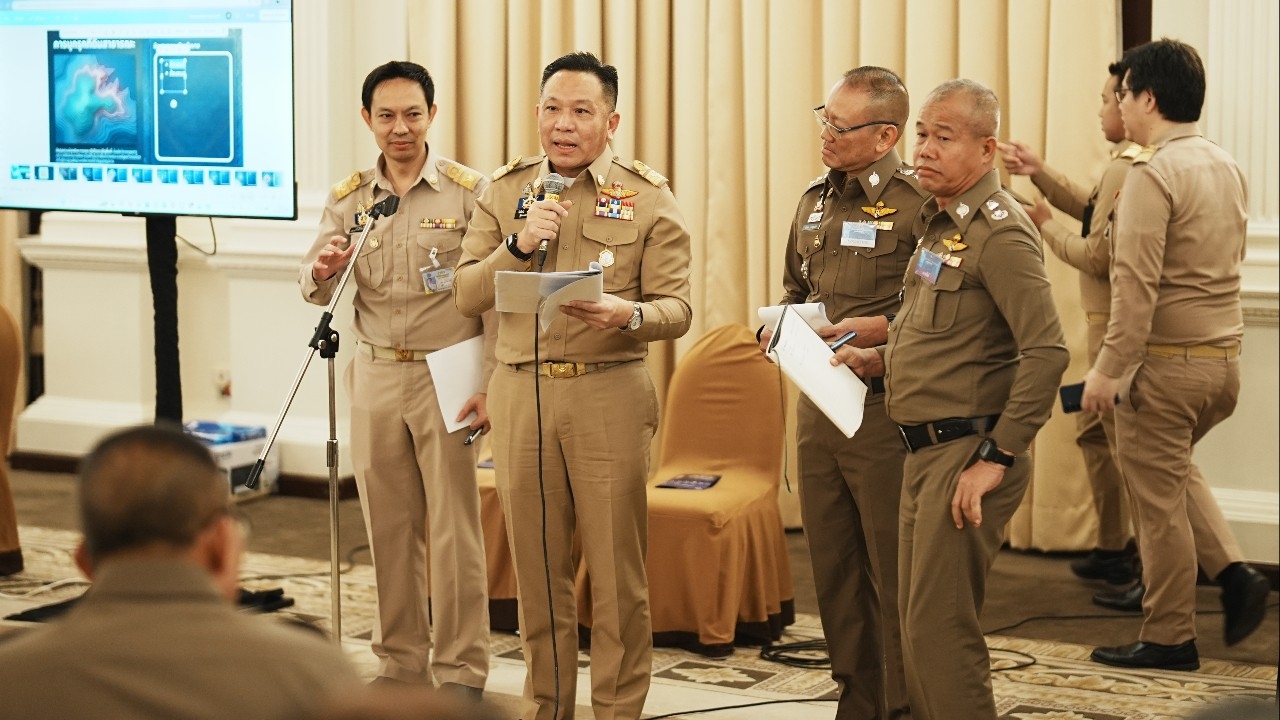
At 13:30 on 21 May 2026, at the Santimaitri Building, Government House, a workshop was held to present progress on security efforts aligned with government policy. Mr. Nirat Pongsitthaworn, Governor of Phuket Province, summarized various local issues, especially public land encroachment. There was consensus that fair land allocation, land management, and decentralization are necessary. Land encroached upon by investors using locals as fronts must be strictly handled by law. For less severe public land issues at the provincial level, local authorities can manage, but in high-value areas like Phuket and Surat Thani, there is strong competition for control. Central agencies must intervene on-site rather than leaving provincial officials to handle it alone; otherwise, the problem may persist indefinitely.
Mr. Nirat added that relevant agencies, including the Royal Forest Department and the Department of National Parks, Wildlife and Plant Conservation, need to conduct on-site management because all detailed information rests with them. Field agencies currently act based on documents and tangible evidence, while provincial administrative and police authorities can only proceed with court orders. For deeper interventions, the concerned agencies must come to investigate.
Mr. Nirat also addressed the issue of influential persons, noting that the police have requested an updated, clearer definition to aid in creating a database and red list for further action. It is crucial to prevent the problem from growing, as expansion would complicate enforcement. Subsequent steps involve suppression and witness protection according to security procedures. Additionally, the problem of informal debt is nationwide; although less severe in the South, mechanisms must be established down to the district level. Police and administrative officials agree on this approach.
Regarding tourist safety, while general areas focus on tourists being victims of assaults, the South has an increasing issue of tourists being involved in or causing disturbances among locals, especially in densely populated provinces like Surat Thani, Phuket, Krabi, and Phang Nga. Solutions include controlling risky businesses and activities lacking legal regulation, such as foreign rental car operations which currently have no regulatory framework. It has been proposed to enact laws covering these areas, including unregulated boats and water activities. Additionally, real-time CCTV systems need to be developed.
Mr. Nirat further stated that cooperation has been established with embassies and consulates to ensure tourists comply with Thai laws. At the end of last month, all consulates in Phuket were invited to discuss the overall situation, including in-depth talks about nationalities of concern. The discussions were serious, emphasizing uncompromising law enforcement. It was clearly communicated that legal actions will proceed regardless of tourism impacts, with severe offenses resulting in deportation and blacklisting if imprisonment occurs. This approach has led to a calm and stable situation locally after firm enforcement measures.