

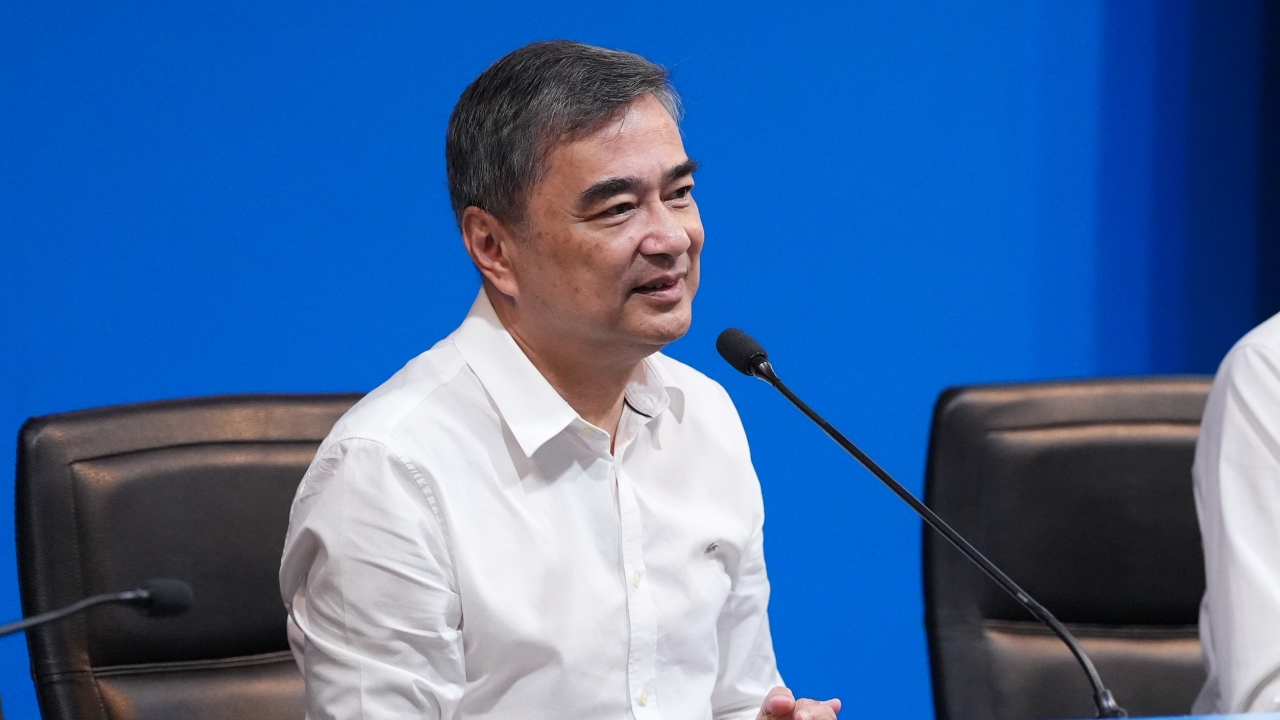
Abhisit summarized the Democrat Party's efforts to revive people's law bills, advancing five bills in one week, pushing constitutional amendments to establish a constituent assembly while prohibiting changes to Chapters 1-2, and continuing to file a conflict of interest investigation against Sak Siam.
21 May 2026 GMT+7 Mr. Abhisit Vejjajiva, party-list Member of Parliament and leader of the Democrat Party, gave a special interview through the party's team. He summarized the Democrat Party's legislative and oversight activities over the past week. This represents proactive opposition work to restore citizens' rights, close legal gaps neglected by the executive, and vigorously push important laws and anti-corruption measures.
Abhisit revealed that after the Cabinet decided not to endorse several important bills pending from the previous parliament, public efforts had to start over this week. Democrat MPs jointly reintroduced these bills to the parliamentary agenda, revamping content previously approved by the special committee as a balanced compromise among sectors, strengthening them further, including:
The draft Royal Decree on Pollutant Release and Transfer Register (PRTR). The Democrat Party's version retains the original content agreed upon by civil society and business sectors but shortens the transitional period from five years to two years to accelerate raising Thailand's environmental standards to meet the criteria for joining the Organisation for Economic Co-operation and Development (OECD), aligning with national milestones.
The labor protection bill focuses on eliminating all forms of discrimination in workplaces. It revises the previously completed committee draft slightly to keep pace with changes in the modern labor market.
The village health volunteer (VHV) bill aims to elevate and legally recognize their status, establish ethical standards, and define benefits for frontline health workers. The Democrat Party added a “VHV Welfare Fund” mechanism to provide concrete life security guarantees.
Beyond these people's relief laws, Abhisit noted the party has completed two core policy bills ready for submission to parliament:
1. The draft amendment to the Official Information Act B.E. 2540 (1997), updating rules requiring government agencies to create and store data digitally to enhance transparency and enable open data sharing. It also streamlines appeal processes to ensure faster and fairer responses when the state refuses information disclosure.
2. The draft SME Council Act to establish a central organization representing SMEs nationwide to counterbalance and negotiate power. It includes provisions mandating the state to implement concrete SME promotion measures, such as setting quotas for government procurement.
Regarding transparency oversight, Abhisit stated the party’s legal team reviewed the National Anti-Corruption Commission (NACC) statements that former Transport Minister Sak Siam Chidchob did not intentionally falsify asset declarations nor interfere with procurement.
“The Democrat Party believes the Constitutional Court's past rulings bind all organizations and have clearly indicated Sak Siam's actions constitute a conflict of interest under the NACC Act, Section 126. Therefore, Democrat MPs have jointly filed a petition with the NACC to investigate and adjudicate this violation according to legal standards.”
On political developments regarding constitutional amendments, Abhisit acknowledged the Democrat Party lacks sufficient MPs alone to propose amendments under constitutional rules, so it has begun negotiations with parties sharing similar ideologies and challenges to jointly push amendment drafts. They plan to submit the joint draft next week, focusing on three key points.
1. The constituent assembly's composition must be widely representative, genuinely involving public participation. The parliamentary voting mechanism must be designed to distribute seats fairly, preventing monopolization by vested interests or parliamentary majorities.
2. The new constitution drafting will exclude amendments to Chapter 1 (General Provisions) and Chapter 2 (The Monarchy), recognizing these areas as sensitive to state security and societal sentiments.
3. The parliamentary ratification process of the drafted constitution will be improved to prevent minority groups with special conditions from blocking the legislation, ensuring democratic mechanisms can proceed.
“All these activities represent the legislative work the Democrat Party has advanced this week.”