

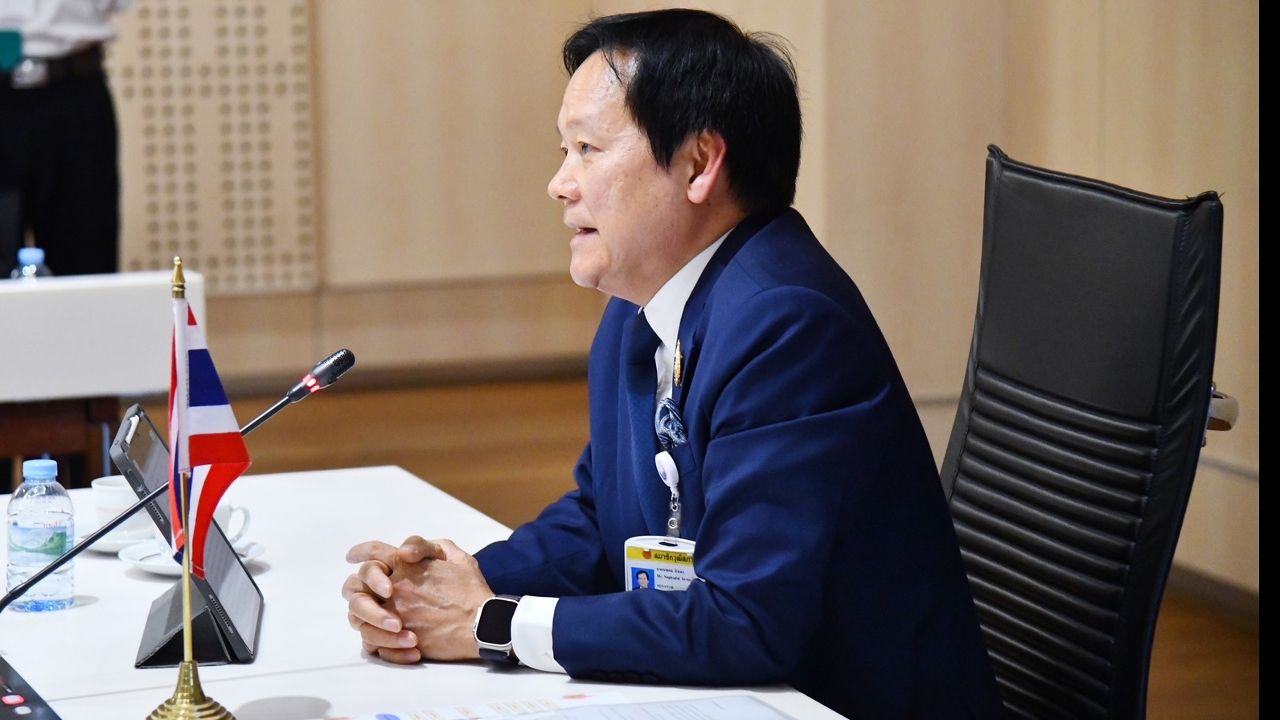
Senator Noppadon explained to ASEAN+3 ambassadors that the Thai government canceled MOU 43 because it failed to resolve border disputes, criticizing Cambodia for repeatedly violating agreements over the years and occupying Ban Nong Chan and Chong An Ma.
At 11:30 a.m. on 22 May 2026 at the Parliament, Senator Noppadon Inna, chairman of the special committee studying the pros and cons of canceling MOUs 43 and 44 to resolve Thai-Cambodian border issues, briefed ambassadors from 12 countries stationed in Thailand, including Indonesia, Japan, Malaysia, Myanmar, the Philippines, Timor-Leste, and Vietnam, as well as representatives from China, Laos, South Korea, Brunei Darussalam, and Singapore.
Mr. Noppadon stated that the conflict along the Thai-Cambodian border is well known. The factors leading to Thailand's decision to cancel MOUs 2543 and 2544 relate to border and resource disputes, overlapping land and maritime areas, which are sensitive issues historically, legally, and in terms of national security.
Recently, public concern and legislative worries have arisen over security impacts, territorial sovereignty, and national interests potentially affected by MOUs 43 and 44. Ambiguities in the border line under negotiation, impacts on managing overlapping areas, misunderstandings, differing interpretations of reference documents such as the 1:200,000 scale map, and repeated violations have led to social calls to "cancel, amend, or review both MOUs" to create a new cooperation framework aligned with national interests.

The special committee studied this issue comprehensively, gathering information from the army, navy, and the Department of Treaties and Legal Affairs at the Foreign Ministry. They also visited seven border provinces adjoining Cambodia and invited representatives from the 1st and 2nd Army Regions and the Ministry of Defense to provide information on border clashes. This thorough investigation provided valuable insights for the committee's study, especially regarding the situation on the ground.
Mr. Noppadon continued that Cambodia has violated Thai territory by sending Cambodian civilians to trespass hundreds of times. Thailand has protested in writing repeatedly, but Cambodia has often ignored these objections. He gave two clear examples to illustrate the long-standing challenges Thailand faces at the border. First, Ban Nong Chan in Sa Kaeo Province is Thai territory, but after the 1979 Cambodian war, many Cambodians fled hunger and conflict and crossed into Thailand. At that time, the Thai government, with international organizations like the UN High Commissioner for Refugees, the International Committee of the Red Cross, and the Thai Red Cross, provided humanitarian aid and protection to hundreds of thousands of Cambodian refugees in camps including Nong Chan. Although the camp was later closed, some Cambodians refused to leave and occupied Ban Nong Chan until the July 2025 clashes.
The second example is Chong An Ma in Ubon Ratchathani Province. Out of goodwill and humanitarian concern, Thailand allowed Cambodian villagers temporary access for trade and local product sales. However, over time, about 200 households gradually settled permanently within Thai territory. These are just two examples among at least 15 similar incidents on Thai soil over many years. After careful and comprehensive study, prioritizing national and public interests and honoring soldiers' sacrifices, the special committee unanimously decided to cancel MOUs 2543 and 2544.
The main reason for canceling MOU 2543 is that it conflicts with the constitution and related laws. The Cabinet only acknowledged it on 13 June 1999 without formal approval. Furthermore, acceptance of the 1:200,000 scale map, created by the Siam-Indochina Boundary Commission, effectively altered Thailand's territory, conflicting with the 1904 Convention provisions. Thus, MOU 2543 may be seen as a treaty changing Thai territory without parliamentary approval as required by the Thai constitution.

Mr. Noppadon added that the border map under MOU 2543 was not endorsed because Cambodia's own constitution mandates its territorial integrity must not be violated. Therefore, the map would not be recognized by either Thailand or Cambodia, rendering past efforts futile.
The survey and demarcation of the Thai-Cambodian land border under MOU 2543 have made little progress over nearly 26 years, currently only about 60% complete of the first of five planned phases. After two major clashes in 2025, the border situation changed drastically. The MOU 2543 framework is no longer fully applicable. Thailand and Cambodia must adhere to the joint declaration of the 3rd special GBC committee meeting on 27 Dec 2025 as the initial international treaty framework for peaceful coexistence. Cambodia has violated agreements and provoked incidents for its own advantage and misinformation. Any agreement with Cambodia requires more caution and rigor than usual, and MOU 2543 lacks such safeguards.
Regarding canceling MOU 2544, Mr. Noppadon said the key point is Cambodia's 1972 continental shelf claim clearly violates Thai sovereignty, so it should not be part of any negotiation framework. Cambodia demonstrated unwillingness to comply with the MOU, proposing on 16 Dec 2022 to share petroleum resources in overlapping continental shelf areas equally 50:50, indicating no intent to resolve the dispute. Cambodia continues to claim sovereignty over Thailand's Koh Kut Island, either wholly or partially. Given the political and social environment, Cambodia's insincerity negatively affects negotiations, including excessive territorial claims without legal basis, especially regarding the continental shelf ignoring Thai sovereignty around Koh Kut, and other actions.
Mr. Noppadon concluded that if the Thai government proceeds with canceling both MOUs in the future, he hopes the international community will understand the necessity of this action.