

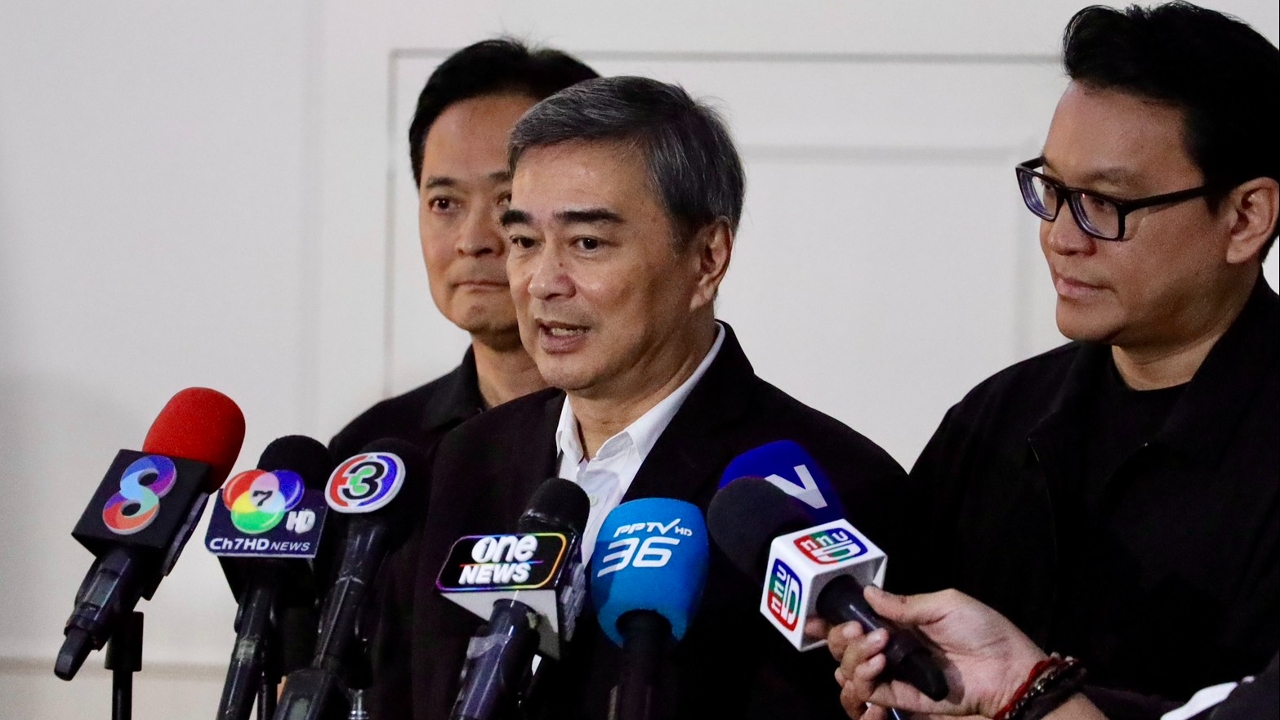
Abhisit reveals that next week the Democrat Party will finalize and submit their constitutional amendment draft. He criticizes the Bhumjaithai Party's formula for selecting the Constitution Drafting Assembly (CDA) as confusing and excluding public participation, while raising concerns about attempts to increase the Senate's power. He emphasizes the necessity of conducting a referendum.
At 10:50 a.m. on 22 May 2026 at the Democrat Party headquarters, Abhisit Vejjajiva, party-list MP and leader of the Democrat Party, discussed the submission of the constitutional amendment draft. He said the party lacks enough MPs to submit the draft alone, so it is consulting with other parties also short of members. They agree on two main principles for submission: 1. The process must create a Constitution Drafting Assembly (CDA) with genuine public participation, unlike Bhumjaithai Party's draft; 2. There must be no amendments to Chapters 1 and 2, differing from the People's Party draft. Although there are some differences in details like the CDA selection and constitution approval between the parties, they expect to reach an agreement next week to submit the draft. Each party is preparing proposals to be discussed then. Abhisit noted that Bhumjaithai's draft clearly differs regarding direct public participation, only involving registration without broader engagement. Additionally, the CDA selection method has issues, with confusion around principles, proportions, and provinces.
Criticism of Bhumjaithai Party's confusing CDA selection formula.
When asked about Bhumjaithai Party submitting the draft under their party's name, instead of the Cabinet which typically proposes important laws, Abhisit said it is not necessary. Whether the government takes a stance is a separate matter. The government did not include this in its policy from the start, so it is unsurprising there is no Cabinet draft, as the government does not wish to pursue this issue, leaving it to political parties. This is a valid position, but public acceptance may vary. Regarding public participation, he questioned the necessity of having citizens directly elect the CDA, which might conflict with the Constitutional Court's rulings. His idea is to use electronic polling, allowing people to express opinions on CDA members via an electronic system. This would broaden public involvement and reduce costs compared to general elections. For those without phones, citizens could register in their local subdistricts to participate. This is not an election but a polling process; thus, the resulting names are not final and must be further selected by the parliament.
Increasing Senate power requires a referendum.
When asked about granting the Senate (SEN) the power to approve the new constitution draft before the referendum, Abhisit said supporters argue it aligns with the current constitution's approval process, but opinions differ on its suitability. Bhumjaithai Party has reduced the required number from one-third to one-fourth, and the Democrat Party is considering lowering it further. Whether to grant this special power is debated, as some senators want it included. He noted that the constitution, as a rule for all, aims to prevent the majority from deciding everything. Even if the parliamentary majority exists,
if the number of senators or opposition is below a certain level, it should be possible to raise objections. Without any threshold, the majority could control all aspects of drafting the constitution, leaving minorities without rights. The approval process for the draft constitution, prepared by the CDA before the referendum, is not proposed by MPs or political parties but drafted by the CDA, which is bound to parliament.