

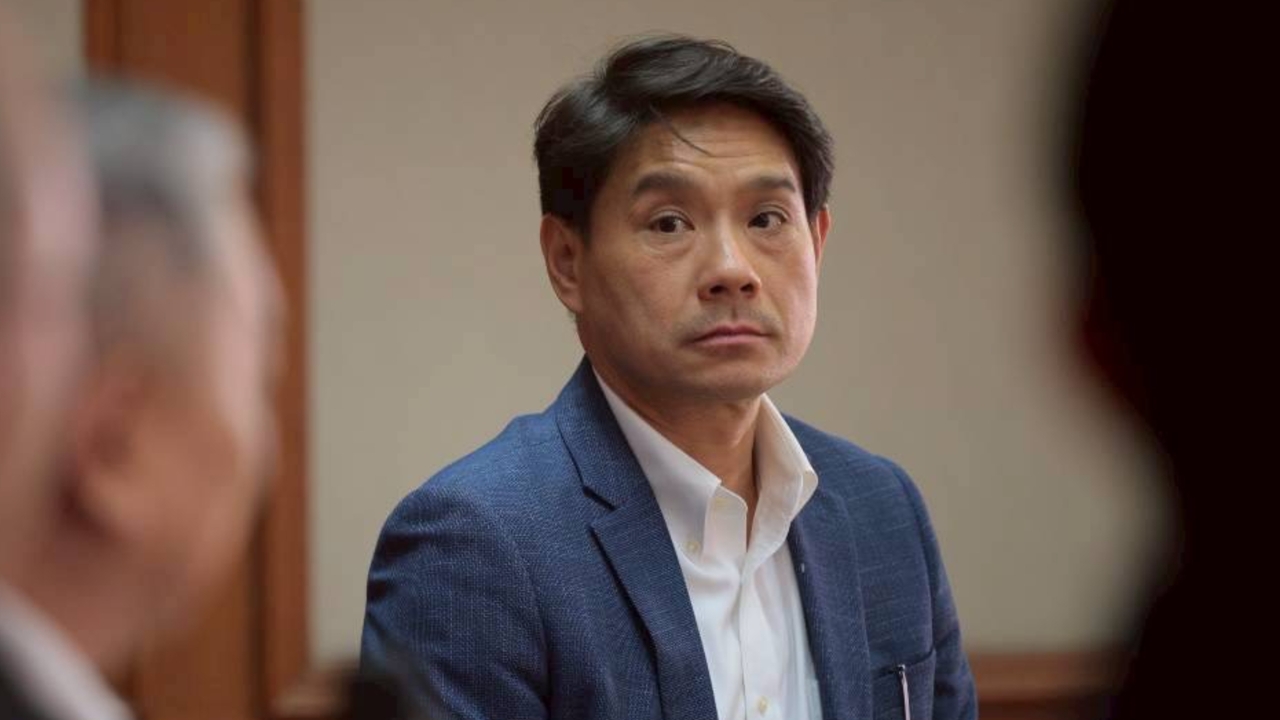
Pichan pointed out that Thai politics in the 12 years following the 2014 coup merely changed the "medium" to a "blue regime," urging the public to unite in pushing for a new constitution that is a true democracy of the people. The People’s Party calls for public empowerment to drive this change.
On 23 May 2026 at Thammasat University, Tha Prachan campus, Pichan Chaowaphatwanwong, Secretary-General of the People’s Party, joined a panel discussion launching the book "(Not) Changing Thai Politics 2023–2026." Pichan said that yesterday (22 May) marked 12 years since the 2014 coup. At first glance, Thai politics seem to have transitioned from military dictatorship to a government elected by the people, but in reality, the only change is in the shift of the "medium" only, as power was transferred from the "deep state" and unseen hands.
In the 2019 election, the medium changed from the military and army to a government that perpetuates power. Although it lacks powers under Article 44, the structure still supports it. Later in 2023, a "shift in factions" government was formed, marking another medium change. Most recently in 2026, even though the government gained legitimacy from election results and no longer holds Article 44 powers, in practice it seems to wield more absolute power than Article 44, using authority through independent agencies, MPs, and Senators under what the People’s Party calls the "blue regime."
What remains unchanged in Thai politics, in Pichan’s view, is that governments remain linked to capital groups and elites, overlooking or neglecting the people's interests. A clear and close example is the energy pricing structure or electricity bills, where the public bears the burden of the "standby charge" inherited from past governments. Despite government changes and some efforts, this structure remains unresolved without concrete results.
Moreover, large state projects continue to see winning bidders from capital groups who do not initiate the projects but negotiate with the government to amend contracts and conditions won in the bids. So, if asked whether Thai politics has truly transitioned, Pichan believes the medium has changed, but politics still remain tied to power groups, elites, and capital, neglecting the people’s interests.
Pichan further stated that the main factor hindering this transition is the 2017 constitution, a legacy of the 2014 coup. He proposed a three-phase transition approach: in the short term, demanding the legislative branch, the House of Representatives, to intensify oversight of independent agencies to ensure transparent functioning, using mechanisms such as parliamentary committees.
In the medium term, if the representatives agree that the 2017 constitution has issues, they don’t have to wait solely for constitutional amendment but can collaborate to amend organic laws immediately, such as the political party dissolution law. If a majority in the House agrees, they can proceed with amendments directly.
In the long term, regarding constitutional amendments, Pichan noted that the recently submitted draft amendment by the Bhumjaithai Party was not proposed in the name of the Cabinet. While this might be an attempt to seek consensus, it could also be a political power grab, especially the condition in the Bhumjaithai draft that increases Senators' power by requiring at least one-quarter of Senators to approve any full constitutional amendment — a condition absent from the 2017 constitution. The People’s Party strongly opposes this and doubts whether this method will yield a constitution truly belonging to the people.
Additionally, there is the issue of the selection of the Constitution Drafting Assembly (CDA). Although there is a Constitutional Court ruling acting as a barrier, if interpreted strictly, there is no indication prohibiting indirect election of the CDA members.
Pichan emphasized that the People’s Party values public participation to achieve a truly people’s constitution. They call on all political parties to declare their stance through their own drafts. The People’s Party is ready to co-sign with any political party proposing amendments, provided the draft does not conflict with the party’s principles, allowing multiple drafts to be considered in Parliament.
The People’s Party Secretary-General added that true transition is not just about making social rules fairer; the key is the power of the people. He cited an example from South Korea, where the public united to oppose a coup attempt, causing it to fail within hours. Such popular power to collaborate and create change is what will enable Thailand to transition and achieve real transformation.
To make the people’s voice truly powerful in changing the country, all sectors must participate. The People’s Party works politically on this approach, encouraging public involvement in policy design and candidate selection.
However, it must be acknowledged that there is a troubling reality in Thai politics. Recently, the People’s Party expressed concern about Prime Minister Anutin Charnvirakul’s administration, particularly regarding the principle that “The King can do no wrong,” meaning the monarchy stands above conflict and politics. Therefore, government policies should not create perceptions of links to the Privy Council, which advises the King.
This is a very sensitive matter, and the Prime Minister should carefully and appropriately manage the monarchy’s status. Although the government needs to report to and hear from the Privy Council, it must clearly separate advisory areas from administrative ones. If advice is needed, mechanisms between the Prime Minister’s office and the Royal Household or Privy Council should be confidential and appropriate, not publicly disclosed. Otherwise, policies might raise public concerns about ties to the monarchy and whether those policies affect the institution.
“Anutin is a long-time politician and should know what is appropriate or not. The meeting allowing media to record and broadcast images is, in my view, a government effort to show officials, capital groups, or the public whether this administration is connected to the Privy Council,” Pichan observed.
Pichan concluded that last week the People’s Party communicated this issue straightforwardly to explain to the public, believing it will raise awareness that the power to establish the constitution and form the government belongs to the people, which is the ultimate goal of their political work.