

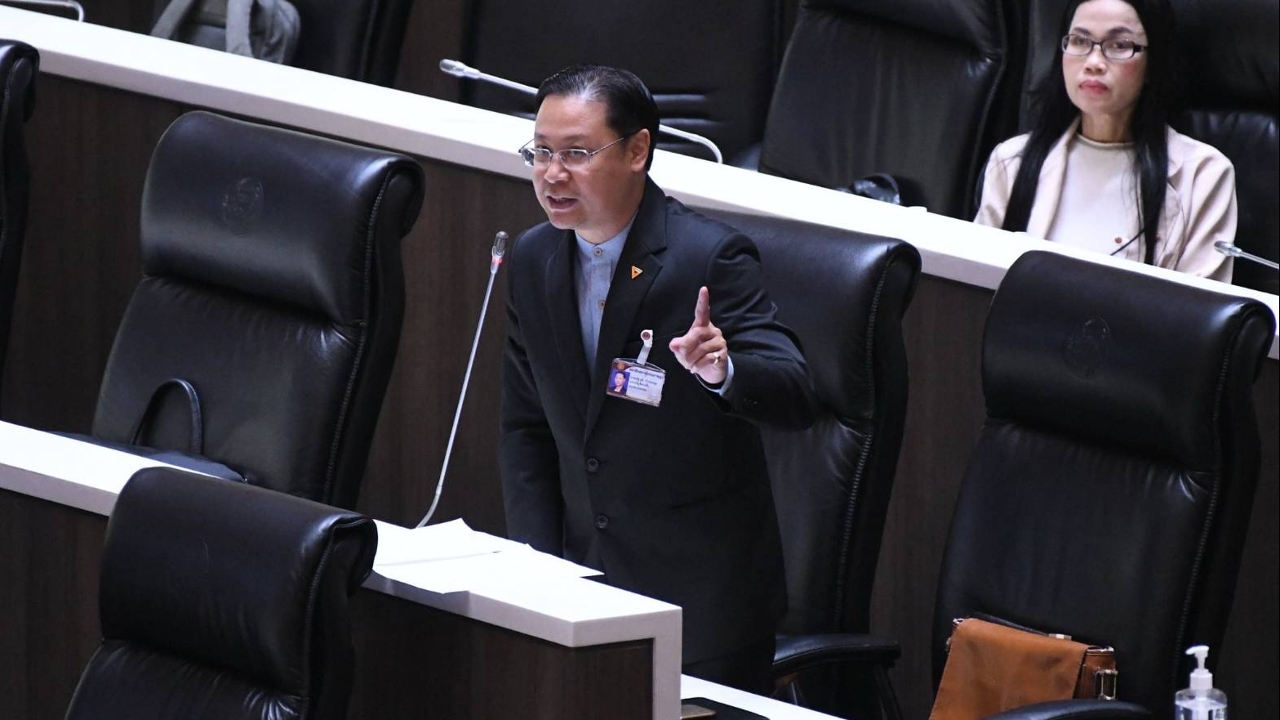
Nattawut urges the government to speed up legal reforms to align with "marriage equality" after 480 days remain unfinished, emphasizing the need to safeguard the rights of all married couples and not let Pride Month be just an annual event.
On 24 May 2026, Nattawut Buapathum, a party-list MP from the People’s Party, called on the government to promptly monitor the review and amendment of laws to align with the Act Amending the Civil and Commercial Code, or the marriage equality law, which has been in effect since 23 January 2025. He noted that Section 68 of the marriage equality law requires responsible state agencies to evaluate outcomes and review related laws, then submit draft amendments to the Cabinet within 180 days from the law’s enforcement date, which expired on 19 July 2025. As of today, more than 480 days later, these legal amendments remain unfinished.
The laws needing amendment can be divided into two main groups. The first group includes about 70–80 laws that, although not yet revised to match the new legal definitions of spouses, automatically recognize the rights of same-sex spouses, such as inheritance and medical care rights. The second group includes three crucial laws that, if the government does not urgently amend, will significantly affect the rights and duties of LGBTQ+ spouses. These are:
(1) The Revenue Code, specifically regarding tax duties and rights related to children or adopted children.
(2) The Child Protection Act for Children Born via Assisted Reproductive Technology 2015, or the Surrogacy Protection Act, which currently limits rights exclusively to heterosexual married couples where the wife cannot conceive naturally. Without amendments, male-male or female-female couples cannot legally access surrogacy rights.
(3) The Nationality Act 1965, which currently imposes different conditions for acquiring Thai nationality. It allows foreign women married to Thai nationals to apply more easily, but this case accounts for only one-fifth of all marriages between Thai nationals and foreigners. Other marriage types, including those of LGBTQ+ individuals, face unfairly stricter nationality conversion criteria.
Nattawut added that regarding the surrogacy law, the responsible agency, the Ministry of Public Health, has expressed concerns about risks and loopholes potentially leading to human trafficking. Meanwhile, the Ministry of Interior is worried the Nationality Act could be exploited for sham marriages to gain nationality. However, he believes these issues can be addressed by designing protective mechanisms and that legal amendments remain essential to ensure no one loses their rights.
Furthermore, in the previous House of Representatives, Nattawut, serving on the Committee on Children, Youth, Women, the Elderly, the Disabled, Ethnic Groups, and LGBTQ+ Affairs, invited the Ministry of Public Health and the Ministry of Interior to report on progress in reviewing and amending the laws. Both agencies only stated they were drafting amendments and gathering public feedback, then went silent afterward.
Nattawut further stated that during the recent election campaign, the People’s Party pledged to advance amendments to these three laws, while thoroughly consulting all related parties. In the latest parliamentary session, he emphasized that the upcoming Pride Month in June should not be reduced to a mere annual government event. Instead, the government must focus on substantive legal rights recognition for LGBTQ+ individuals, as this reflects the government’s commitment to genuine gender equality in society.
In the current House of Representatives, as a member of the Committee on Children’s Affairs, Nattawut recently discussed plans to invite responsible agencies to clarify and expedite progress on reviewing and amending the laws. Regardless of the government’s future actions, the People’s Party will move forward with drafting these three laws to submit to parliament soon, aiming to ensure that LGBTQ+ individuals and everyone can truly access equal rights.