

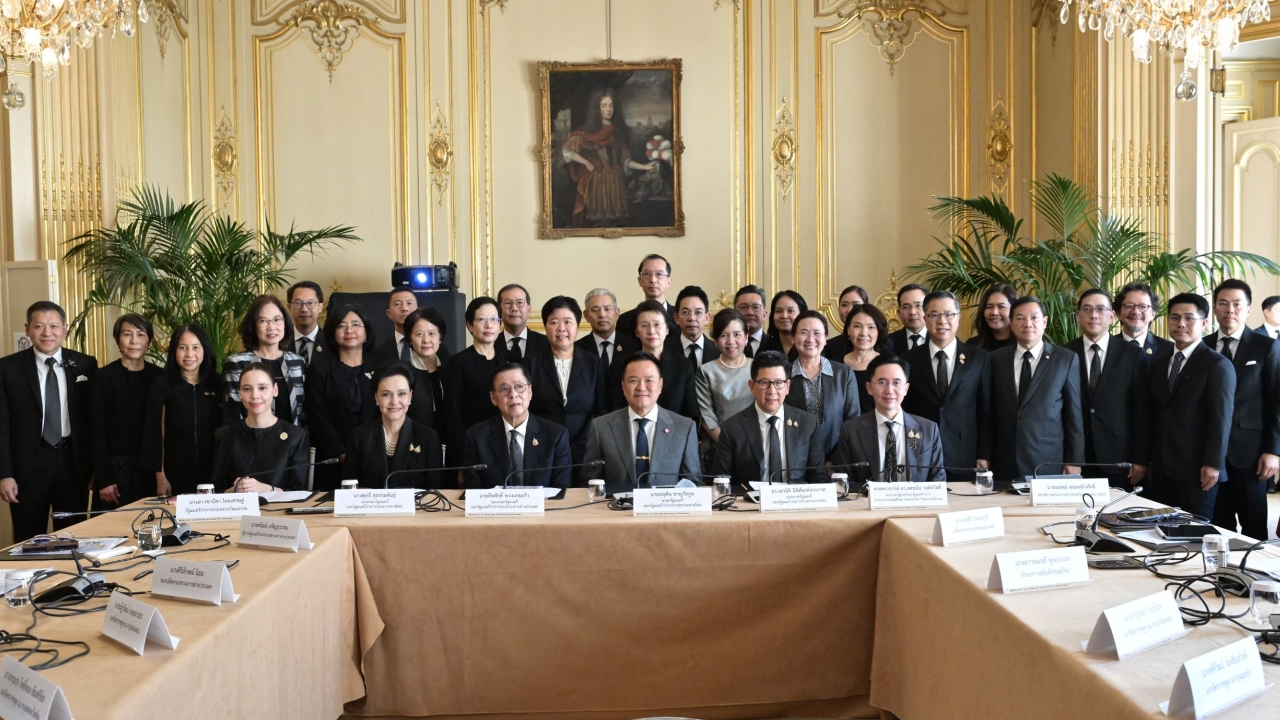
The Prime Minister set policy for Team Thailand-Europe to drive proactive diplomacy, emphasizing that opportunities and benefits should reach the people. He called for collaboration among all agencies in a "cluster" approach to advance the Thai-European Union Free Trade Agreement (FTA).
On 24 May 2026 at 14:00 local time in the French Republic, five hours behind Thailand, at Salle Foch in the Le Cercle de L’Union Interralliee building in Paris, Prime Minister and Minister of Interior Anutin Charnvirakul chaired a meeting with ambassadors and consuls general from 24 European countries. The meeting included deputy prime ministers, ministers, and senior officials from the Ministry of Foreign Affairs. This was the first meeting where the Prime Minister and deputy prime ministers engaged directly with European ambassadors and consuls general. The Prime Minister exchanged views and listened to feedback on policy implementation during a discussion lasting over three hours.


After the meeting, Ms. Ratchada Thanadirek, spokesperson for the Prime Minister’s Office, outlined the key points discussed.
1. Accelerating the Thai-European Union Free Trade Agreement (FTA).
The Prime Minister stressed that a top urgent agenda for the government is to expedite the Thai-EU Free Trade Agreement (FTA). This issue is highly important to both Thai and foreign businesses as it will reduce tax and trade barriers, allowing more quality Thai goods and raw materials to enter the European market. The Prime Minister assured that all agencies will coordinate in an integrated “cluster” system to push forward the conclusion of the FTA negotiations. Several ambassadors reflected that Thailand is back on the international radar, recognized not only as a producer but as an economic partner strengthening global supply chains. They also noted that countries which previously signed FTAs have seen significant export growth to the EU.
2. Proactive diplomacy covering security, economy, society, environment, and humanitarian issues.
The Prime Minister emphasized the 2.0 diplomacy approach—a proactive diplomacy balancing global conflicts by focusing on four pillars: security, economy, society and environment, and humanitarian efforts. He stressed conducting diplomacy that yields tangible results and benefits that the public can experience directly.
The Deputy Prime Minister and Minister of Finance stated that Thailand is ready to welcome trade and investment. The government is developing infrastructure and workforce capabilities, working with the Deputy Prime Minister and Minister of Higher Education, Science, Research and Innovation to design educational curricula to build skills. They are also advancing energy transition policies to promote clean energy supporting future industries.
3. Upgrading national standards to OECD levels. The government is accelerating reforms to align laws and standards with the OECD to support Thailand’s application for membership. The Prime Minister aims to achieve this within three years, shortening the previous five-year target.
4. Highlighting Thailand’s strengths in future food and energy security.
The Prime Minister shared that during vision exchanges with ASEAN leaders, all countries prioritized "food security" as a regional agenda, an area where Thailand has strong potential.
5. Thailand hosting major global events.


The Prime Minister noted that Thailand will host several significant global meetings, increasing its presence in the "global spotlight." These include: 1. Gastech 2026, the world’s largest energy exhibition, in September; 2. The World Bank–IMF Annual Meetings 2026 in October; and 3. The Global Wellness Summit in November. He called on embassies and consulates to promote and leverage these opportunities to build Thailand’s image, confidence, and attract investment.
In conclusion, the Prime Minister emphasized that Thailand is ready to become a strategic regional hub, with strengths in political stability, investment-ready infrastructure, and a strong private sector. With cooperation among the public sector, private sector, the Board of Investment, and Thai embassies in Europe working as "Team Thailand," the government’s strategic momentum and Thailand’s rise on the global stage will surely succeed.