

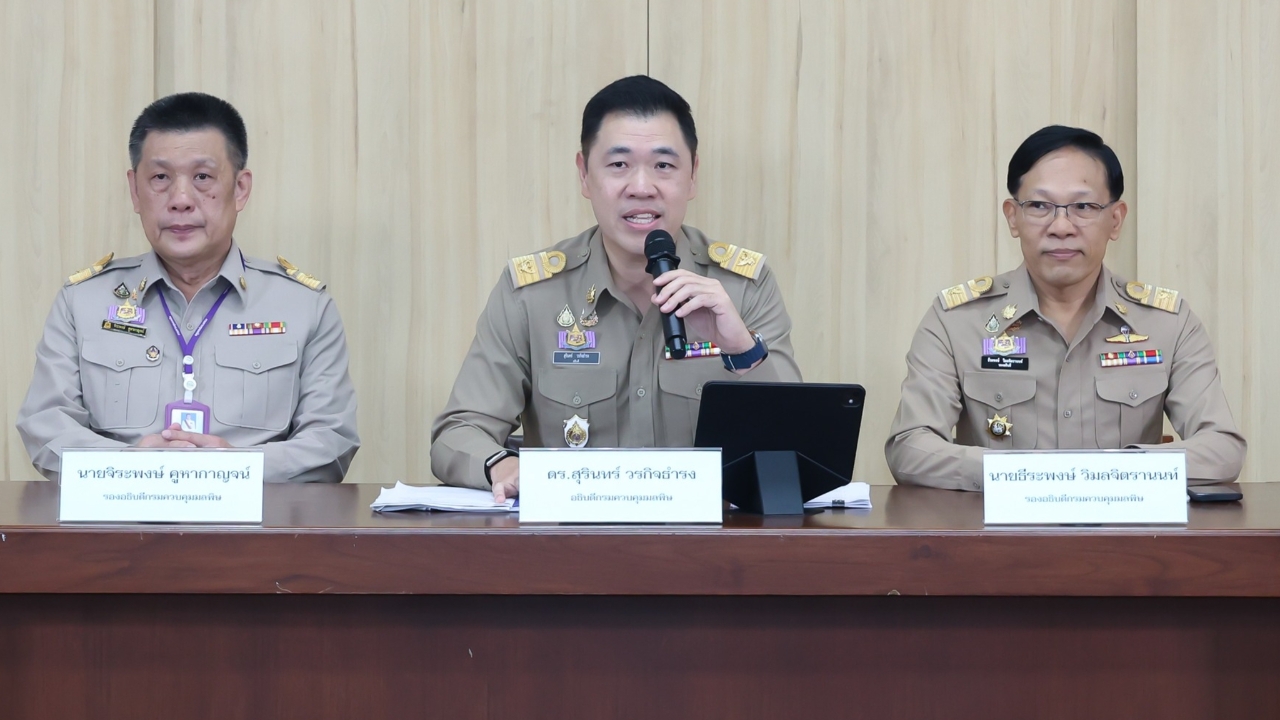
The Director-General of the Pollution Control Department declared that the department has consecutively received "excellent" evaluation results for three years. In nearly 30 years, it has never received complaints of this kind of corruption. He disputes the Private Sector Joint Committee's survey results that damage the organization's reputation and reveals seven suspicious points in their research.
25 May 2026 GMT+7 Mr. Surin Worrakitthamrong, Director-General of the Pollution Control Department He announced the review results of the research documents on private sector opinion surveys by the Private Sector Joint Committee of three institutions, which stated that the Pollution Control Department was the agency demanding the highest bribes, citing amounts of 102,160 baht per instance. The Pollution Control Department noted that over nearly 30 years, it has never received any complaints about corruption of this nature.
Mr. Surin emphasized that the Pollution Control Department does not refuse anti-corruption investigations and welcomes such scrutiny, as corruption seriously affects the economy, investment, and the public. He confirmed that disciplinary penalties will be strictly imposed without exception if any staff are found guilty.
. Previously, the Pollution Control Department collaborated with the Office of the Public Sector Anti-Corruption Commission (PACC) to implement the Corruption Risk Management System (CRMS), resulting in "excellent" qualitative evaluation scores for three consecutive years. However, after senior management reviewed its missions and projects, they identified that the processes of inspection and law enforcement at pollution sources pose risks of corruption related to abuse of power and position. A working group has been appointed to review measures and procedures at every stage to prevent corruption.

After receiving the Private Sector Joint Committee's explanation of survey principles and methodology on 22 May 2026, the Pollution Control Department raised seven significant concerns indicating that the committee's research process may be academically incorrect and unjustified:
1. Sample groups were not comprehensive. The study divided government agencies into five groups totaling 162 agencies nationwide but surveyed only 26 agencies, which does not cover the entire Thai bureaucracy and is academically insufficient for national policy formulation.
2. Use of outdated tools from 1999. The questionnaire was mainly based on the World Bank's 1999 framework, an old dataset. Many agencies had their roles revised after 2002; for example, the Department of Mineral Resources is not included in the five classified agency groups.
3. Limited sample scope focused only on certain private sector groups, without including other relevant sectors such as the public, general service recipients, academia, or civil society.
4. Contradictory questionnaire structures. Two formats were used: an online Google Forms survey and face-to-face interviews. The committee said the online survey was a backup to check consistency, but the two questionnaires differ significantly in sections and questions, lacking meaningful alignment.
5. Very short survey period. With 401 respondents nationwide, the survey ran from 26 March to 10 April 2026, only 16 days. This tight timeline risks standard control, especially since the face-to-face questionnaire had 70 questions requiring 25 interviews daily, risking quality control.
6. Too few respondents per agency. The data at the agency level is insufficient to conclude or rank national corruption comprehensively. With 45% (about 184) of respondents having direct experience spread over 26 agencies, that averages about 7 or fewer respondents per agency.
7. Leading questions in the questionnaire, such as measuring belief or assumptions negatively phrased, e.g., "If no extra payment is made, do you believe the process will be delayed beyond deadlines?"

The Director-General further stated, The committee's explanation admitted that confidence levels and sample error reflect accuracy at the agency level. Therefore, concluding that the Pollution Control Department is the top agency demanding bribes per instance is academically incorrect, violates research principles, and breaches research ethics.
He concluded by saying, The publication of such news seriously damages the Pollution Control Department, making it difficult to remedy. It undermines the morale and confidence of civil servants in their work. The department agrees with fact-checking through proper and fair procedures but disagrees with the committee's research methods this time. It also warns against impersonators posing as Pollution Control Department officers or those falsely claiming to have test results from the department to solicit benefits. Suspected misconduct can be reported to the department via online channels, direct contact, or mail.
Additionally, at 10:55 a.m., Mr. Suchart Chomklin, Minister of Natural Resources and Environment, arrived at the ministry after responding to a parliamentary question from Senator Mangkon Sricharoenkul at the parliament building regarding the progress of fact-finding in the case of the death of the folded-ear Sido elephant during its transfer from Khon Kaen province to the forest elephant food restoration project area in Phu Luang district, Loei province.